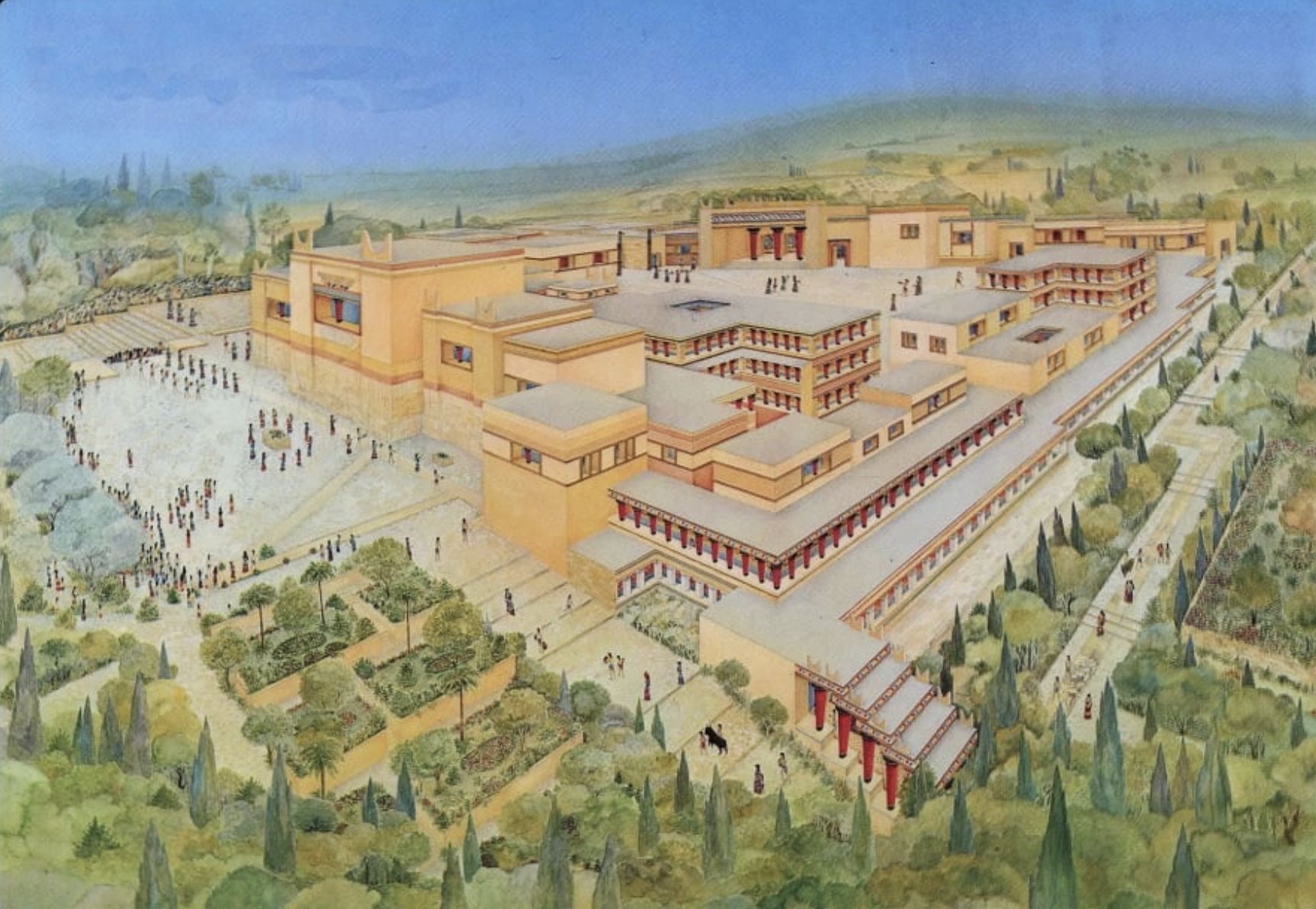
Knossos, on Crete, was the largest palace of the Minoan civilization (c. 2000 – 1400 B.C.), famous for its complex architecture, vibrant frescoes, and association with the legend of the Minotaur. The Palace of Knossos, the largest Bronze Age archaeological site on Crete, served as the ceremonial and political center of the Minoan civilization. It functioned as a hub for administration, storage, religious rituals, and possibly trade management. While smaller settlements existed around it, Knossos is primarily known for its monumental complex rather than as a densely populated urban center. The palace reached its peak between 1900 and 1450 B.C., during the height of Minoan civilization.
The Minoan civilization laid the foundations of European culture through its art, architecture, trade, writing, and mythology, shaping the social and cultural patterns of later Greece and the Mediterranean.
Importance of the Minoan Civilization for European Culture:
- Earliest Advanced European Civilization
- The Minoans (c. 2700–1450 B.C.) were among Europe’s first complex societies.
- They developed large palaces, urban planning, and administrative systems.
- Art and Architecture
- Their frescoes, pottery, and architecture influenced later Greek art and aesthetics.
- Use of columns, open courtyards, and decorative motifs can be traced to later Greek and Mediterranean designs.
- Trade and Maritime Innovation
- The Minoans were skilled seafarers and traders, connecting Crete with Egypt, the Near East, and other Aegean islands.
- Their trade networks helped spread technology, goods, and cultural ideas across early Europe.
- Writing and Administration
- Developed Linear A (undeciphered) and Linear B (early Greek), laying foundations for record-keeping and literacy in the Aegean.
- Religious and Cultural Influence
- Minoan religious symbols and myths influenced later Greek mythology, including the stories of the Minotaur, labyrinths, and goddesses of nature.
When the Santorini volcano erupted around 1600 B.C., Knossos suffered ash fallout, tsunamis, and earthquakes, but the palace survived and was rebuilt, though the eruption ultimately weakened the Minoan civilization.
Long-Term Effects:
- Some scholars suggest the eruption weakened Minoan power, eventually making Crete more vulnerable to Mycenaean influence from mainland Greece.
- The Minoan civilization suffered economic disruption due to destroyed farmland, ports, and trade networks.
- Knossos itself was damaged but not destroyed, and the palace was rebuilt and continued to flourish for several centuries afterward.