Gold Souk
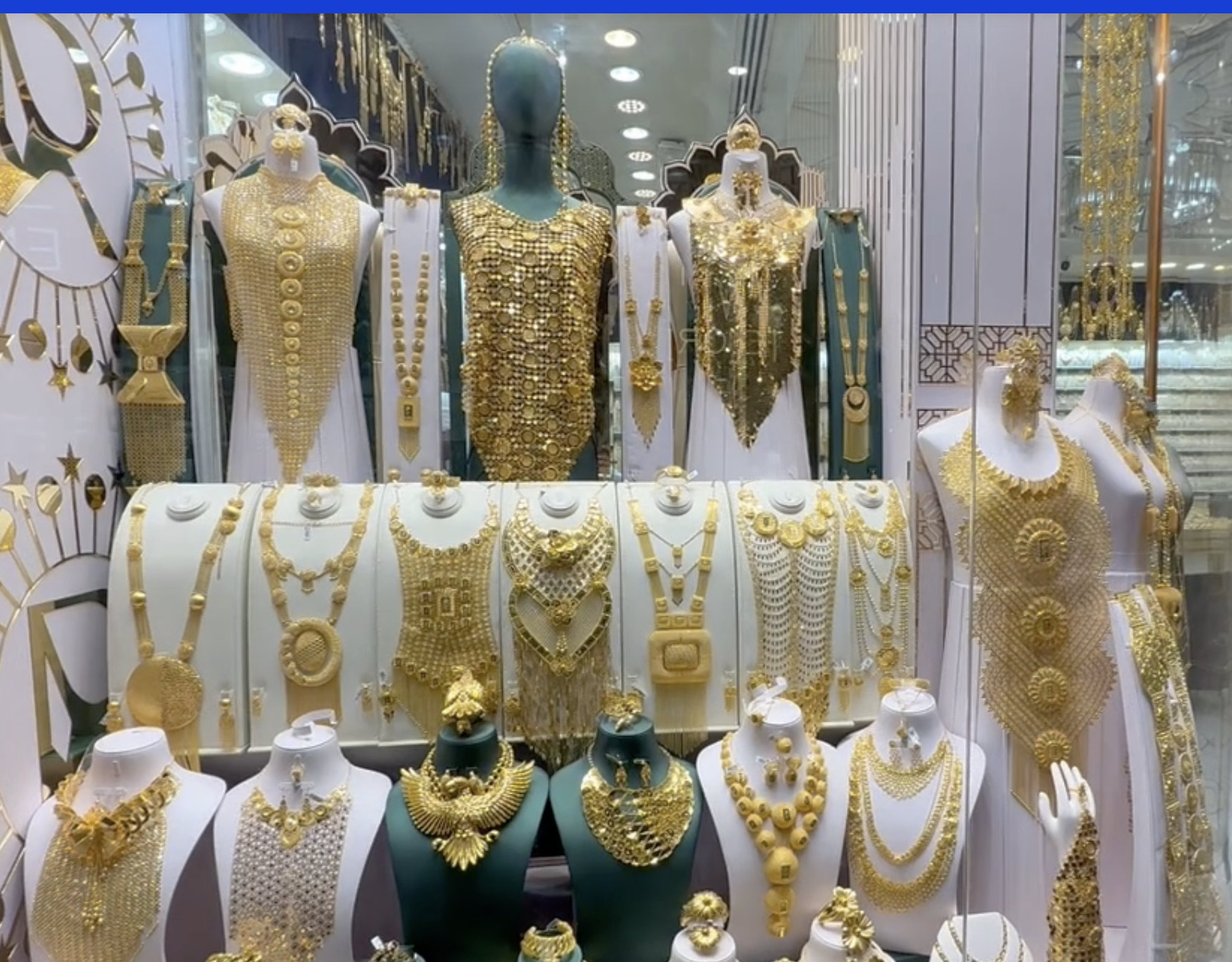
While famous for gold, the Dubai Gold Souk also features a wide variety of other items, including precious stones, pearls, and silver. Visitors can find jewelry like diamonds, emeralds, sapphires, and custom-made pieces alongside traditional and modern silver and platin designs, making it a comprehensive marketplace for precious goods beyond just gold.
The Gold Souk in Dubai was founded in the early 1900s as a modest trading area near the Dubai Creek. It grew significantly in the 1940s when policies attracted merchants from India, Pakistan and Iran, and its role expanded further with the discovery of oil in the 1960s and the formation of the UAE in 1971. Today, it remains a vibrant marketplace for both retail and wholesale, blending a historical legacy with a modern global trade center.
- Specialized market: The term “Gold Souk” refers to a specific marketplace that specializes in gold jewelry, but Dubai also has other souks for different goods, like the Spice Souk and Perfume Souk. Merchants from India, Iran, and Pakistan settled in Deira and began trading gold and spices. Gold was extremely profitable and stable, so the shops specialized more and more in gold.
- Global hub: Dubai has become one of the world’s largest gold trading hubs, attracting millions of tourists who come to buy gold due to its high purity and often tax-free status, as explained on Timeout Dubai.
- Tax-free shopping: The market’s popularity is also driven by its ability to offer gold jewelry with no GST (Goods and Services Tax). Dubai’s low taxes and strategic position between Asia, Africa, and Europe helped it become:
- the biggest gold market in the Middle East
- one of the biggest gold trading hubs in the world
- Gold is a cultural symbol. In Gulf culture, gold is important for:
- weddings
- gifts
- investment
- savings
Gold Shopping Essentials: Tips and Warnings
The Gold Souk and other jewelry shopping spots in Deira, a world-famous district for gold, also have some untrustworthy sellers who can spoil what could otherwise be a wonderful Dubai experience. To protect yourself and your money, there are a few critical rules you must follow:
1. Beware of “trust me” deals
- If a seller asks you to trust them without proof (e.g., “just buy it, I guarantee it’s real”), this is a major red flag.
- In Dubai, reputation is important, but even so, there are opportunists who can harm the reputation of the entire region.
- Always verify the gold before paying: check weight, purity (karat), and price.
2. Always insist on transparent pricing
- If the price is unclear, hidden, or negotiable in a suspicious way, don’t even continue the negotiation.
- Gold should be sold with visible price per gram, clearly labeled karat, and official receipt.
- Avoid any shop where they refuse to show the price or hide the calculation.
Trust is important in Dubai business, but in the Gold Souk, trust must be backed by transparency.
If a deal relies only on personal trust or opaque pricing, walk away immediately.
If a jewelry seller cheated you in Dubai
If a jewelry seller cheated you in Dubai, it’s important to act quickly and follow the proper legal and practical steps. Dubai has strong consumer protection laws, and you can report fraudulent sellers. Make sure to provide all evidence when filing a complaint:
I- Dubai Consumer Protection Department
- Part of the Economic Department (DED): https://consumerrights.gov.ae/en/
Complaints can be about defective or unsafe products, poor service quality, misleading advertising, breach of warranty or unfair business practices. The resolution timeframe is usually within five working days.
Source: https://consumerrights.gov.ae/en/submit-a-complaint/consumer-complaints
You can file a complaint online or in person. You can submit a complaint through their website, smart application, or by calling their toll-free number. For issues related to customs, Dubai Customs handles related complaints via their dedicated channels. Dubai Central Services Website offers a one-stop portal for various consumer complaints.
II- Contact your legal protection insurance immediately
If you have a legal protection insurance that covers disputes abroad:
- Notify them as soon as possible.
- Provide all evidence: receipt, photos, communications with the seller.
- They can advise you on legal steps, sometimes even cover lawyer fees or help file an official complaint in Dubai.
- Acting early improves your chances of a successful resolution.
In international disputes, timing is crucial — activating your insurance promptly can save time, money, and stress.
The Basics You Must Know Before Buying Gold
Not everyone has the basic knowledge needed to buy gold safely. If a seller is uncooperative or not proactive in helping you verify the gold or negotiate a fair price, the safest choice is to simply leave the store.
Show the seller that you have some knowledge about gold buying, and observe how they respond. A trustworthy seller will help you feel comfortable, answer your questions proactively, and guide you through the process clearly.
1. Ask for the Carat of the Gold
The carat (k) indicates the purity of the gold.
- Pure gold (24k) is very soft and malleable, so it is often mixed with other metals like copper or silver to make it stronger and more durable for everyday wear.
- For example:
- 24k gold = 100% pure gold
- 18k gold = 75% gold + 25% other metals
Always confirm the carat before buying, and make sure the seller explains the composition clearly. The higher the purity, the higher the price. This is one of the most important steps to avoid misunderstandings or being overcharged.
2. Ask for the Price and Understand It
Before buying, make sure you understand how the price is calculated. Compare it with the daily market rate to avoid overpaying.
A reliable source for checking prices is the Dubai Jewellery Group (DJG):
- DJG is the largest trade body for Dubai’s jewelry industry, with around 600 members across all sectors of the trade — including bullion, gold and diamond jewelry, wholesale & retail, precious metals, diamonds, and pearls.
- According to DJG, “Consumers can buy gold, diamonds, pearls, and other jewellery in Dubai with complete trust and assurance of authenticity from our members.”
- The group was formed under the guidance of the Dubai Department of Economic Development in 1996.
Other Reputable Gold‑Price Sources
- GoldRateUAE — a website that lists daily updated rates per gram for 24K, 22K, 21K and 18K gold in Dubai.
- GoldPriceInUAE.com — another site that tracks live gold‑rates for the UAE (all emirates), giving you current price info before you go shopping.
- Websites like Gold Rate in Dubai Today that aggregate or show “live” (or near‑live) gold rate per gram for different karats.
What to Check When Using Such Sources
- Note that the rate per gram is often just the “metal value.” Retail prices may add:
- Making charges (craftsmanship, labor)
- Shop margin / markup
- Any taxes or fees (if applicable)
So final jewellery price will be higher than the “pure gold‑rate.”
- Use these rates as a baseline — then compare what a seller offers. If the offer is much higher (especially before making charges), you know there may be overpricing or extra costs.
3. Check for a Hallmark Unique Identification (HUID)
When you’ve set your eyes on a piece of jewelry, make sure it has a Hallmark Unique Identification (HUID) mark.
- The HUID is an alphanumeric code etched on the product, often accompanied by the carat, which verifies:
- Purity of the gold
- Weight of the piece
- Authenticity of the gold
- The hallmark is your guarantee of the gold’s purity, whether it’s 24K, 22K, 18K, or 14K.
So while 916 or 999.9 are common for high-purity gold in Dubai, lower-karat gold is also legitimate if it carries the correct hallmark (like 750 for 18K).
Checking the hallmark protects you from buying underweight or adulterated gold, especially in busy markets like the Gold Souk.
4. Understand the Price Breakdown Before Negotiating
Once you’ve decided on a piece of jewelry, the seller will usually provide a price breakdown. Study it carefully – it’s your tool for negotiation.
The final price typically consists of three components:
- Value of the gold – based on the current market rate; this is fixed and indisputable.
- Making charges – the cost of craftsmanship, which can vary depending on the design, complexity, and whether you’re buying from a branded store (e.g., in Dubai Mall). Typical making charges range between 10–25% of the gold value. Simple items like plain gold coins have the lowest making charges.
- VAT and other fees – if applicable; this is fixed and transparent.
While gold value and VAT are non-negotiable, making charges often are, so knowing this gives you leverage in bargaining.