Deutschtum, Volkstum, Auslandsdeutsche, Volksgemeinschaft, and völkisch
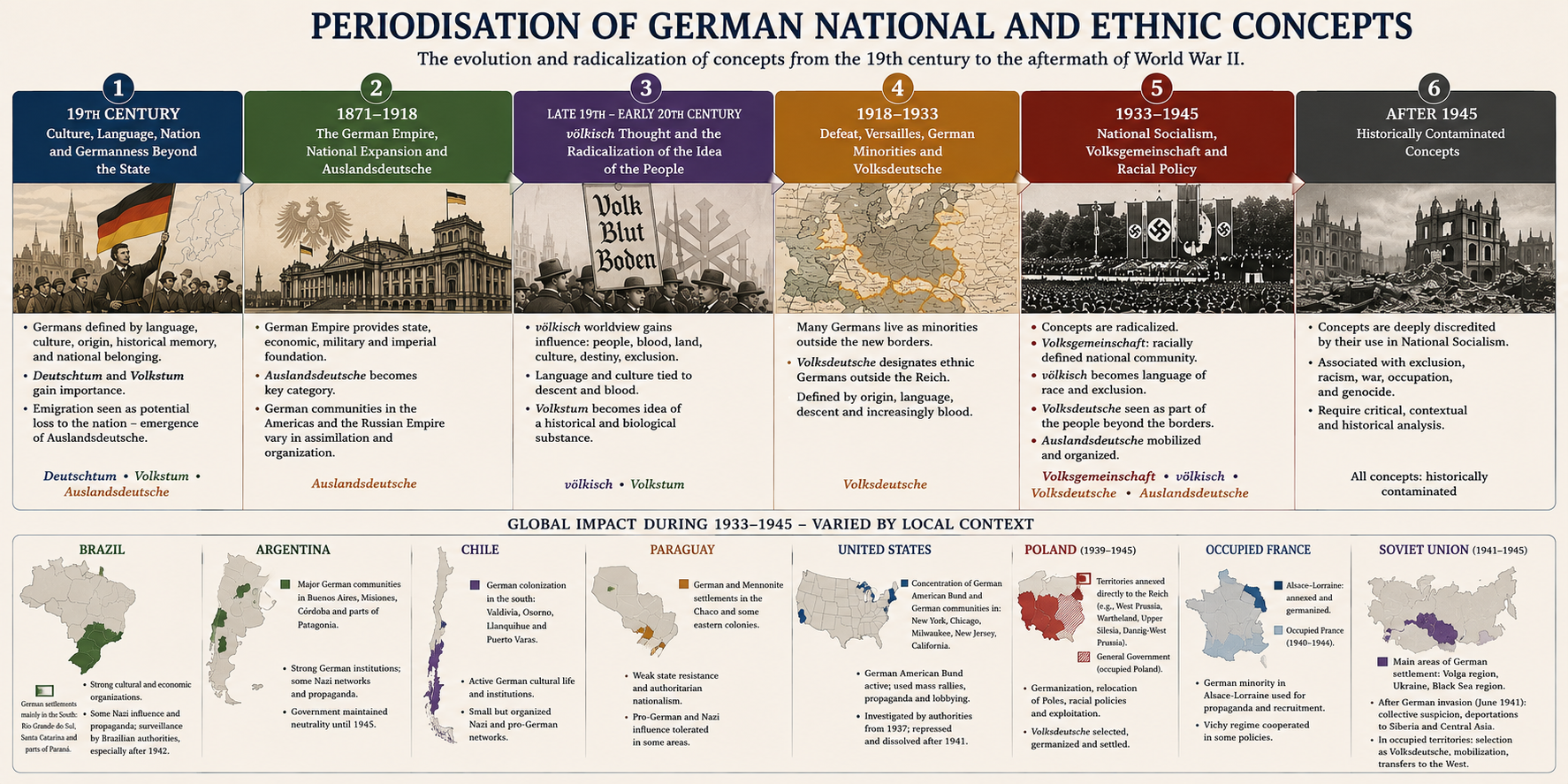
1. The Nineteenth Century: Culture, Language, Nation, and Germanness Beyond the German State
During the nineteenth century, both before and after German unification in 1871, the idea emerged that Germans were defined not only by a state, but also by language, culture, origin, historical memory, and national belonging. Within this context, concepts such as Deutschtum and Volkstum gained increasing importance.¹
During this period, Volkstum could refer to the distinctive character of a people: its language, customs, traditions, way of life, and cultural continuity. Yet the term already contained a problematic tendency: the transformation of culture into a collective essence. The people were no longer viewed merely as a political community, but as a historical and cultural community and, increasingly, as a community defined by common origin.
Within the same intellectual environment, growing attention was directed toward Germans living outside Germany. German nationalists increasingly regarded emigration not merely as the departure of individuals, but as a potential loss to the nation. This explains the growing importance attributed to the Auslandsdeutsche, the Germans abroad.²
2. 1871–1918: The German Empire, National Expansion, and the Auslandsdeutsche
With the founding of the German Empire in 1871, the idea of Germanness acquired a state, economic, military, and imperial foundation.³ The German state began to take a greater interest in German communities outside Germany.
During this period, Auslandsdeutsche became an increasingly important category. It referred to Germans living outside German territory, as well as to communities of German origin that, according to many nationalist discourses, were expected to remain connected to the German language, German culture, and German interests.
This category included communities in Brazil, the United States, Argentina, Chile, Paraguay, and the Russian Empire. The principal difference lay in the degree of assimilation. In the United States, assimilation was regarded as comparatively advanced, whereas certain German circles believed that southern Brazil offered greater opportunities for preserving organized and relatively separate German communities.⁴
3. The Late Nineteenth and Early Twentieth Centuries: Völkisch Thought and the Radicalization of the Idea of the People
Between the late nineteenth and early twentieth centuries, völkisch thought gained increasing influence.⁵ The word völkisch derives from Volk, meaning people, but it does not simply mean “popular.” It designates a worldview based on peoplehood, origin, blood, land, culture, destiny, and exclusion.
A decisive transformation occurred during this period: language and culture became increasingly associated with descent, blood, and the supposed essence of a people. German belonging was no longer conceived merely in cultural or linguistic terms, but increasingly as something inherited.
Within this context, Volkstum also acquired a more ideologically charged meaning. It no longer referred simply to the culture of a people, but to an alleged historical and biological substance of the people. This development created the conceptual bridge to the later category of Volksdeutsche.
4. 1918–1933: Defeat, Versailles, German Minorities, and the Volksdeutsche
Following Germany’s defeat in the First World War in 1918 and the Treaty of Versailles, the question of Germans living beyond Germany’s borders became even more politically sensitive. Many Germans found themselves living as minorities in newly established states or in territories separated from Germany.
Within this context, the term Volksdeutsche acquired growing importance.⁶ It referred to ethnic Germans outside the Reich: people of German origin, language, or identity who were not necessarily German citizens. During the interwar period, this category gained even greater political and ideological significance.
The distinction is important:
Auslandsdeutsche = Germans abroad; a broader category.
Volksdeutsche = ethnic Germans outside the Reich, defined by origin, language, descent, and, increasingly, blood.
Poland represents a central and, in many respects, exceptional case because it involved German minorities, disputed borders, territorial revisionism, and national conflict. The Germans of Russia may also be classified within this context: in a broad sense, they were Auslandsdeutsche; in a more ethnic and political sense, particularly during the twentieth century, they were increasingly treated as Volksdeutsche.
5. 1933–1945: National Socialism, Volksgemeinschaft, and Racial Policy
Under National Socialism, these concepts were radicalized.
Volksgemeinschaft became a central term in Nazi propaganda.⁷ It meant “national community” or “people’s community,” but it did not describe an open community. It was a racial, political, and ideological community. It included those considered to belong to the German people and excluded Jews, political opponents, people classified as “alien to the community,” and other persecuted groups.
During this period:
- völkisch became an ideological language of blood, race, peoplehood, and exclusion.
- Volkstum was used to support the idea of an ethnic-racial essence of the people.
- Volksdeutsche were treated as members of the German people living beyond Germany’s borders.
- Auslandsdeutsche were mobilized as communities to be supported, organized, and connected to the Reich.
- Volksgemeinschaft provided the overarching framework: a racially defined German community.
In Poland, this process assumed its most extreme form: occupation, Germanization, ethnic classification, mass violence, forced displacement, and territorial domination.⁸ In occupied France, German rule took the form of military occupation, political subordination, economic exploitation, racial persecution, forced labour, and collaboration through the Vichy regime. In Alsace and Moselle, which were effectively incorporated into the Reich, Germanization was pursued more directly through the suppression of French institutions, the imposition of German language and identity, and compulsory service in the German armed forces. In Brazil, there was no occupation or formal annexation, but attempts were made to mobilize German communities through schools, the press, associations, the NSDAP/AO, and cultural and economic networks.⁹
In the United States, the German American Bund initially operated under constitutional protections, but it was repeatedly investigated by federal and congressional authorities; prosecutions and the imprisonment of its leader severely weakened the organization before it was outlawed and formally dissolved after the United States entered the war in December 1941; in Argentina, strong German networks benefited from prolonged neutrality and an ambivalent government response; in Chile, a local National Socialist movement gained limited political representation before being restricted and defeated after its failed coup attempt in 1938; and in Paraguay, authoritarian nationalism and weak official resistance permitted pro-German and Nazi influence to persist within parts of the German-speaking population.
In the Soviet Union, the German invasion of June 1941 fundamentally changed the position of ethnic German communities. Fearing collaboration with Nazi Germany and the influence of Deutschtum and Volksdeutsche ideology, Stalin abolished the Volga German Autonomous Soviet Socialist Republic and deported hundreds of thousands of ethnic Germans to Siberia and Central Asia as wartime security measures. In German-occupied Soviet territories, by contrast, Nazi authorities classified selected people of German ancestry as Volksdeutsche, mobilized some for German purposes, and transferred many westward.
6. After 1945: Historically Contaminated Concepts
After 1945, these concepts became profoundly marked by their National Socialist use.¹⁰ Volksgemeinschaft, völkisch,and Volksdeutsche became historically charged terms because of their association with exclusion, racism, war, occupation, and genocide.
Auslandsdeutsche continued to exist as a potentially descriptive term, but it also requires careful use because its history was shaped by nationalist and völkisch policies. Volkstum likewise became problematic because it carries the notion of the people as a cultural and ethnic essence.
For this reason, in a critical article these terms should not be treated as neutral expressions. They must be explained and analyzed as historical concepts of belonging, power, hierarchy, and exclusion.
- Cf. GRIMM, Jacob; GRIMM, Wilhelm. Deutsches Wörterbuch, entries “deutsch”, “-tum” and “Volkstum”; MOSSE, George L. The Crisis of German Ideology: Intellectual Origins of the Third Reich. New York: Grosset & Dunlap, 1964; KOSELLECK, Reinhart. Begriffsgeschichten: Studien zur Semantik und Pragmatik der politischen und sozialen Sprache. Frankfurt am Main: Suhrkamp, 2006.
- Cf. CRONENBERG, Allen Thomson Jr. The Volksbund für das Deutschtum im Ausland: Völkisch Ideology and German Foreign Policy, 1881–1939. PhD dissertation, Stanford University, 1970, p. 51; SCHULZE, Frederik. “‘Auslandsdeutschtum’ in Brazil (1919–1941): Global Discourses and Local Histories”. German History, v. 33, n. 3, 2015, p. 405–422.
- Cf. WEHLER, Hans-Ulrich. Das Deutsche Kaiserreich 1871–1918. Göttingen: Vandenhoeck & Ruprecht, 1973; WINKLER, Heinrich August. Der lange Weg nach Westen, v. 1: Deutsche Geschichte vom Ende des Alten Reiches bis zum Untergang der Weimarer Republik. München: C. H. Beck, 2000; BLACKBOURN, David. History of Germany 1780–1918: The Long Nineteenth Century. Oxford: Blackwell, 1997.
- Cf. EPP, Friedrich. Rio Grande do Sul oder Neudeutschland. Mannheim: J. Schneider, 1864; LUEBKE, Frederick C. Germans in Brazil: A Comparative History of Cultural Conflict During World War I. Baton Rouge: Louisiana State University Press, 1987; SEYFERTH, Giralda. Nacionalismo e identidade étnica: a ideologia germanista e o grupo étnico teuto-brasileiro numa comunidade do Vale do Itajaí. Florianópolis: Fundação Catarinense de Cultura, 1981; SCHULZE, “‘Auslandsdeutschtum’ in Brazil”, p. 405–422.
- Cf. MOSSE, The Crisis of German Ideology; PUSCHNER, Uwe. Die völkische Bewegung im wilhelminischen Kaiserreich: Sprache, Rasse, Religion. Darmstadt: Wissenschaftliche Buchgesellschaft, 2001; STERN, Fritz. The Politics of Cultural Despair: A Study in the Rise of the Germanic Ideology. Berkeley: University of California Press, 1961.
- Cf. BERGEN, Doris L. “The Nazi Concept of ‘Volksdeutsche’ and the Exacerbation of Anti-Semitism in Eastern Europe, 1939–45”. Journal of Contemporary History, v. 29, n. 4, 1994, p. 569–582; LUMANS, Valdis O. Himmler’s Auxiliaries: The Volksdeutsche Mittelstelle and the German National Minorities of Europe, 1933–1945. Chapel Hill: University of North Carolina Press, 1993.
- Cf. WILDT, Michael. Volksgemeinschaft als Selbstermächtigung: Gewalt gegen Juden in der deutschen Provinz 1919 bis 1939. Hamburg: Hamburger Edition, 2007; KOONZ, Claudia. The Nazi Conscience. Cambridge, MA: Harvard University Press, 2003; GELLATELY, Robert. Backing Hitler: Consent and Coercion in Nazi Germany. Oxford: Oxford University Press, 2001.
- Cf. LUMANS, Himmler’s Auxiliaries; BERGEN, “The Nazi Concept of ‘Volksdeutsche’”, p. 569–582; MAZOWER, Mark. Hitler’s Empire: Nazi Rule in Occupied Europe. London: Allen Lane, 2008; BROWNING, Christopher R. The Origins of the Final Solution: The Evolution of Nazi Jewish Policy, September 1939–March 1942. Lincoln: University of Nebraska Press, 2004.
- Cf. DIETRICH, Ana Maria. Nazismo tropical? O Partido Nazista no Brasil. São Paulo: Todas as Musas, 2012; GERTZ, René Ernaini. O fascismo no sul do Brasil: germanismo, nazismo, integralismo. Porto Alegre: Mercado Aberto, 1987; SCHULZE, “‘Auslandsdeutschtum’ in Brazil”, p. 405–422; LUEBKE, Germans in Brazil.
- Cf. FREI, Norbert. Vergangenheitspolitik: Die Anfänge der Bundesrepublik und die NS-Vergangenheit. München: C. H. Beck, 1996; WILDT, Volksgemeinschaft als Selbstermächtigung; MOSSE, The Crisis of German Ideology.