O nazismo no Brasil não surgiu de repente em 1933, quando Adolf Hitler chegou ao poder na Alemanha. Ele encontrou terreno em uma história anterior: a presença alemã organizada no país desde o século XIX, especialmente no sul do Brasil, com escolas, igrejas, clubes, jornais, associações, empresas, redes familiares e uma forte cultura de preservação da língua e da identidade alemã. Essa base não era automaticamente nazista. Mas, em determinados contextos, ofereceu canais pelos quais a propaganda nacional-socialista pôde circular, conquistar simpatizantes e organizar uma presença política ligada ao III Reich.
Por isso, é necessário começar com uma distinção fundamental. A história do nazismo no Brasil não autoriza transformar todos os imigrantes alemães, todos os descendentes de alemães ou todas as comunidades de origem alemã em nazistas. Isso seria falso e injusto. Ao mesmo tempo, também seria falso negar que o nazismo teve organização real no Brasil, com partido, militantes, propaganda, símbolos, festas, jornais, atuação juvenil, vínculos com a Alemanha e tentativa de mobilizar parte dos chamados “alemães no exterior” em favor do projeto nacional-socialista.¹
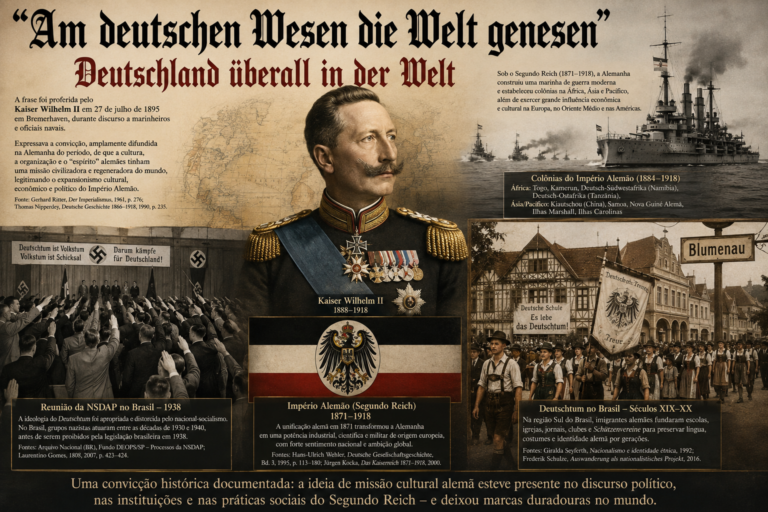
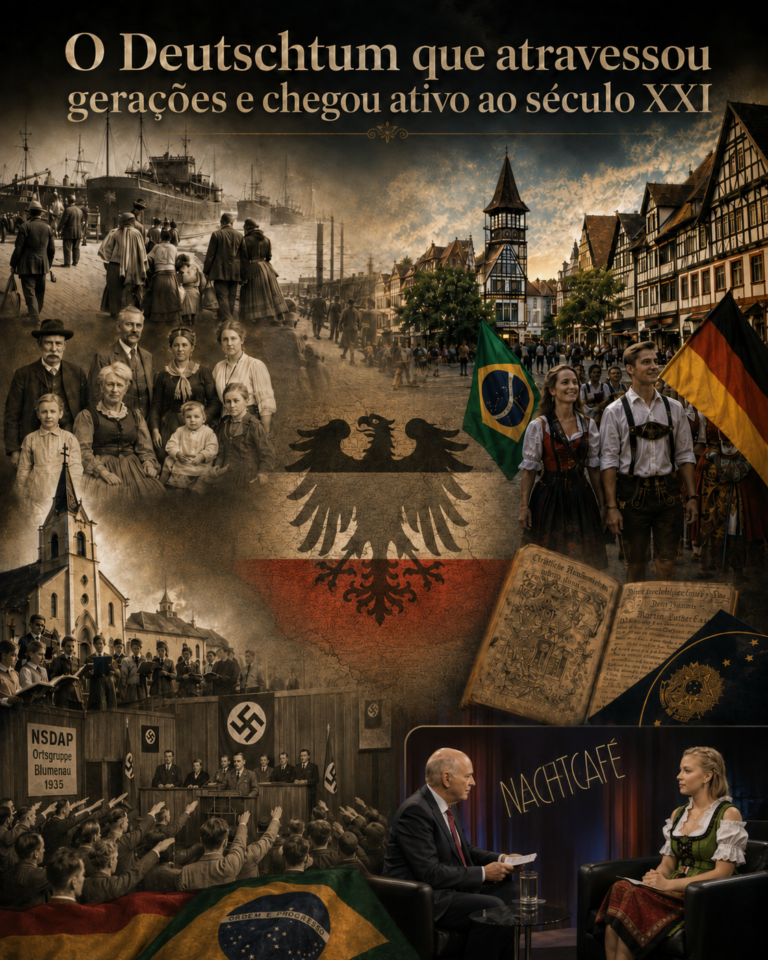
O Partido Nazista atuou oficialmente no Brasil entre 1928 e 1938. Ele estava vinculado à Auslandsorganisation der NSDAP, a Organização do Partido Nazista para o Exterior, sediada em Berlim. Segundo Ana Maria Dietrich, a estrutura brasileira fazia parte de uma rede espalhada por 83 países e reuniu cerca de 2.900 membros registrados, tornando-se a maior célula do partido fora da Alemanha.²
Esse número, porém, não esgota a dimensão do problema. Ele revela a existência de uma presença nazista organizada, disciplinada e politicamente conectada ao regime hitlerista, mas mede apenas a filiação formal à NSDAP. Limitar o nazismo no Brasil a esses pouco mais de 2 mil membros registrados reduz artificialmente sua profundidade social. A filiação partidária era a face organizada do fenômeno; o retorno de mais de 8 mil integrantes da comunidade alemã do Brasil ao Reich, estudado por Méri Frotscher, mostra que a atração exercida pela Alemanha nazista ultrapassava o partido e alcançava vínculos emocionais, familiares, comunitários e transnacionais.
Antes do nazismo: Deutschtum, comunidade e preservação cultural
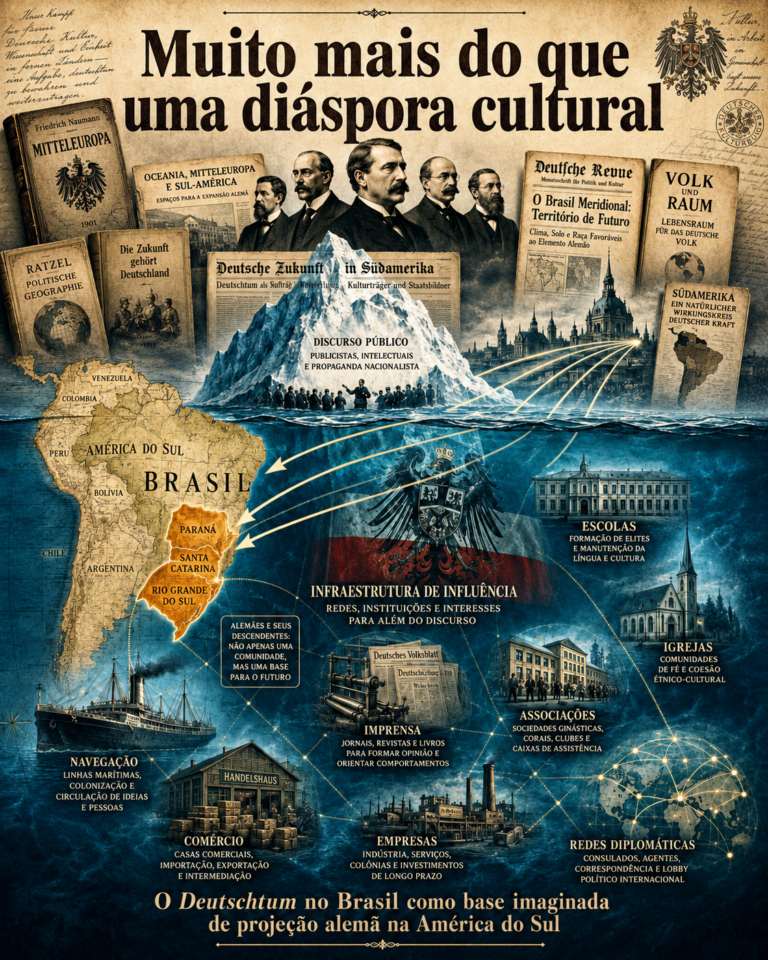
Para compreender por que o nazismo encontrou base no Brasil, é preciso olhar para antes de Hitler. A imigração alemã para o Brasil formou, ao longo do século XIX e início do século XX, comunidades que preservavam a língua alemã, mantinham escolas próprias, publicavam jornais, criavam associações culturais, religiosas e recreativas, e transmitiam uma memória coletiva ligada à Alemanha.
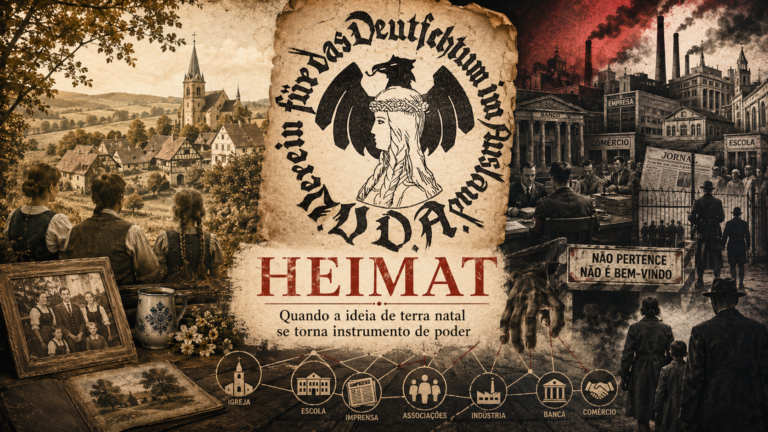
Essa preservação cultural era apresentada como defesa da língua, da família, da educação, da fé, do trabalho e da tradição. Muitas vezes, esse era realmente o sentido vivido por famílias de imigrantes e descendentes. Mas havia também uma dimensão mais ampla: o Deutschtum, isto é, a germanidade entendida como pertencimento cultural, linguístico, étnico e histórico.
O Deutschtum não era, por si só, nazismo. Ele existia antes do nacional-socialismo. Mas criou uma linguagem de pertencimento que podia ser politizada. Quando a Alemanha nazista passou a se apresentar como centro de todos os alemães do mundo, inclusive daqueles que viviam fora do território alemão, parte dessa germanidade no exterior pôde ser reinterpretada como lealdade política ao Reich.
O problema, portanto, não estava simplesmente em falar alemão, manter tradições familiares ou preservar memórias de imigração. O problema surgia quando essa identidade cultural era convertida em obediência política a uma potência estrangeira e, mais tarde, a um regime racista, antissemita, antidemocrático e totalitário.³
A Alemanha nazista e os “alemães no exterior”
Com a chegada de Hitler ao poder, em 1933, a relação entre Estado alemão, diáspora alemã e comunidades de origem alemã mudou profundamente. O regime nacional-socialista não via os alemães no exterior apenas como emigrantes ou descendentes. Ele procurava enquadrá-los dentro da ideia de Volksgemeinschaft, a “comunidade do povo”, entendida em termos raciais, étnicos e nacionais.
Essa visão ultrapassava as fronteiras do Estado alemão. Para o nazismo, o pertencimento alemão não dependia apenas da cidadania ou do lugar de residência, mas de sangue, origem, língua e cultura. Assim, alemães que viviam no Brasil podiam ser tratados como parte de uma comunidade alemã mundial, que deveria permanecer ligada ao Reich.
Nesse ponto, a obra de Méri Frotscher é importante. Ao estudar as migrações de retorno do Brasil para a Alemanha entre 1938 e 1939, sob o nazismo, Frotscher mostra que a ascensão do nacional-socialismo provocou entusiasmo entre muitos emigrantes alemães no exterior. Enquanto judeus alemães e opositores do regime procuravam fugir da Alemanha, parte dos alemães emigrados passou a ver o Reich hitlerista como pátria restaurada, forte e desejável.⁴
Isso revela um aspecto essencial da história: o nazismo não atuou apenas por meio de propaganda enviada de Berlim. Ele também mobilizou desejos, frustrações, lembranças e expectativas de pessoas que viviam fora da Alemanha, mas continuavam emocionalmente ligadas a ela. Para alguns, o “retorno à pátria alemã” significava reencontrar uma Alemanha supostamente renovada, disciplinada, orgulhosa e nacionalmente recuperada.
Por que o nazismo encontrou base de fortalecimento no Brasil?
O fortalecimento do nazismo no Brasil teve várias causas combinadas.
A primeira foi a existência de comunidades de origem alemã com vida institucional própria. Escolas, igrejas, clubes, jornais e associações facilitaram a circulação de ideias vindas da Alemanha. Onde a língua alemã continuava viva, a propaganda nazista podia ser compreendida diretamente, sem mediação da imprensa brasileira ou das autoridades nacionais.
A segunda causa foi o prestígio da Alemanha. Mesmo antes do nazismo, a Alemanha era frequentemente associada a disciplina, ciência, indústria, organização, educação e trabalho. Essa imagem positiva dificultou, em certos meios, a percepção crítica do caráter violento, racista e totalitário do regime hitlerista.
A terceira causa foi o ressentimento alemão após a Primeira Guerra Mundial. A derrota de 1918, o Tratado de Versalhes e a crise da República de Weimar foram interpretados por muitos nacionalistas alemães como humilhação histórica. Hitler explorou esse sentimento prometendo restaurar a grandeza da Alemanha. Essa promessa teve eco também entre alemães fora da Alemanha.
A quarta causa foi o anticomunismo. Nos anos 1930, o medo do comunismo tornou-se um poderoso instrumento de mobilização política. O nazismo apresentou-se como barreira contra a “ameaça vermelha”. No Brasil, onde também havia tensões políticas internas, esse discurso encontrou receptividade em setores conservadores, empresariais, religiosos e de direita.
A quinta causa foi o ambiente político brasileiro da época. A década de 1930 foi marcada por crise do liberalismo, nacionalismo, medo da revolução social e atração por modelos políticos fortes. A Ação Integralista Brasileira, fundada em 1932, não era o Partido Nazista, mas fazia parte do mesmo clima internacional de radicalização de direita, culto à autoridade, anticomunismo e rejeição à democracia liberal.⁵
A sexta causa foi a própria ambiguidade da identidade teuto-brasileira. Muitos descendentes de alemães eram brasileiros, nasceram no Brasil e tinham vínculos concretos com a sociedade brasileira. Mas parte da vida comunitária continuava voltada para a Alemanha como referência cultural e simbólica. O nazismo procurou explorar justamente essa tensão: ser brasileiro por residência ou nascimento, mas alemão por sangue, língua, cultura e lealdade.
Propaganda, juventude e emoção coletiva
O nazismo compreendia que política não se faz apenas com argumentos. Faz-se também com emoção, símbolo, pertencimento e espetáculo. Bandeiras, uniformes, saudações, festas, comemorações, discursos, músicas e imagens criavam uma atmosfera de força e unidade.
No Brasil, a propaganda nazista buscou apresentar Hitler como restaurador da Alemanha. A crise alemã era narrada como superada pelo nacional-socialismo. A Alemanha aparecia como país renascido, disciplinado e novamente respeitado. Essa imagem tinha grande poder entre pessoas que se sentiam ligadas à pátria de origem ou à memória familiar alemã.
A juventude era um campo especialmente importante. Escolas, associações juvenis e atividades culturais podiam funcionar como espaços de formação de identidade. Para jovens de origem alemã, a mensagem nazista podia transformar uma herança cultural familiar em missão política. A língua, a origem e a memória dos antepassados eram reinterpretadas como compromisso com o III Reich.
Esse processo não atingiu todos da mesma forma. Houve adesão, indiferença, resistência e conflito. Mas o nazismo ocupou justamente os espaços onde identidade, juventude, língua e orgulho coletivo se encontravam.
O “retorno à pátria alemã” e a prova da ligação transnacional
A pesquisa de Méri Frotscher ajuda a compreender que o nazismo no Brasil não deve ser visto apenas como militância local. Ele fazia parte de uma circulação transnacional entre Brasil e Alemanha. Famílias, memórias, documentos, cartas, viagens, propaganda e projetos de retorno ligavam os dois países.
O estudo de Méri Frotscher sobre as migrações de retorno do Brasil para a Alemanha sob o nazismo mostra que esse movimento não foi marginal. Mais de 8 mil integrantes da comunidade alemã no Brasil regressaram ao Reich, em um contexto no qual a Alemanha hitlerista era apresentada a muitos emigrantes como pátria restaurada, forte e nacionalmente renascida. Esse retorno é historicamente revelador: enquanto judeus alemães e opositores do regime fugiam da Alemanha, parte dos alemães residentes no Brasil via o Reich nazista como destino desejável e como promessa de pertencimento nacional. Esse movimento é historicamente revelador: enquanto a Alemanha se tornava um Estado cada vez mais repressivo, racista e perseguidor, ela era imaginada por alguns emigrantes como lugar de ordem, reconstrução e pertencimento nacional.⁴
Essa contradição é central. Para judeus, opositores políticos e perseguidos, a Alemanha nazista era ameaça e fuga. Para parte dos emigrantes alemães e seus familiares, ela podia aparecer como promessa de futuro. A mesma Alemanha produzia exílio para uns e atração para outros.
Isso ajuda a explicar a força do nazismo no exterior: ele não se limitava a impor uma ideologia de cima para baixo. Ele dialogava com sentimentos já existentes: saudade, ressentimento, orgulho nacional, desejo de reconhecimento, medo do comunismo, idealização da pátria e crença na superioridade cultural alemã.
Apoio, adesão e alcance social dentro das comunidades de origem alemã
As comunidades de origem alemã no Brasil não eram homogêneas. Havia diferenças religiosas, sociais, regionais, políticas e geracionais. Católicos, protestantes, liberais, conservadores, integralistas, nacionalistas alemães não nazistas, brasileiros nacionalistas e simpatizantes do Reich não formavam um bloco único. Essa diversidade, porém, não deve ser usada para reduzir a força do nazismo no Brasil nem para transformar diferenças internas em prova automática de resistência organizada.
O ponto decisivo é outro: o nazismo encontrou, em determinados meios da comunidade alemã no Brasil, base real de apoio, circulação e legitimação. A filiação formal à NSDAP mostra a face organizada do fenômeno, mas não mede toda a sua profundidade social. A influência da Alemanha hitlerista circulava por canais mais amplos: escolas, imprensa, associações, clubes, redes econômicas, relações com consulados, lideranças comunitárias, nacionalismo étnico, Deutschtum e vínculos emocionais com a pátria de origem.
Também é necessário evitar uma falsa conclusão. Dizer que a comunidade alemã no Brasil não era homogênea não significa dizer que houve resistência ampla, organizada e documentada ao nazismo. Significa apenas reconhecer que nem todos os imigrantes e descendentes podem ser reduzidos automaticamente à militância nazista. O que as fontes demonstram com força é a existência de uma organização nazista formal, uma base comunitária receptiva em determinados meios e uma atração social que ultrapassou os limites do partido.
Por isso, a pergunta histórica central não é “todos eram nazistas?”, porque essa pergunta desloca o problema para uma generalização individual impossível. A pergunta decisiva é: por que a presença nazista no Brasil foi tão expressiva e por quais canais ela conseguiu se organizar, circular e encontrar aceitação? Essa pergunta obriga a olhar para as estruturas que sustentavam a vida comunitária alemã no Brasil – língua, escola, imprensa, igreja, associações, clubes, redes econômicas, consulados, lideranças locais, nacionalismo étnico, Deutschtum e vínculos emocionais com a Alemanha.
A repressão brasileira e a nacionalização
A partir de 1937 e, sobretudo, de 1938, o governo de Getúlio Vargas endureceu sua política contra organizações estrangeiras, propaganda política externa e manifestações públicas de lealdade a outros Estados. O ponto decisivo foi o Decreto-Lei nº 383, de 18 de abril de 1938, que proibiu estrangeiros de exercer atividade política no Brasil e vedou organizações, clubes, símbolos, uniformes, jornais, revistas, conferências e outras formas de propaganda vinculadas a partidos políticos estrangeiros.⁶ Na prática, essa legislação atingia diretamente o Partido Nazista, vinculado ao III Reich e atuante em território brasileiro.
A campanha de nacionalização também alcançou escolas estrangeiras, imprensa em língua estrangeira, associações comunitárias e o uso público de línguas vinculadas a grupos de imigração. Embora tenha afetado diferentes comunidades – alemães, italianos, japoneses, poloneses, ucranianos, russos, sírios-libaneses, judeus asquenazes de língua alemã ou iídiche e outras -, a partir de 1942 a repressão concentrou-se de modo mais duro sobre alemães, italianos e japoneses, associados aos países do Eixo.⁷
No caso alemão, essa medida tinha importância particular: durante décadas, língua, escola, igreja, imprensa, clubes, associações e redes econômicas haviam sustentado não apenas a preservação do Deutschtum no Brasil, mas também a ambição, presente em certos discursos nacionalistas e coloniais alemães, de formar no sul do país uma espécie de “Nova Alemanha” em território brasileiro. Não se tratava apenas de manter costumes familiares. Em certos projetos, tratava-se de consolidar um espaço alemão dentro do Brasil, com língua, instituições, economia, memória, disciplina comunitária e identidade coletiva próprias, resistente à assimilação plena e politicamente vulnerável à instrumentalização por uma potência estrangeira.
Essa repressão tinha uma dimensão clara de defesa da soberania brasileira. Um partido estrangeiro, ligado ao III Reich e organizado dentro do território nacional, era incompatível com a autoridade soberana do Estado brasileiro. O Brasil não foi caso isolado. Países como Estados Unidos, Reino Unido, Canadá e Austrália também adotaram medidas de vigilância, registro, restrição ou internação contra organizações nazistas, propaganda estrangeira, “enemy aliens” e pessoas consideradas politicamente vinculadas às potências do Eixo.⁸
Na União Soviética, a reação foi ainda mais extrema. Após o pacto germano-soviético de 1939, a Alemanha nazista rompeu o acordo e invadiu a URSS de surpresa em 22 de junho de 1941, na Operação Barbarossa, com o objetivo de conquistar território, destruir o Estado soviético e travar uma guerra racial e ideológica de aniquilação. Nesse contexto, Stalin adotou medidas de segurança máxima e em escala coletiva. Entre elas esteve a deportação em massa de soviéticos descendentes de alemães, especialmente os alemães do Volga, para a Sibéria e a Ásia Central.⁹
No caso brasileiro, a ameaça alemã tinha raízes anteriores. Desde o período do II Império Alemão, setores do nacionalismo alemão, da literatura colonial e do Deutschtum já haviam imaginado o sul do Brasil como espaço de expansão cultural alemã, chegando a falar em uma espécie de “Nova Alemanha” em território brasileiro. Essa ideia não era apenas saudade da pátria de origem ou preservação cultural. Em certos discursos, ela projetava uma territorialidade alemã dentro do Brasil, sustentada por língua, escola, igreja, imprensa, associações, economia e identidade coletiva próprias.
Com a ascensão de Hitler, essa memória deixou de ser apenas projeto cultural, fantasia colonial ou discurso nacionalista alemão do passado. Ela passou a se conectar a uma organização política real: o Partido Nazista, vinculado ao III Reich e atuante dentro do Brasil. A própria migração de retorno estudada por Méri Frotscher mostra esse vínculo transnacional: em 1938 e 1939, migrantes nascidos na Alemanha e residentes no Brasil retornaram ao Reich nazista, em alguns casos acompanhados de filhos e familiares já vinculados ao Brasil. Segundo a apresentação da obra de Frotscher, enquanto judeus alemães e opositores fugiam da Alemanha, a ascensão do nacional-socialismo provocou “euforia mundial entre muitos emigrantes alemães no estrangeiro”.⁴
Essa “nova Alemanha”, porém, não era apenas um projeto de reconstrução nacional. Era um Estado brutal em formação e expansão: militarização, ocupação de países vizinhos, perseguição política, racismo aplicado como política de Estado, genocídio e violência crescente contra civis, especialmente judeus e poloneses. A promessa de grandeza alemã vinha acompanhada da germanização violenta dos territórios ocupados: submissão, expulsão, deportação, escravização e assassinato de populações consideradas inimigas, inferiores ou indesejáveis na nova Alemanha.
O retorno de mais de 8 mil integrantes da comunidade alemã do Brasil revela que o regime nazista encontrou, entre parte dos alemães residentes no país, adesão voluntária, expectativa e euforia diante da Alemanha hitlerista. Não se tratava apenas de propaganda recebida passivamente. Para muitos, a Alemanha nacional-socialista aparecia como lugar de retorno, participação e reconstrução da pátria alemã. Assim, aquilo que antes podia ser apresentado como preservação da germanidade foi, em parte, incorporado por uma ideologia totalitária que transformava origem, língua e pertencimento étnico em lealdade política ao Reich.
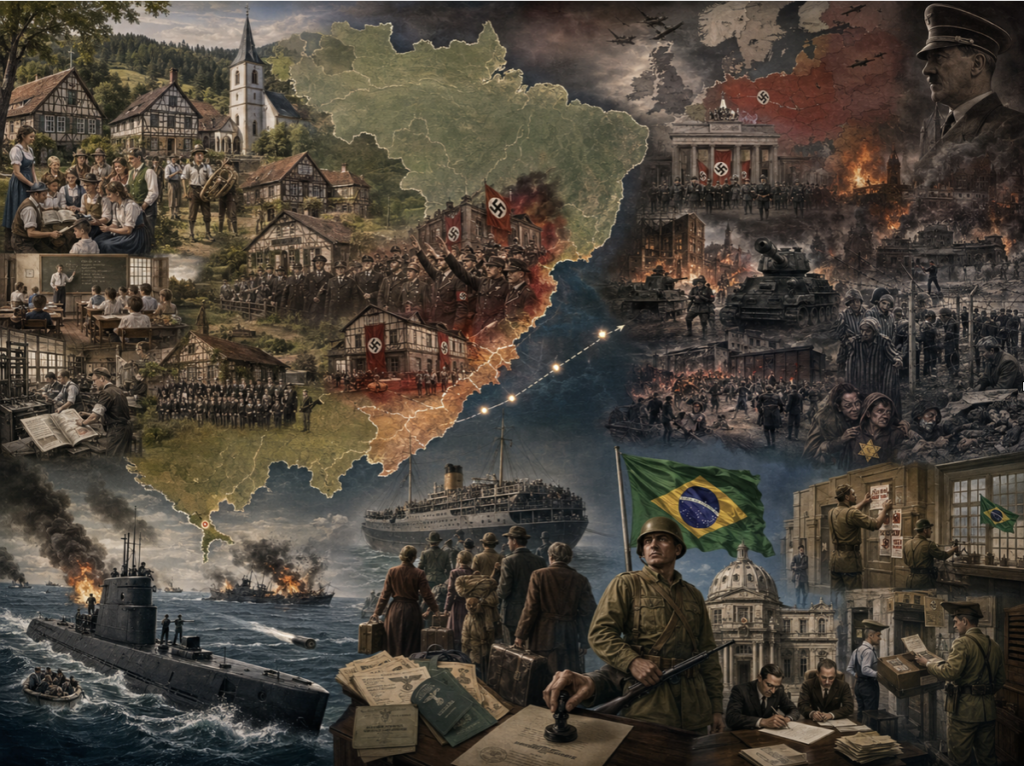
Diante desse quadro, o Estado brasileiro não podia tratar o problema apenas como questão cultural. Havia uma combinação explosiva: comunidades de origem alemã fortemente organizadas, propaganda nacional-socialista, vínculos políticos com uma potência estrangeira, nacionalismo étnico, guerra mundial e, finalmente, ataques militares alemães contra embarcações brasileiras. Entre 15 e 19 de agosto de 1942, o submarino alemão U-507 atacou navios brasileiros na costa da Bahia e de Sergipe, causando centenas de mortes, inclusive de civis. O Brasil ainda não havia declarado guerra à Alemanha. A agressão alemã veio antes da entrada formal do Brasil na guerra. Poucos dias depois, em 22 de agosto de 1942, o Brasil declarou guerra à Alemanha e à Itália.¹⁰
Nesse contexto, o governo brasileiro precisou agir com a autoridade máxima do Estado. A nacionalização, a proibição de organizações estrangeiras, a restrição à propaganda em língua estrangeira, o controle sobre associações e a repressão à atuação nazista não nasceram simplesmente de hostilidade contra imigrantes ou descendentes. O Brasil havia tolerado por décadas a manutenção de comunidades, escolas, igrejas, jornais, associações e atividades econômicas de origem alemã. O problema tornou-se incontornável quando essa estrutura passou a ser disputada por um regime estrangeiro totalitário, expansionista e militarmente agressivo.
A questão, portanto, não era mais distinguir lentamente, caso a caso, quem era nazista convicto, quem simpatizava com o Reich, quem apenas preservava a cultura alemã e quem nada tinha a ver com o nacional-socialismo. Diante de uma organização política estrangeira ativa, de propaganda vinculada ao III Reich, de uma história anterior de projetos de “Nova Alemanha” no sul do Brasil e, depois, de ataques alemães contra navios brasileiros, o Estado brasileiro foi colocado diante da necessidade de agir de forma ampla e eficaz para proteger o país e sua população.
A reação brasileira foi necessária porque a ameaça era real. Não se tratava de negar a contribuição de imigrantes alemães e descendentes ao Brasil, nem de confundir preservação cultural com nazismo. Tratava-se de impedir que língua, origem, escola, imprensa, associação, economia e memória comunitária fossem transformadas em instrumentos de lealdade política a uma potência estrangeira. Qualquer que fosse a forma de governo no Brasil naquele momento, a soberania nacional exigia uma resposta.
O erro de separar completamente nazismo e Deutschtum
Uma forma de distorcer essa história é afirmar que nazismo e Deutschtum não tinham relação alguma. Essa separação absoluta é cômoda, mas não se sustenta historicamente. O nazismo não criou o Deutschtum, mas se apropriou dele, radicalizou seus elementos étnicos, linguísticos e culturais e os colocou a serviço do projeto nacional-socialista. Aquilo que antes podia ser apresentado como preservação da língua, da escola, da igreja, da imprensa, dos clubes e da memória alemã no exterior passou a ser mobilizado como instrumento de lealdade política ao Reich. O Deutschtum foi, assim, convertido em base de propaganda, recrutamento simbólico e identificação racial com a Alemanha nazista.
Com isso, tornou-se insustentável a ideia de um Deutschtum organizado como realidade politicamente neutra. Já no período do II Império Alemão, elementos culturais alemães – língua, origem, escola, disciplina comunitária, trabalho, associação, memória histórica e vínculo com a pátria de origem – haviam sido reunidos por setores nacionalistas em uma visão cada vez mais política da germanidade. Essa visão não se limitava à preservação cultural: ela podia alimentar ambições de expansão, influência externa, hierarquia entre povos e projeção de poder alemão para além das fronteiras do Reich.
O nacional-socialismo levou essa lógica ao extremo. Ele não apenas usou o Deutschtum; transformou-o em instrumento de mobilização racial e política. Onde antes se falava em cultura, língua e tradição, passou-se a exigir pertencimento, obediência, identificação étnica e lealdade ao Reich. Por isso, no contexto dos anos 1930 e da Segunda Guerra Mundial, o Estado brasileiro não podia tratar o Deutschtum organizado apenas como folclore, saudade familiar ou vida associativa de imigrantes. Ele havia se tornado, em parte, uma base concreta para a propaganda e a expansão simbólica da Alemanha nazista.
Por que essa história ainda importa?
Essa história importa porque continua havendo tentativas de minimizar, romantizar ou fragmentar o passado. Quando se diz que o nazismo no Brasil foi apenas um episódio pequeno, sem raízes sociais, sem relação com estruturas comunitárias e sem ligação com o Deutschtum, cria-se uma versão confortável, porém incompleta.
O Brasil precisa conhecer essa história em sua essência. E a Alemanha atual também tem interesse nisso. A Alemanha republicana-democrática do pós-guerra não deve ter sua imagem confundida com projetos atuais de nostalgia étnica, separatismo cultural, supremacismo ou idealização de uma “Nova Alemanha” no Brasil.
O nazismo se desenvolveu no Brasil porque encontrou uma base anterior de germanidade organizada, porque explorou vínculos emocionais com a Alemanha, porque se beneficiou do prestígio cultural alemão, porque mobilizou medo do comunismo, porque atuou em um ambiente de radicalização política e porque ofereceu a alguns emigrantes e descendentes uma promessa de pertencimento a uma Alemanha supostamente renascida.
Essa é a lição histórica central: cultura não é problema quando convive com respeito, integração e lealdade ao país em que se vive. O perigo começa quando cultura vira projeto político de separação, segregação, superioridade e submissão a uma autoridade externa. Foi nesse ponto que o Deutschtum deixou de ser apenas preservação cultural e se tornou risco para a soberania brasileira.
O Brasil correu esse risco em dois momentos históricos diferentes. No período do II Império Alemão, a ameaça ainda não se apresentava como invasão militar direta, mas como projeto de influência, expansão cultural e construção de uma territorialidade alemã dentro do Brasil. Setores do nacionalismo alemão, da literatura colonial e do Deutschtumimaginaram o sul do Brasil como espaço de prolongamento da germanidade, uma espécie de “Nova Alemanha” em território brasileiro. Essa ideia reunia língua, escola, igreja, imprensa, associações, trabalho, propriedade, economia e identidade coletiva para formar um espaço alemão organizado dentro de um país soberano.
No III Reich, esse risco tornou-se muito mais perigoso. O nazismo não criou o Deutschtum, mas se apropriou dele, radicalizou seus elementos étnicos, linguísticos e culturais e os colocou a serviço do projeto nacional-socialista. Aquilo que antes podia ser apresentado como preservação da língua, da escola, da igreja, da imprensa, dos clubes e da memória alemã no exterior passou a ser mobilizado como instrumento de lealdade política ao Reich. O Deutschtum foi convertido em base de propaganda, recrutamento simbólico, identificação racial e subordinação política à Alemanha nazista.
Assim, o perigo para o Brasil não estava simplesmente na existência de imigrantes alemães ou descendentes de alemães. O perigo estava na transformação de uma comunidade culturalmente organizada em base de influência de uma potência estrangeira. No II Império, isso aparecia como projeto colonial, nacionalista e cultural de uma “Nova Alemanha”. No III Reich, apareceu como organização política real, com Partido Nazista atuando diretamente no Brasil, propaganda nacional-socialista, mobilização dos chamados alemães no exterior e, finalmente, agressão militar alemã contra navios brasileiros antes da declaração formal de guerra do Brasil.
Por isso, essa história precisa ser conhecida, estudada e lembrada. Ela mostra que o Brasil não enfrentou apenas uma questão de imigração, língua ou costumes. Enfrentou o risco de ver parte de seu território social, cultural e simbólico ser disputado por projetos externos de germanidade, primeiro nacional-coloniais e depois nazistas. A memória dessa história é necessária para impedir que cultura seja novamente usada como instrumento de separação, superioridade, lealdade externa ou ameaça à soberania nacional.
A Alemanha tem um programa robusto exatamente com esse propósito. Chamada de Erinnerungskultur, a cultura da memória é uma política de Estado e um compromisso social contínuo que garante que o Holocausto e os horrores do nazismo sejam estudados e lembrados para que tais atrocidades jamais se repitam. Este projeto parte desse mesmo princípio e o expande para a história Brasil-Alemanha, pois essa história também não pode se repetir.
Referencias literarias
- DIETRICH, Ana Maria. Nazismo tropical?: o Partido Nazista no Brasil. Tese (Doutorado em História Social) – Faculdade de Filosofia, Letras e Ciências Humanas, Universidade de São Paulo, São Paulo, 2007. Disponível no Repositório de Teses da USP. Ver também: UNITED STATES HOLOCAUST MEMORIAL MUSEUM. “The Nazi Party”. Holocaust Encyclopedia, 2025.
- DIETRICH, Ana Maria. Nazismo tropical?: o Partido Nazista no Brasil. Tese (Doutorado em História Social) – Faculdade de Filosofia, Letras e Ciências Humanas, Universidade de São Paulo, São Paulo, 2007. A tese informa que o Partido Nazista no Brasil atuou entre 1928 e 1938, integrou uma rede presente em 83 países e reuniu cerca de 2.900 membros.
- UNITED STATES HOLOCAUST MEMORIAL MUSEUM. “The Nazi Party”. Holocaust Encyclopedia, 2025; UNITED STATES HOLOCAUST MEMORIAL MUSEUM. “Nazi Racism: An Overview”. Holocaust Encyclopedia, 2025.
- FROTSCHER, Méri. “Retorno à pátria alemã”: migrações de retorno do Brasil para a Alemanha sob o nazismo (1938–1939). Passo Fundo: Acervus, 2024. A obra analisa o retorno de mais de 8 mil integrantes da comunidade alemã no Brasil ao Reich no contexto do nacional-socialismo, especialmente entre 1938 e 1939, e destaca que, enquanto judeus alemães e opositores fugiam da Alemanha, a ascensão do nacional-socialismo provocou euforia entre muitos emigrantes alemães no estrangeiro.
- FUNDAÇÃO GETULIO VARGAS. Atlas Histórico do Brasil. Verbete “Integralismo”. Rio de Janeiro: FGV CPDOC, s.d. Ver também, para o contexto brasileiro da década de 1930, PANDOLFI, Dulce (org.). Repensando o Estado Novo. Rio de Janeiro: Editora FGV, 1999.
- BRASIL. Decreto-Lei nº 383, de 18 de abril de 1938. “Veda a estrangeiros a atividade política no Brasil e dá outras providências”. Coleção das Leis da República dos Estados Unidos do Brasil, Rio de Janeiro, v. 2, p. 53–54, 1939.
- SEYFERTH, Giralda. “Os imigrantes e a campanha de nacionalização do Estado Novo”. In: PANDOLFI, Dulce (org.). Repensando o Estado Novo. Rio de Janeiro: Editora FGV, 1999, p. 199–228.
- UNITED STATES HOLOCAUST MEMORIAL MUSEUM. “German American Bund”. Holocaust Encyclopedia, s.d.; THE NATIONAL ARCHIVES. “Defence Regulation 18B, Advisory Committee Papers”. Kew: The National Archives, s.d.; THE CANADIAN ENCYCLOPEDIA. “War Measures Act”. Toronto: Historica Canada, s.d.; ANZAC PORTAL. “Enemy aliens”. Canberra: Australian Government, Department of Veterans’ Affairs, s.d.
- UNITED STATES HOLOCAUST MEMORIAL MUSEUM. “Operation Barbarossa”. Holocaust Encyclopedia, s.d.; POLIAN, Pavel. Against Their Will: The History and Geography of Forced Migrations in the USSR. Budapest/New York: Central European University Press, 2004. Para a deportação dos alemães do Volga, ver também a historiografia sobre o decreto soviético de 28 de agosto de 1941.
- 10.FERREIRA, Jorge. “Mortes no mar, dor na terra: brasileiros atingidos pelo submarino alemão U-507”. Estudos Ibero-Americanos, Porto Alegre, PUCRS, 2017; NATIONAL ARCHIVES. “Surrender of Germany (1945)”. Washington, D.C.: National Archives, 2023; MUSEUM BERLIN-KARLSHORST. “The German Surrender in May 1945”. Berlin: Museum Berlin-Karlshorst, s.d.