
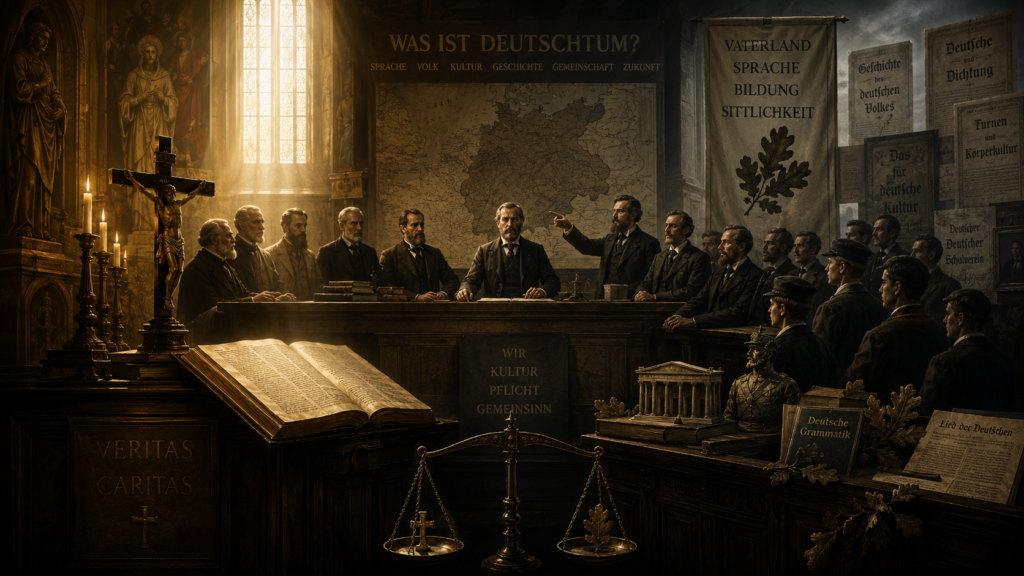
The relationship between Christianity and the Germanic lineage that would later be appropriated by German identity is ancient. Deutschtum, however, is not ancient in the same sense. This distinction is fundamental.¹
The Franks, Saxons, Bavarians, Alemanni, and other Germanic peoples were not “Germans” in the modern sense. Nor were they bearers of an already established Deutschtum. The term itself, modern national consciousness, and the political and cultural meaning later associated with Germanness belong to a much later period, especially the nineteenth century. Nevertheless, these peoples and their traditions were subsequently incorporated into the German national narrative as sources of origin, historical memory, and legitimacy.²
It is therefore incorrect to say that Deutschtum began with the Franks. Such a statement would be an anachronism. The correct point is different: modern Deutschtum drew upon a much older Germanic and Frankish-Germanic memory, reinterpreting it as the historical root of the German people.³
This distinction changes the entire analysis.
The Christianization of the Germanic peoples belongs to the long religious and political prehistory of what would later become the German tradition. Deutschtum, by contrast, is a modern construction of Germanness. The decisive conflict emerged when this modern construction began to determine whether Christianity itself was compatible with the German people.⁴
The Germanic Lineage Before Deutschtum
Long before the existence of a German nation-state, various Germanic peoples were gradually integrated into Christianity and into new forms of political authority. Among them, the Franks played a decisive role.⁵
The conversion of Clovis to Roman Christianity, between the late fifth and early sixth centuries, marked a fundamental stage in the rapprochement between Germanic political power and Christianity. From that moment onward, the Christian faith functioned not merely as a personal religion. It also became part of the legitimization of kingship, the organization of political authority, social discipline, legal development, and the integration of diverse populations under a common political order.⁵
Later, under Charlemagne, this connection became even stronger. Frankish expansion, the forced Christianization of peoples such as the Saxons, imperial formation, and religious authority were all brought together within a single vision of order. To Christianize also meant to conquer, integrate, reorganize, and subject.⁶
This was not yet Deutschtum. It was, however, part of a body of historical experience that centuries later would be reinterpreted as the Germanic, Frankish, Christian, and imperial lineage of the German world.⁷
The memory of the Franks, the Saxons, Christianization, the Holy Roman Empire, language, law, tribal traditions, and regional customs would later be mobilized by intellectuals, nationalists, and ideologues as evidence of an alleged historical continuity of the German nation. Yet this continuity did not exist as Deutschtum during the age of the Franks. It was constructed retrospectively through several historical layers: it first acquired a more conscious form with the humanism of the fifteenth and sixteenth centuries; gained new momentum during the Reformation; was culturally reorganized in the eighteenth century; became a national project in the nineteenth century; and was subsequently radicalized by imperial nationalism and völkisch thought.⁸
Before 1871, the Germans were politically divided among numerous states, kingdoms, principalities, and free cities. To argue that a German nation had existed even before the establishment of a unified German state, intellectuals and nationalists appealed to language, culture, the memory of the Germanic peoples, Christianization, the Holy Roman Empire, ancient law, myths, popular traditions, and wars against external enemies. In this way, a plural, regional, dynastic, religious, and imperial past was reorganized as though it had constituted the long preparation for a modern German nation.⁹
The Modern Emergence of Deutschtum
Deutschtum belongs to the modern world. This does not mean that language, culture, collective memory, or forms of belonging did not exist among Germanic peoples and German-speaking populations before that time. They had existed for centuries in regional, religious, legal, dynastic, and imperial forms. The decisive difference is that, during the nineteenth century, these elements came to be reinterpreted as the foundation of a modern German national community.⁹
Before 1871, there was no unified German nation-state. Instead, there were numerous kingdoms, principalities, free cities, and German-speaking territories. Consequently, Germanness gradually developed as a cultural, linguistic, historical, and political idea that transcended the borders of the existing states. Language, literature, customs, ancestry, Germanic memory, religion, law, and history were all mobilized as signs of belonging to an imagined German community even before political unification.¹⁰
Strictly speaking, one can speak of Deutschtum only within the context of the modern nation-state of the nineteenth century. Earlier terms such as deutsch or the older diutisc originally referred to the vernacular language or to forms of belonging within pre-modern political orders. They did not yet signify Deutschtum. The concept emerged when language, culture, ancestry, history, and collective memory came to be interpreted as expressions of a single German national community.¹¹
With the foundation of the German Empire in 1871, this idea acquired new strength. The nation-state did not create German belonging from nothing, but it gave it political, military, educational, symbolic, and administrative form. From that point onward, Deutschtum came to signify more than language or culture. It could express a conception of Germanness embracing peoplehood, history, mission, discipline, work, education, family, religion, memory, and collective destiny.¹²
For the Auslandsdeutsche—Germans living outside Germany—Deutschtum also became a category of transnational belonging. It could connect emigrant communities through language, schools, churches, the press, clubs, associations, the memory of their origins, and the idea of a German continuity extending beyond the borders of the Reich.¹³
This point is fundamental for understanding the German presence in Brazil. Deutschtum did not appear merely as cultural preservation or nostalgia for the homeland. In certain contexts, it functioned as an organized way of maintaining the German language, schools, churches, newspapers, community networks, and symbolic loyalties linked to Germanness, even on Brazilian soil.¹⁴
Christendom, Germanness, and the Modern Reversal
For centuries, Christianity had been one of the principal languages through which political order was legitimized. Kings, empires, wars, laws, education, and collective belonging could all be justified in the name of the faith, the Church, the Christian mission, or the Christian order of the world.¹⁵
Within the Germanic-Christian tradition, Christianity helped shape structures of authority and integration. In the modern era, however, something fundamentally new occurred: national identity began to compete with religion for the position of the supreme foundation of the community.¹⁶
In the German case, this tension intensified throughout the nineteenth century. The nation, the people, the language, the culture, the Reich, and ancestry gradually came to occupy an increasingly central place. Christianity remained important, but it was no longer the sole horizon of belonging. In some circles, it began to be measured according to its usefulness to the nation.¹⁷
The question itself changed.
For centuries, the central question had been: How are political authority and the people to be ordered within a Christian world?
During the nationalist and völkisch period, the question became: **Does Christianity serve the German people? Is it compatible with Germanness? Does it strengthen or weaken the Volkstum?**¹⁸
This was the decisive reversal.
When Did Deutschtum Become More Important than Christianity?
There is no single date. It was a historical process. Nevertheless, its development can be traced through a clear historical sequence.
The first decisive phase occurred during the nineteenth century, especially in the decades before and after the foundation of the German Empire in 1871. During this period, modern Germanness acquired growing cultural, political, and symbolic strength. Language, history, the memory of the Germanic peoples, the idea of the nation, and the creation of the German nation-state established a new hierarchy of belonging. To be German increasingly carried profound political and cultural significance.¹²
The second phase unfolded between the late nineteenth and the early twentieth centuries, when völkisch movements radicalized the concept of the German people. The Volk was no longer understood merely as a cultural or linguistic community. In many ideological discourses, it became an organic, racial, spiritual, and historical community. Peoplehood, blood, soil, ancestry, race, culture, destiny, and mission were fused into a closed conception of collective belonging.¹⁸
Within this intellectual climate, Christianity itself began to be judged according to standards of Germanness. It was no longer sufficient simply to be Christian. The new question became whether Christianity was sufficiently German, sufficiently national, sufficiently Aryan, sufficiently connected to the Volkstum.¹⁹
The third phase emerged after the First World War and especially during the crisis of the Weimar Republic. Germany’s defeat in 1918, the Treaty of Versailles, fear of communism, economic instability, national resentment, and the rise of National Socialism created an environment in which national and völkisch identity increasingly demanded absolute allegiance.²⁰
Around 1930, this tension had become explicit. Texts such as Deutschtum und Christentum, by Lic. Pohlmann, originally published in 1930, demonstrate that the issue was no longer merely religious. The question had become whether Christianity itself could remain within an order defined by Deutschtum.²¹
This text is important not because it marks the beginning of the relationship between Christianity and the Germanic lineage. That relationship is far older. Its importance lies in demonstrating a later stage in which modern, völkischDeutschtum sought to place Christianity itself under judgment.²¹
The underlying question was: Who should occupy the highest place—Christ or the German people?
Christianity Before the Tribunal of Germanness
The völkisch debates produced different answers to this question.²¹
One current regarded Christianity as a foreign, universal religion marked by its Jewish origins. According to this view, Christianity did not truly belong to the Germanic world. It should therefore be overcome, replaced, or absorbed into a German, Germanic, racial, or national religion.²¹
A second current did not wish to abandon Christianity altogether but rather to transform it. It advocated a “German,” “Aryan,” “heroic,” “popular,” or “de-Judaized” Christianity. In this interpretation, Jesus could be separated from His Jewish origin, the Old Testament could be rejected or marginalized, and the Christian faith could be reinterpreted according to criteria of race, peoplehood, and Germanness.¹⁹
A third current attempted to reconcile Christianity with Deutschtum. It argued that Christianity found its deepest, most authentic expression in the German soul. Although this position appeared less radical, it could likewise reduce Christianity to an expression of national identity.²²
In every case, however, the pressure was the same: Christianity had to demonstrate its compatibility with the German people.
Universal faith was subjected to national identity. Religion was filtered through criteria of ancestry, blood, culture, race, and belonging. Christianity ceased to be the higher foundation and instead became something to be adapted.¹⁹
Protestants and Catholics: Who More Consciously Cultivated This New Order?
The answer requires careful qualification. It cannot be said that all Protestants embraced völkisch nationalism, nor that all Catholics resisted it. Neither confession should be treated as a homogeneous bloc. There were nationalist Protestants, Protestant resisters, nationalist Catholics, Catholic resisters, opportunists, critics, conformists, and victims.²³
Historically, however, the most conscious attempt to create a German, national, racialized form of Christianity aligned with the new political order emerged more strongly within Protestant circles.²³
There were historical reasons for this. German Protestantism was more deeply intertwined with the territorial churches, the regional states, political authority, and the long-standing tradition of cooperation between throne and altar. After the founding of the German Empire in 1871, many Protestant circles strongly identified with the Empire, Prussia, the monarchy, and Germany’s national mission.²³
When the Empire collapsed in 1918, part of this nationalist Protestantism entered into crisis. For many, the Weimar Republic represented rupture, humiliation, and disorder. In this context, certain Protestant sectors became especially receptive to a national, authoritarian, anti-communist, and völkisch reconstruction of society.²³
The Deutsche Christen (“German Christians”) expressed this tendency in its most radical form. They sought to adapt German Protestantism to National Socialism, defended racial purity as a criterion of belonging, and attempted to sever the Evangelical Church from its Jewish roots. In this environment, Deutschtum was no longer merely a cultural identity; it became the organizing principle of the faith itself.²³
The situation within Catholicism was different. The Catholic Church possessed a transnational structure centered on Rome and therefore could not be transformed into a German national church with the same ease. Political Catholicism—especially through the Centre Party (Zentrum) and distinct Catholic social milieus—maintained for a considerable time a greater distance from National Socialism.²⁴
This does not imply innocence. There were nationalist Catholics, antisemites, conformists, silent bystanders, and collaborators. Nor should the traditional Christian anti-Judaism found in parts of Catholic history be confused with Nazi biological racism, although it contributed to creating a long-standing climate of hostility toward Jews. The Reich Concordat of 1933 likewise demonstrates that the Catholic Church sought to protect its institutional rights through negotiation with the Nazi regime, a decision with important political consequences.²⁴
The distinction, therefore, is not that Protestants were guilty while Catholics were innocent. Rather, it lies in the different forms of adaptation.
Within völkisch Protestantism, especially among the Deutsche Christen, there was a far more explicit attempt to construct a German Christianity subordinated to the people, race, and the nation-state. Within Catholicism, there was greater structural resistance to the complete nationalization of the Church, but there were also accommodation, nationalism, anti-Judaism, silence, and collaboration at various levels.²³ ²⁴
Thus, both confessional traditions participated in the new order, although in different ways and to different degrees. Yet the deliberate formulation of a “German Christianity” subordinated to Deutschtum appeared most clearly within völkisch Protestantism.²³
The Central Issue: The Reversal of the Hierarchy
The Christianized Germanic lineage demonstrates a long historical relationship between Christianity, political authority, and collective belonging. This relationship, however, must not be confused with Deutschtum.¹
Modern Deutschtum emerged much later. It drew upon ancient memories, appropriated the Germanic and Frankish-Germanic heritage, reinterpreted history as a continuous German narrative, and transformed language, culture, ancestry, and peoplehood into the foundations of collective identity.³
The dangerous reversal occurred when this modern conception of Germanness came to occupy the position of the supreme standard. From that point onward, Christianity was no longer simply a faith received, practiced, or debated theologically. Instead, it came to be examined politically:
**Is it German enough? Is it Aryan enough? Is it truly rooted in the Volkstum? Does it strengthen or weaken the German people?**¹⁹
At that moment, Deutschtum became more important than Christianity for nationalist and völkisch circles—not necessarily because they abandoned the Christian faith altogether, but because they subordinated it to an identity defined by the people.¹⁸ ¹⁹
This is the key to understanding the issue.
When Christianity must be “authorized” by Germanness, faith no longer shapes identity; identity shapes faith. When Christ is reinterpreted according to blood, race, and ancestry, religion becomes an instrument of exclusion. When the Bible is filtered through national criteria, Christianity ceases to be universal and becomes nationalized.¹⁹
The question, “Are Deutschtum and Christianity compatible?”, often concealed a deeper one:
Who holds ultimate authority—the Christian faith or the German people understood as a community of blood and destiny?
Why Does This Matter for Brazil and Germany?
This discussion does not belong solely to the internal history of Germany. It also helps explain how German ideas of peoplehood, ancestry, belonging, language, religion, and cultural mission circulated beyond Germany itself, including in Brazil.¹³ ¹⁴
In southern Brazil, Deutschtum frequently manifested itself through the preservation of the German language, schools, churches, newspapers, associations, family traditions, work ethic, and communal memory. Many of these practices could be presented simply as expressions of culture, tradition, or the preservation of identity. In certain historical contexts, however, they could also form part of a broader conception of German belonging beyond the borders of Germany.¹⁴
The Church played a central role in this process. It could serve as a place of faith, charitable assistance, education, and community life. At the same time, it could also function as an institution for preserving the German language, reinforcing social discipline, maintaining symbolic separation, and ensuring the continuity of German cultural identity. Within many communities of German origin, religion, schooling, and language developed hand in hand.¹⁴
The problem does not lie in having German ancestry, speaking German, preserving family memories, or maintaining religious traditions. The problem arises when language, faith, ancestry, blood, schools, churches, and collective belonging are fused into a closed conception of peoplehood based on separation and superiority.¹⁴ ¹⁸
For this reason, the relationship between Deutschtum and Christianity is essential for understanding the history of Germany and Brazil. It demonstrates that Deutschtum was not merely a matter of folklore, cuisine, music, diligence, or nostalgia. It could also constitute a comprehensive framework for organizing identity, community, and loyalty. In its more radical forms, it was capable of subordinating even religion itself to the idea of the people.¹⁴ ¹⁹
Conclusion
Modern Germanness was constructed through the appropriation of a much older historical lineage: the Germanic peoples, Christianization, the Franks, the Saxons, Charlemagne, the Holy Roman Empire, language, law, historical memory, and tradition. These elements belonged to different historical periods and diverse political orders, yet they were later brought together and reinterpreted as though they constituted the long preparation for a modern German national identity.¹ ³
This appropriation proved decisive. It enabled modern Deutschtum to present itself not merely as a contemporary cultural phenomenon, but as the continuation of a profound historical tradition.³
During the nineteenth century, especially after the foundation of the German Empire in 1871, this conception of Germanness acquired significant political force. Between the late nineteenth century and the first decades of the twentieth century, völkisch movements radicalized this idea by interpreting peoplehood, ancestry, blood, race, soil, culture, and destiny as the supreme foundations of the national community.¹² ¹⁸
It was within this context that Deutschtum, in certain circles, began to assume greater importance than Christianity. The Christian faith came to be judged according to its compatibility with Germanness. Some sought to reject it as foreign. Others attempted to de-Judaize it. Others endeavored to Germanize it. Still others reduced it to an expression of the German soul.¹⁹ ²¹
The reversal was profound: Christianity, which for centuries had contributed to legitimizing political and social order, was now placed before the tribunal of the people.¹⁵ ¹⁹
This represents one of the central issues in the history of Deutschtum. When national or racial identity becomes more important than faith, religion itself can be transformed into an instrument of power, exclusion, and radicalization.¹⁸ ¹⁹ ²³
For this reason, this history must be approached with precision. Not to confuse the Franks with modern Germans. Not to project Deutschtum back onto the Middle Ages. Rather, to demonstrate how a modern construction of Germanness appropriated an ancient Germanic heritage and, at a particular historical moment, came to place Christianity itself under judgment.¹ ³ ¹⁹
Notes and References
1. GEARY, Patrick J. The Myth of Nations: The Medieval Origins of Europe. Princeton: Princeton University Press, 2002; SCALES, Len. The Shaping of German Identity: Authority and Crisis, 1245–1414. Cambridge: Cambridge University Press, 2012.
2. GEARY, Patrick J. Before France and Germany: The Creation and Transformation of the Merovingian World. Oxford: Oxford University Press, 1988; REUTER, Timothy. Germany in the Early Middle Ages, c. 800–1056. London/New York: Longman, 1991.
3. KREBS, Christopher B. A Most Dangerous Book: Tacitus’s Germania from the Roman Empire to the Third Reich. New York/London: W. W. Norton, 2011; GEARY, Patrick J. The Myth of Nations: The Medieval Origins of Europe. Princeton: Princeton University Press, 2002; MOSSE, George L. The Crisis of German Ideology: Intellectual Origins of the Third Reich. New York: Grosset & Dunlap, 1964.
4. MOSSE, George L. The Crisis of German Ideology: Intellectual Origins of the Third Reich. New York: Grosset & Dunlap, 1964; PUSCHNER, Uwe. “Die völkische Bewegung.” Bundeszentrale für politische Bildung, 7 July 2016.
5. GREGORY OF TOURS. Historiae; WOOD, Ian. The Merovingian Kingdoms, 450–751. London/New York: Longman, 1994; GEARY, Patrick J. Before France and Germany: The Creation and Transformation of the Merovingian World. Oxford: Oxford University Press, 1988.
6. EINHARD. Vita Karoli Magni; Annales regni Francorum; FRIED, Johannes. Karl der Große: Gewalt und Glaube. Munich: C. H. Beck, 2013; McKITTERICK, Rosamond. Charlemagne: The Formation of a European Identity. Cambridge: Cambridge University Press, 2008.
7. REUTER, Timothy. Germany in the Early Middle Ages, c. 800–1056. London/New York: Longman, 1991; SCALES, Len. The Shaping of German Identity: Authority and Crisis, 1245–1414. Cambridge: Cambridge University Press, 2012.
8. KREBS, Christopher B. A Most Dangerous Book: Tacitus’s Germania from the Roman Empire to the Third Reich. New York/London: W. W. Norton, 2011; FICHTE, Johann Gottlieb. Reden an die deutsche Nation. Berlin, 1808; MOSSE, George L. The Crisis of German Ideology: Intellectual Origins of the Third Reich. New York: Grosset & Dunlap, 1964.
9. SHEEHAN, James J. German History 1770–1866. Oxford: Oxford University Press, 1989; WINKLER, Heinrich August. Der lange Weg nach Westen. Deutsche Geschichte vom Ende des Alten Reiches bis zum Untergang der Weimarer Republik. Munich: C. H. Beck, 2000; SCALES, Len. The Shaping of German Identity: Authority and Crisis, 1245–1414. Cambridge: Cambridge University Press, 2012.
10. ANDERSON, Benedict. Imagined Communities: Reflections on the Origin and Spread of Nationalism. London/New York: Verso, 1983; BREUILLY, John. Nationalism and the State. 2nd ed. Manchester: Manchester University Press, 1993; SHEEHAN, James J. German History 1770–1866. Oxford: Oxford University Press, 1989.
11. DUDEN. “Deutschtum”; SCALES, Len. The Shaping of German Identity: Authority and Crisis, 1245–1414. Cambridge: Cambridge University Press, 2012.
12. WINKLER, Heinrich August. Der lange Weg nach Westen. Munich: C. H. Beck, 2000; NIPPERDEY, Thomas. Deutsche Geschichte 1866–1918. Machtstaat vor der Demokratie. Munich: C. H. Beck, 1992.
13. CONRAD, Sebastian. Globalisation and the Nation in Imperial Germany. Cambridge: Cambridge University Press, 2010; OSTERHAMMEL, Jürgen. Die Verwandlung der Welt: Eine Geschichte des 19. Jahrhunderts. Munich: C. H. Beck, 2009; DUDEN. “Deutschtum.”
14. SEYFERTH, Giralda. Nacionalismo e identidade étnica: a ideologia germanista e o grupo étnico teuto-brasileiro numa comunidade do Vale do Itajaí. Florianópolis: Fundação Catarinense de Cultura, 1981; GERTZ, René E. O fascismo no sul do Brasil: germanismo, nazismo, integralismo. Porto Alegre: Mercado Aberto, 1987; DREHER, Martin N. Igreja e germanidade. São Leopoldo: Sinodal, 1984; DIETRICH, Ana Maria. Nazismo tropical? O Partido Nazista no Brasil. São Paulo: Universidade de São Paulo, 2007.
15. REUTER, Timothy. Germany in the Early Middle Ages, c. 800–1056. London/New York: Longman, 1991; FRIED, Johannes. Karl der Große: Gewalt und Glaube. Munich: C. H. Beck, 2013.
16. SMITH, Anthony D. The Ethnic Origins of Nations. Oxford: Blackwell, 1986; ANDERSON, Benedict. Imagined Communities. London/New York: Verso, 1983; BREUILLY, John. Nationalism and the State. 2nd ed. Manchester: Manchester University Press, 1993.
17. WINKLER, Heinrich August. Der lange Weg nach Westen. Munich: C. H. Beck, 2000; MOSSE, George L. The Crisis of German Ideology. New York: Grosset & Dunlap, 1964.
18. MOSSE, George L. The Crisis of German Ideology. New York: Grosset & Dunlap, 1964; PUSCHNER, Uwe. “Die völkische Bewegung.” Bundeszentrale für politische Bildung, 7 July 2016.
19. BERGEN, Doris L. Twisted Cross: The German Christian Movement in the Third Reich. Chapel Hill/London: University of North Carolina Press, 1996; HESCHEL, Susannah. The Aryan Jesus: Christian Theologians and the Bible in Nazi Germany. Princeton/Oxford: Princeton University Press, 2008; Deutsches Historisches Museum. “Deutsche Christen.”
20. PEUKERT, Detlev J. K. The Weimar Republic: The Crisis of Classical Modernity. New York: Hill and Wang, 1992; WEITZ, Eric D. Weimar Germany: Promise and Tragedy. Princeton: Princeton University Press, 2007.
21. POHLMANN, Lic. Deutschtum und Christentum. Bordesholm: Heliand-Verlag, 1930; reprinted in KÖPKE, Matthias, ed. Deutschtum und Christentum. Unüberbrückbare Gegensätze? Eine Sammlung von Aufsätzen. 5th expanded ed., 2020, pp. 63–79.
22. HARNACK, Adolf von. Das Wesen des Christentums. Leipzig: J. C. Hinrichs, 1900/1902; RINGER, Fritz K. The Decline of the German Mandarins: The German Academic Community, 1890–1933. Cambridge, MA: Harvard University Press, 1969.
23. BERGEN, Doris L. Twisted Cross. Chapel Hill/London: University of North Carolina Press, 1996; GAILUS, Manfred. Protestantismus und Nationalsozialismus. Cologne/Weimar/Vienna: Böhlau, 2001; Deutsches Historisches Museum. “Deutsche Christen.”
24. BLASCHKE, Olaf. Die Kirchen und der Nationalsozialismus. Stuttgart: Reclam, 2014; GAILUS, Manfred. “Das Verhältnis zwischen Kirche und Staat im nationalsozialistischen Deutschland.” Bundeszentrale für politische Bildung, 1 November 2018; Deutsches Historisches Museum. “Reichskonkordat 1933.”