
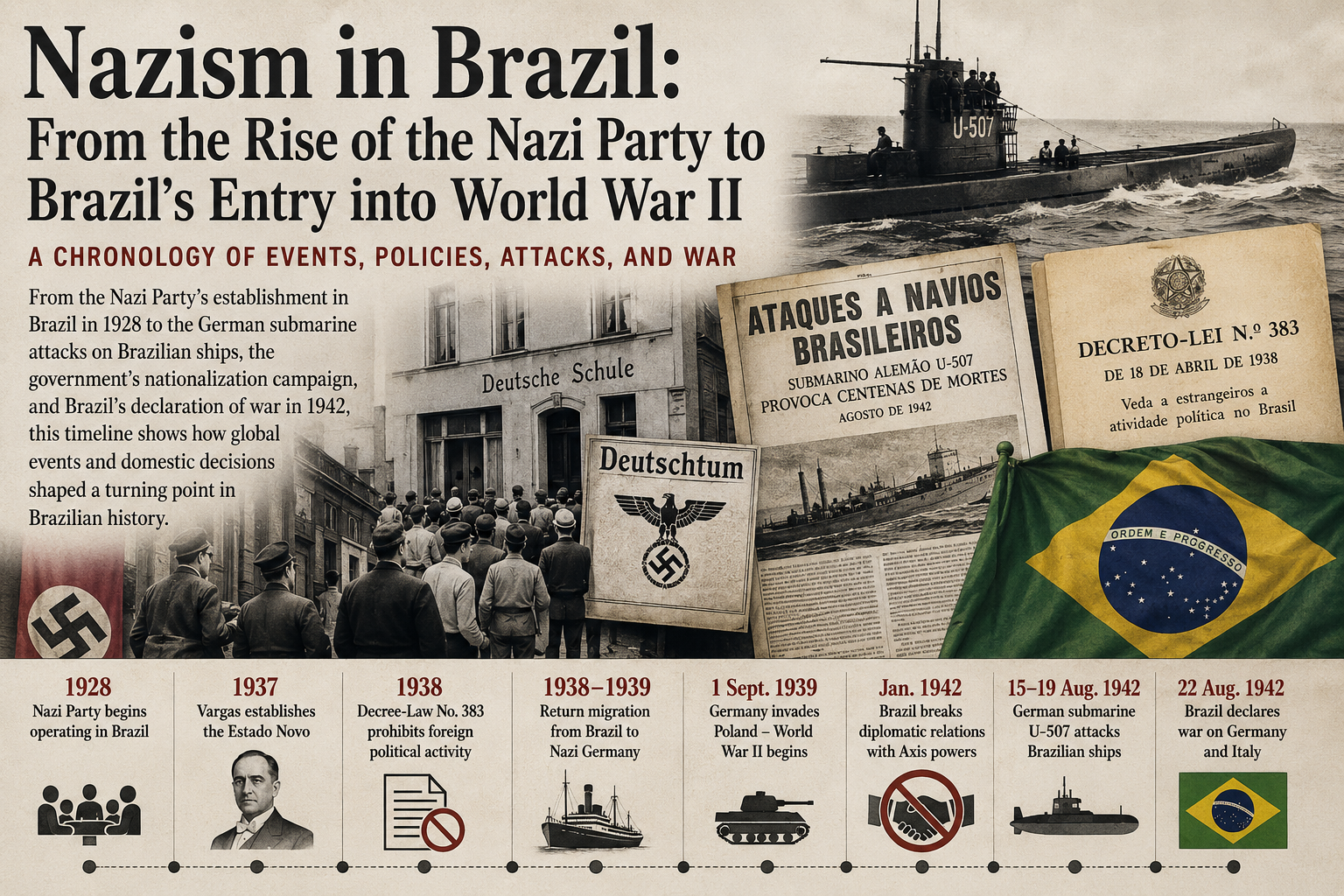
1928 – The Nazi Party Begins Operating in Brazil
The Nazi Party began operating in Brazil in 1928—six years before Adolf Hitler came to power in Germany. Between 1928 and 1938, it functioned as part of the international network of the Auslandsorganisation der NSDAP (Foreign Organization of the Nazi Party), directed from Germany. With approximately 2,900 registered members, Brazil became the largest branch of the Nazi Party outside Germany.¹
30 January 1933 – Hitler Comes to Power in Germany
Adolf Hitler was appointed Chancellor of Germany on 30 January 1933. From that moment onward, National Socialism took control of the German state. The relationship with the so-called Germans abroad acquired new political significance, as German emigrants and their descendants came to be regarded by the regime as a field for propaganda, mobilization, and potential loyalty to the Reich.
1933–1938 – Nazi Propaganda among Germans Abroad
Between 1933 and 1938, the Nazi regime intensified its propaganda among German emigrants and communities of German origin outside the Reich. In Brazil, this policy found an established foundation in Deutschtum: the German language, community schools, churches, newspapers, clubs, associations, and economic networks, as well as a local branch of the Nazi Party founded in 1928.
10 November 1937 – Vargas Establishes the Estado Novo
On 10 November 1937, Getúlio Vargas established the Estado Novo (“New State”). The regime strengthened central authority and expanded state control over politics, the press, associations, schools, and foreign organizations. From that point onward, policies of nationalization and surveillance against external loyalties gained increasing momentum.
18 April 1938 – Decree-Law No. 383 Prohibits Foreign Political Activity
Decree-Law No. 383 of 18 April 1938 prohibited foreign nationals in Brazil from engaging in any political activity or interfering in the country’s public affairs. It also banned societies, clubs, foundations, newspapers, magazines, conferences, parades, symbols, and uniforms associated with foreign political parties. The measure directly affected organizations such as the Nazi Party in Brazil.²
4 May 1938 – Decree-Law No. 406 Strengthens Control over Foreign Nationals
Decree-Law No. 406 of 4 May 1938 regulated the admission, residence, and assimilation of foreign nationals. It formed part of a broader set of measures through which the Brazilian state strengthened national control over immigration, foreign residents, and their integration into Brazilian society.³
1938 – Nationalization of Education and Restrictions on Foreign Schools
The nationalization policy had a profound impact on foreign schools, educational materials, newspapers published in foreign languages, and German, Italian, and Japanese community institutions. In the German case, this was particularly significant because the German language, German schools, and the German-language press were fundamental pillars of Deutschtum in Brazil. These institutions served not only to preserve cultural identity but also, in certain circumstances, as channels for political influence and National Socialist propaganda.
1938 – Suppression of the Nazi Party in Brazil
With the prohibition of foreign political activity and the implementation of nationalization policies, the Nazi Party in Brazil was suppressed. This measure was grounded in the principle of national sovereignty: a foreign political party linked to the Third Reich and operating directly within Brazilian territory was incompatible with the authority of the sovereign Brazilian state.
1938–1939 – Return Migration from Brazil to Nazi Germany
Between 1938 and 1939, more than 8,000 members of the German community and their descendants left Brazil to live in the new Germany—the Nazi Reich. While German Jews and opponents of the regime were fleeing its brutality, National Socialism generated widespread enthusiasm among many German emigrants abroad, including those living in Brazil.⁴
1 September 1939 – Germany Invades Poland
On 1 September 1939, Nazi Germany invaded Poland. This attack marked the beginning of the Second World War in Europe. Germany’s expansion involved military occupation, terror against civilians, the violent Germanization of conquered territories, expulsions, deportations, forced labor, and the murder of populations regarded as enemies, inferior peoples, or otherwise undesirable.
September 1939 – The United Kingdom Adopts Emergency Measures
With the outbreak of war against Germany, the United Kingdom adopted emergency security measures. Defence Regulation 18B authorized the internment of individuals considered a threat to national security in wartime, including persons suspected of Nazi sympathies or activities contrary to the war effort. British archival records also document the state’s responsibility for the internment of “enemy aliens” and individuals detained under Regulation 18B.⁵
1939 – Australia Adopts Measures against “Enemy Aliens”
Australia introduced measures to control and intern individuals classified as “enemy aliens.” The National Security Act 1939 authorized the establishment of internment camps. These measures affected Germans, Italians, Japanese, and other groups regarded as security risks. Many individuals were interned without any individual proof of wrongdoing.⁶
1939–1940 – Canada Applies Wartime Measures against “Enemy Aliens”
Canada invoked the War Measures Act to implement extraordinary security measures. During the Second World War, the Canadian government interned 8,579 enemy aliens in 24 receiving stations and internment camps.⁷
1939–1941 – The United States Monitors Pro-Nazi Organizations
In the United States, the German American Bund, an extremist, antisemitic, and pro-Nazi organization, became the subject of intense public and governmental scrutiny. According to the United States Holocaust Memorial Museum, the Bund sought to promote support for National Socialism among German Americans by organizing rallies, publishing propaganda newspapers, and conducting youth indoctrination activities.⁸
22 June 1941 – Germany Invades the Soviet Union
On 22 June 1941, Nazi Germany broke the German-Soviet Pact and invaded the Soviet Union in Operation Barbarossa. For the Soviet Union, the German threat was direct and existential, involving territorial conquest, political destruction, and ideological warfare.
August 1941 – Stalin Deports Soviet Citizens of German Descent
Following the German invasion, Stalin adopted collective security measures against Soviet citizens of German descent, particularly the Volga Germans. The German threat was real: Nazi forces were already advancing deep into Soviet territory, leaving behind a trail of destruction, occupation, and violence. Moreover, opportunistic minorities of German origin collaborated with the invading forces in certain regions, as documented in international studies and reports concerning collaboration in occupied territories.
Within this context of total war, Stalin did not attempt to distinguish individually between collaborators, sympathizers, suspects, and innocent persons. Soviet citizens of German descent were treated collectively as potential collaborators with the invader and were deported en masse to Siberia and Central Asia.
7 December 1941 – Japan Attacks Pearl Harbor
Japan attacked Pearl Harbor on 7 December 1941. A few days later, Germany declared war on the United States. The conflict thus became a truly global war fought on every major front.
1 January 1942 – Declaration by United Nations
On 1 January 1942, twenty-six nations signed the Declaration by United Nations, pledging to continue the struggle against Germany, Italy, and Japan. The signatories included the United States, the United Kingdom, the Soviet Union, China, Canada, and Australia. Brazil had not yet become a signatory at that time.⁹
28 January 1942 – Brazil Remains Neutral but Breaks Diplomatic Relations with Germany, Italy, and Japan
Following the Rio de Janeiro Conference in January 1942, Brazil severed diplomatic relations with Germany, Italy, and Japan. This did not constitute a declaration of war. Brazil moved closer to the Allied powers but was not yet formally at war with Germany.
February–July 1942 – German Attacks on Brazilian Merchant Ships
After Brazil had broken diplomatic relations with the Axis powers, Brazilian merchant vessels began to be attacked by German submarines. These attacks took place while Brazil remained officially neutral.
15–19 August 1942 – U-507 Attacks Brazilian Ships off the Brazilian Coast
Between 15 and 19 August 1942, the German submarine U-507 attacked Brazilian merchant ships off the coasts of Sergipe and Bahia. Among the vessels sunk were the Baependy, Araraquara, Aníbal Benévolo, Itagiba, Arará, and Jacira. The attacks claimed hundreds of lives, including civilians, women, and children. Brazil had not yet declared war on Germany. German aggression preceded Brazil’s formal entry into the war.¹⁰
22 August 1942 – Brazil Declares War on Germany and Italy
Only after the German attacks on Brazilian ships did Brazil declare war on Germany and Italy, on 22 August 1942. This point is crucial: **Brazil did not declare war first and then suffer attacks. Rather, Brazil was attacked before it formally entered the war.**¹¹
1942 Onward – Control over Companies, Banks, and Economic Interests Connected with the Axis
After Brazil entered the war, companies, banks, properties, commercial networks, and economic interests linked to Germany, Italy, and Japan came to be treated as matters of national security. Economic activity also became subject to government surveillance. Blacklists, restrictions, interventions, and controls over enterprises considered connected with Axis interests formed part of this broader wartime policy. Studies on wartime blacklists in Brazil show that companies wholly or partly owned by Germans, Italians, or Japanese became the subject of governmental measures and political disputes.¹²
8 February 1943 – Brazil Formally Adheres to the Declaration by United Nations
On 8 February 1943, Brazil formally adhered to the Declaration by United Nations, thereby consolidating its position within the Allied coalition against the Axis powers.
2 July 1944 – The First Brazilian Expeditionary Force Contingent Departs for Europe
The first contingent of the Brazilian Expeditionary Force (Força Expedicionária Brasileira – FEB) departed for Europe on 2 July 1944. Brazilian troops fought in the Italian Campaign, making Brazil the only South American nation to deploy ground forces to fight in Europe during the Second World War.
1944–1945 – The Brazilian Expeditionary Force Fights in Italy
The Brazilian Expeditionary Force fought German and Fascist forces in Italy. Among its best-known engagements were the battles of Monte Castello, Montese, and other military operations in northern Italy.
30 April 1945 – Hitler Commits Suicide in Berlin
With Berlin encircled by the Red Army and the Nazi regime collapsing, Adolf Hitler committed suicide on 30 April 1945.
7 May 1945 – Germany Signs the Instrument of Unconditional Surrender at Reims
Germany’s Instrument of Unconditional Surrender was signed at Reims, France, on 7 May 1945, at the headquarters of General Dwight D. Eisenhower.¹³
8 May 1945 – Ratification of Germany’s Surrender in Berlin-Karlshorst
Germany’s surrender was ratified at Berlin-Karlshorst on 8 May 1945. In the Western Allies, this date became known as Victory in Europe Day (VE Day). In the Soviet Union—and today in Russia—victory has traditionally been commemorated on 9 May because of the time difference between Berlin and Moscow.
Supporting Notes
¹ Ana Maria Dietrich, Nazismo tropical? O Partido Nazista no Brasil, doctoral dissertation, University of São Paulo (USP), 2007. The dissertation states that the Nazi Party in Brazil operated between 1928 and 1938 as part of the international network of the Nazi Party’s Foreign Organization (Auslandsorganisation der NSDAP).
² Decree-Law No. 383 of 18 April 1938, “Veda a estrangeiros a atividade política no Brasil e dá outras providências.”The decree prohibited foreign nationals from engaging in political activity and specifically banned foreign political organizations, symbols, publications, meetings, and propaganda.
³ Decree-Law No. 406 of 4 May 1938 concerning the admission of foreign nationals into Brazilian territory.
⁴ Méri Frotscher, “Retorno à pátria alemã”: migrações de retorno do Brasil para a Alemanha sob o nazismo (1938–1939). Passo Fundo: Acervus, 2024. The publisher’s description identifies the period 1938–1939 and refers to the “worldwide enthusiasm among many German emigrants abroad.”
⁵ The National Archives (United Kingdom), “Defence Regulation 18B, Advisory Committee Papers” and “Home Office: Internment, General Files.”
⁶ ANZAC Portal (Australian Government), “Internment Camps in Australia during World War II”; National Library of Australia, “Enemy Aliens and War with Japan.”
⁷ The Canadian Encyclopedia, “War Measures Act.”
⁸ United States Holocaust Memorial Museum, “German American Bund.”
⁹ Avalon Project, Yale Law School, “Declaration by United Nations, January 1, 1942.”
¹⁰ Concerning the attacks carried out by U-507, historical records document the attacks against Brazilian merchant vessels in August 1942 and their direct connection with Brazil’s entry into the war. Jorge Ferreira records 607 fatalitiesresulting from the sinkings of the Baependy, Araraquara, Aníbal Benévolo, Itagiba, and Arará.
¹¹ Brazil declared war on Germany and Italy on 22 August 1942, after the attacks on Brazilian merchant ships.
¹² Tania Quintaneiro’s study on wartime blacklists and companies considered connected with the Axis powers in Brazil during the Second World War.
¹³ National Archives, “Surrender of Germany”; Museum Berlin-Karlshorst, “The German Surrender in May 1945.”