Of all the countries of Europe, none has shaped France’s modern destiny as profoundly, persistently, and violently as Germany. Before German unification, France’s relationship with the German-speaking world was marked by the cultural prestige it exercised over the various German states, including Prussia. In the nineteenth century, however, the rise of Prussian power transformed that relationship: France was deliberately used by Bismarck as the external adversary through whose defeat German unification could be completed under Prussian leadership. The German Empire founded in 1871 emerged from a war deliberately provoked by Bismarck and fought largely on French territory, from the siege and capitulation of Paris, the annexation of Alsace and part of Lorraine, the imposition upon defeated France of a war indemnity of five billion francs – equivalent to approximately 1,450 tonnes of gold and, at today’s gold price, roughly €165 billion (Treaty of Frankfurt, 1871) – and the proclamation of the new Reich in the Hall of Mirrors at Versailles while German troops still occupied French soil.
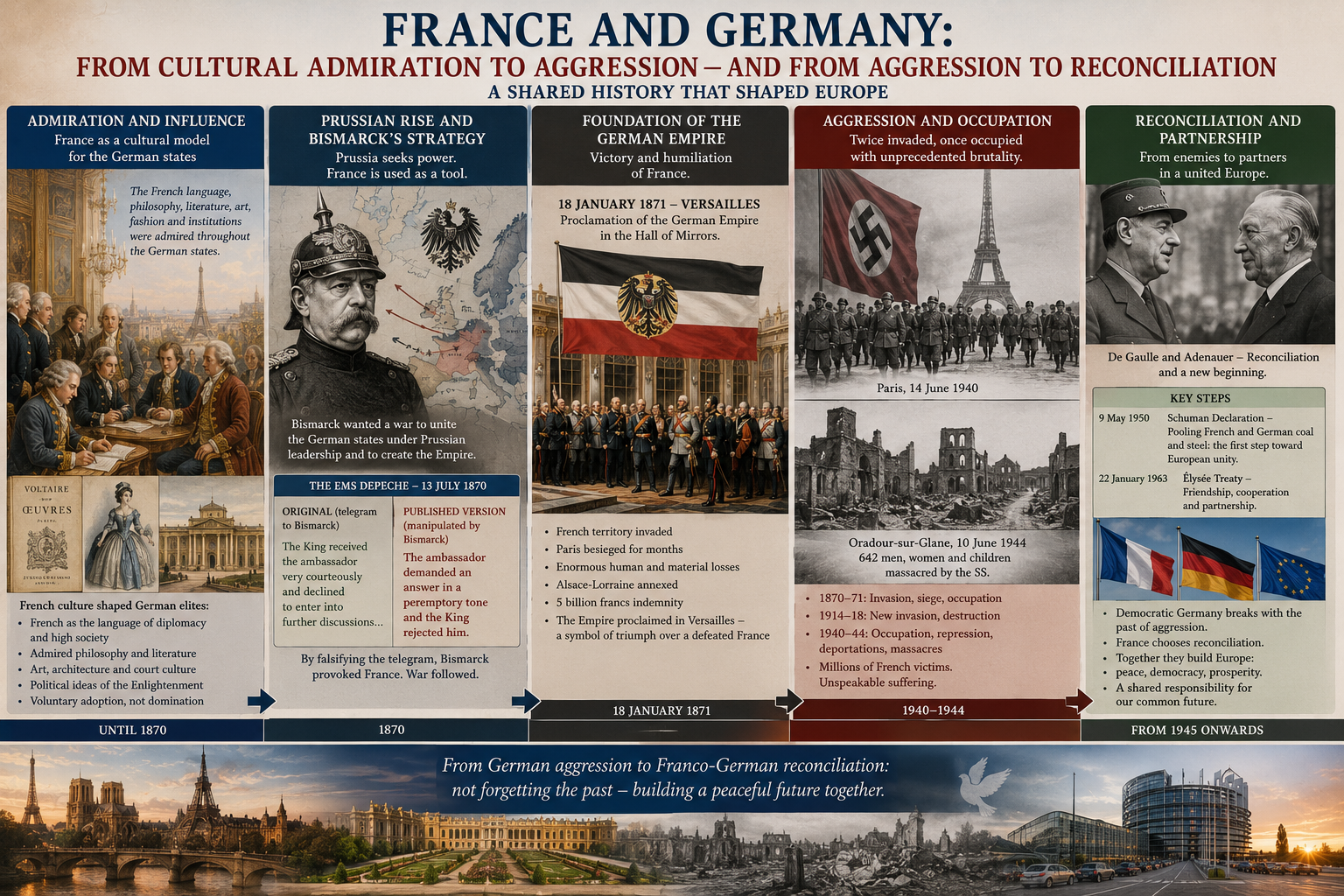
In 1914, Imperial Germany invaded France again, bringing destruction, occupation, and mass death to French soil. In 1940, National Socialist Germany invaded and occupied France, exploited its economy, repressed its population, persecuted and deported Jews, and subjected the country to the violence of a racist and expansionist dictatorship. German occupation and warfare also produced atrocities such as the massacre at Oradour-sur-Glane.
The contrast between the two countries’ historical influence upon one another could hardly have been greater. For generations, France had shaped the political, social, and intellectual life of the German states primarily through the prestige of its culture. Unified Germany, by contrast, exercised its most consequential influence upon France through war, territorial annexation, occupation, economic exploitation, persecution, and destruction.
After 1945, this destructive cycle was finally broken. Despite the repeated invasions, occupations, and immense suffering inflicted upon France by successive German regimes, France played a decisive role in the political rehabilitation, economic reintegration, and democratic stabilization of the Federal Republic of Germany. Rather than seeking the permanent isolation or weakening of its former aggressor, France helped open the way for West Germany’s return to the European community of democratic states.
Through the initiatives of Robert Schuman and, later, Charles de Gaulle, and through their cooperation with German leaders such as Konrad Adenauer, France helped transform its relationship with the former aggressor into a democratic partnership. This reconciliation became one of the principal foundations of European integration and of the new political order that emerged in Western Europe after the Second World War.
For centuries, France exerted an enormous cultural, political, and social influence over the various states of the German-speaking world. This influence developed naturally and was not the product of a deliberate project of domination. It arose from the prestige attained by the French language, literature, philosophy, arts, architecture, fashion, court culture, and political institutions. The elites of the German states voluntarily adopted many of these elements because they regarded France as one of Europe’s foremost cultural and political reference points.
Admiration for French culture did not disappear as Prussia began to emerge as a military power. At the same time, however, the Prussian monarchy increasingly sought greater power within the European system, imposed its leadership upon the other German states, and altered the balance of power on the continent.
The rivalry that subsequently developed did not originate in any French plan to subjugate the German states. It resulted from the expansion of Prussian power and the decision to build German unity under Berlin’s hegemony.
In this process, it was above all France’s position—as one of the leading political, military, and cultural powers of continental Europe—that Prussia sought to diminish. France was not responsible for the divisions among the German states, but it was deliberately transformed into the external adversary of a unification process pursued through political pressure, diplomatic provocation, and war.
Modern Franco-German history therefore followed an extraordinary trajectory: from cultural admiration to the political instrumentalization of France; from provocation to invasion; from war to occupation; and, only after the catastrophes caused by German power, to reconciliation and the joint construction of Europe.
France as a Cultural Reference Point for the German States
Before the formation of a German nation-state, the German-speaking world consisted of numerous kingdoms, principalities, duchies, free cities, and territories of varying sizes and political traditions.
France did not conduct relations with a unified “Germany,” because no such Germany yet existed. Instead, it maintained separate relations with Prussia, Bavaria, Saxony, Hanover, Württemberg, and many other states.
For centuries, merchants, artists, intellectuals, artisans, diplomats, and refugees moved between the two sides of the Rhine. French products were consumed at German courts, while manufactured goods, raw materials, and commodities from the German territories reached the French market.
French influence was especially strong among the elites. French became the language of diplomacy, aristocratic culture, and social distinction throughout much of Europe. French literature, philosophy, fashion, architecture, and customs were admired and adopted at numerous German courts.
In Prussia, Frederick II wrote a large part of his works in French, corresponded with French intellectuals, and sought to place his court within the cultural world dominated by the prestige of Paris. He presented himself as a philosopher: an edition of his writings published in 1750 was entitled Oeuvres du philosophe de Sans-Souci—“Works of the Philosopher of Sanssouci.” Before ascending the throne, he had written Anti-Machiavel, in which he sought to present a rational and moral conception of the exercise of power. His self-definition as a philosopher and his closeness to Voltaire demonstrate the extent to which the Prussian court wished to participate in the French intellectual world, even though his later policies as monarch were also marked by war, territorial expansion, and the military strengthening of Prussia.
This influence was not imposed militarily by France upon the German elites. It resulted from the attraction exerted by a culture that had attained exceptional prominence throughout Europe.
France was admired because it had produced something that the various German states recognized as valuable: an international language, a vibrant intellectual life, prestigious architecture, centralized institutions, and a culture capable of radiating far beyond its borders.
The Rise of Prussia and the Transformation of the Relationship
French cultural influence continued. The political relationship, however, changed as Prussia expanded its territory, strengthened its army, and began to contest hegemony within the German-speaking world.
Following the Napoleonic Wars, Prussia implemented administrative and military reforms and progressively consolidated its position in Central Europe.
German unification did not occur through the simple and spontaneous coming together of all German-speaking peoples. It was directed by the Prussian monarchy and advanced through wars that eliminated or subordinated the principal obstacles to Prussian leadership.
The war against Denmark in 1864 expanded Prussian influence. The war of 1866 excluded Austria from the unification process, dissolved the former German Confederation, and established Prussian hegemony over the states north of the River Main.
Prussia also annexed territories belonging to German states that had fought alongside Austria, deposed their rulers, and established the North German Confederation in 1867, with a common foreign policy, military structure, and institutions under Prussian leadership.
The principal southern states—Bavaria, Württemberg, Baden, and part of Hesse-Darmstadt—remained formally outside this structure. They retained their dynasties, institutions, and part of their sovereignty. Some of their rulers and sectors of their societies distrusted Prussian predominance and did not wish simply to submit to Berlin.
A war against an external power could alter this situation. It would make it possible to activate military alliances, place the armies of different states under Prussian command, and present political union as a necessity of national defence.
It was in this context that France became useful to Bismarck’s project.
France Used to Resolve an Internal German Problem
France bore no responsibility for the difficulties Prussia faced in incorporating the southern German states. It was not the task of the French to resolve the disagreements between Prussia, Bavaria, Württemberg, Baden, or Hesse-Darmstadt. Nor was France under any obligation to facilitate the formation of a new and powerful state on its eastern frontier.
Nevertheless, Bismarck recognized that a conflict with France could transform Germany’s internal divisions into military unity under Prussian leadership.
The mechanism was clear: a common external threat would make it possible to mobilize national sentiment, activate the existing defensive treaties, and reduce the resistance of the southern states to Berlin’s hegemony.
France was thus converted into an instrument of a project that was not its own.
It was not chosen because it was culturally hostile to the Germans. On the contrary, it was an admired, prestigious, and internationally recognized power. Precisely for that reason, its defeat would provide Prussia with a victory of immense political and symbolic value.
Defeating France would mean not merely overcoming a neighbouring army, but surpassing one of Europe’s principal sources of power, culture, and prestige.
The Crisis Provoked by Bismarck
The immediate crisis of 1870 began with the candidacy of Prince Leopold of Hohenzollern-Sigmaringen, who was connected to the Prussian dynasty, for the Spanish throne.
For France, the prospect of one Hohenzollern ruling Spain while another ruled Prussia created the danger of dynastic and strategic encirclement.
The candidacy was withdrawn following French protests. That withdrawal could have brought the crisis to an end.
In July 1870, however, the French ambassador Vincent Benedetti met King William I of Prussia at Bad Ems. Benedetti requested a guarantee from the king that the Hohenzollern candidacy for the Spanish throne would not be renewed in the future.
William I rejected the request courteously, and the episode was reported to Bismarck in a telegram whose tone was relatively moderate.
Before releasing the message to the press, Bismarck deliberately shortened and sharpened its wording. The published version removed the conciliatory context and made it appear that the French ambassador had subjected the Prussian king to humiliating pressure and that the king had offensively dismissed the French representative.
A documentary comparison between the original text and the version made public clearly reveals Bismarck’s intervention. German historical documentation itself states that he was determined to provoke a war, consulted Prussia’s military leaders, and edited the dispatch in a calculated manner intended to provoke a French reaction.
Bismarck succeeded in presenting Prussia to the German states as the victim of aggression. The edited version convinced Prussia’s allies and a significant part of German public opinion that France had presented the king with a degrading and unacceptable demand. In France, meanwhile, the message was interpreted as a deliberately offensive rejection of an attempt at a diplomatic solution.
France formally declared war on Prussia on 19 July 1870. That formal act, however, cannot be isolated from the strategy that produced it and presented as an autonomous cause of the war. The French declaration was precisely the reaction that Bismarck had sought to provoke.
Reducing the entire causality of the conflict to the statement that “France declared war” means reproducing the political appearance constructed by Bismarck himself: that of a Prussia taken by surprise by an act of aggression and compelled merely to defend itself. In reality, Bismarck manipulated a diplomatic crisis in order to induce France to react, present Prussia as the victim, and unite the German states under his leadership. German documentation acknowledges that this strategy contributed substantially to the participation of all the German states in the war and, following victory, to their entry into the new Empire.
From Military Alliance to Political Submission
Following the French declaration, the military alliances between the North German Confederation and the southern states were activated. Bavaria, Württemberg, Baden, and Hesse-Darmstadt entered the war on Prussia’s side. Their armies began fighting within a military structure dominated by the Prussian command. The war produced the political situation Bismarck desired: states that had not yet agreed to join a nation-state under Berlin’s hegemony now fought together against an external enemy.
France was therefore transformed into a common threat capable of reducing the differences among the German states themselves.
After the first military victories, Bismarck began negotiations intended to transform the wartime alliance into a permanent political union. Baden and Hesse moved more rapidly towards the North German Confederation; Bavaria and Württemberg negotiated their accession while preserving special rights, including powers of their own in certain administrative and military fields.
The agreements concluded in November 1870 prepared the way for the new state structure to enter into force on 1 January 1871. The imperial proclamation of 18 January, however, became the principal symbol of the foundation of the German Empire.
France was thus used to resolve an internal problem within the German unification process. The formal French declaration of war, deliberately provoked by Bismarck, allowed Prussia to present itself as the victim and to transform submission to its leadership into a supposedly necessary union in the face of an external threat.
A German War Fought on French Territory
The war did not remain confined to the border, nor was it fought primarily on Prussian territory. The armies of the German states advanced into France, successively defeated the French forces, captured Napoleon III at Sedan, and penetrated deeply into the country. German troops laid siege to Paris from September 1870. The population endured hunger, fuel shortages, cold, disease, and bombardment. The French capital remained under siege for approximately four months and capitulated on 28 January 1871.
The war caused immense human losses among French soldiers and civilians. It destroyed communities, interrupted economic activity, subjected populations to occupation, and transferred to France the human and material costs of a project conceived to strengthen Prussia and complete German unification.
While the French suffered invasion and Paris remained under siege, the German rulers negotiated and celebrated the establishment of their new state.
The German Empire Proclaimed at Versailles
On 18 January 1871, William I of Prussia was proclaimed German Emperor in the Hall of Mirrors at the Palace of Versailles.
The Empire had already possessed a constitutional foundation since 1 January, but the proclamation at Versailles became, in German memory, the true symbolic act of national foundation.
The choice of Versailles also had practical reasons: the palace accommodated the German headquarters, provided the necessary infrastructure, and was sufficiently close to Paris to direct the siege.
This does not eliminate its political significance. Versailles was one of the most important sites of French national memory, associated with the reign of Louis XIV, monarchical power, and France’s international prestige. Proclaiming the new Empire in that space, on occupied French territory and while Paris remained under siege, transformed the foundation of Germany into a demonstration of triumph over a defeated France.
The German Historical Museum itself acknowledges that Versailles was a place of French national identification and that, for the French, the imperial proclamation held there—together with the loss of Alsace-Lorraine—represented shame and humiliation.
France was compelled to surrender Alsace and part of Lorraine and to pay an indemnity of five billion francs.
The creation of the new German state was therefore accompanied by the invasion of France, the siege of its capital, immense human losses, the annexation of its territory, the imposition of an extraordinary indemnity, and the use of one of its greatest historical symbols as the stage for the elevation of the German Empire.
Germany Becomes a Great Power over a Defeated France
Before 1871, France faced a number of separate German states.
After the war, it confronted a unified German Empire that was demographically larger, militarily powerful, economically dynamic, and situated directly on its eastern frontier.
The new Empire was already superior to France and Austria-Hungary in population, territorial extent, economic capacity, and military strength.
The French defeat was not merely an event that happened alongside the foundation of Germany. It formed part of the political, military, and symbolic mechanism through which Prussia transformed its hegemony over the German states into a new imperial state.
Victory over one of Europe’s leading powers provided Prussia with:
- the national mobilization required to unite the German states;
- the military prestige necessary to impose its leadership;
- the political opportunity to negotiate the accession of the southern states;
- a transformation of the continental balance of power;
- and a founding myth capable of presenting German unity as the product of strength, war, and triumph.
Germany’s ascent and France’s suffering were not independent developments.
The new Empire elevated itself politically through the concrete defeat of France. Its foundation was completed while France was under invasion, Paris was besieged, and the French population was subjected to the human consequences of war.
This was not merely a matter of defeating a neighbour. It involved using the defeat of an admired and prestigious power as a stepping stone towards Germany’s own elevation.
The Birth of an Imperial Deutschtum
The concept of Deutschtum existed before 1871 and could refer to language, culture, customs, belonging, and an awareness of Germanness.
The foundation of the Empire, however, profoundly altered the political possibilities of the concept.
Germanness was no longer associated solely with dispersed cultural communities or with the various German states. It could now be linked to a unified nation-state, an emperor, a common army, a military victory, and the status of a great power.
It is in this sense that the war of 1870–1871 contributed to the formation of a Deutschtum of imperial greatness.
This conclusion does not derive from any supposedly immutable “German soul.” It derives from the manner in which historical events were transformed into political and national memory.
For a large part of German society, the proclamation at Versailles became the principal symbol of the foundation of the Reich. Military victory was celebrated as the fulfilment of national aspirations, and unification appeared as the culmination of German history. The German Historical Museum records that the majority of the German population viewed the imperial proclamation as the realization of national unity and as one of the great moments of its history.
The memory of this victory therefore helped consolidate a representation of Germanness that united:
- national belonging;
- Prussian hegemony;
- state power;
- military organization;
- victory over a great power;
- and Germany’s elevation to a dominant position in Europe.
The defeat of France became a constitutive part of this narrative of ascent.
The new imperial Deutschtum drew sustenance not merely from the fact that Germany had demonstrated its ability to win a war. It drew sustenance from having defeated one of Europe’s most admired, prestigious, and influential powers and from having used that defeat to assert its own greatness before the world.
France, which for centuries had radiated culture and prestige naturally, was transformed by Prussian policy into the object of a victory intended to confer greatness upon the new German state.
Germany’s imperial elevation was therefore symbolically constructed upon a France that had been invaded, defeated, territorially mutilated, and humiliated in one of its most venerated historical settings.
The New Invasion of 1914
In 1914, France was once again invaded by German forces. The First World War resulted from a broad European crisis involving military alliances, nationalisms, rivalries among the great powers, and the conflict that erupted in the Balkans. This broader context does not diminish the responsibility of the leadership of the German Empire for the decision to bring war once again onto French territory.
German military strategy envisaged the rapid defeat of France before German forces were concentrated against Russia. To implement this plan, the German army invaded Belgium, violated its neutrality, and advanced through northern France towards Paris. The invasions of Belgium and France were not accidental events. They formed part of the German Empire’s military planning.
The advance was halted at the Battle of the Marne, but large parts of north-eastern France remained occupied or were transformed into battlefields for years. French cities, towns, factories, roads, agricultural land, and infrastructure were destroyed or severely damaged.
Once again, France was compelled to endure on its own territory the effects of a strategy conceived by the political and military leadership of the German Empire and executed by its armies.
French Insecurity after 1918
The Allied victory did not eliminate French fears of another invasion. In less than fifty years, France had endured two wars conducted by German forces on its territory, occupations, material destruction, and immense human losses. Its concern with reparations, territorial guarantees, and limitations on German military capacity did not arise from an irrational hostility towards Germans. It resulted from the concrete experience of repeated invasions.
During the Weimar Republic, important attempts were made at rapprochement and cooperation, particularly in the second half of the 1920s. These initiatives, however, failed to create a sufficiently solid reconciliation to survive the economic crisis, the destabilization of German democracy, and the rise of National Socialism.
The Invasion and Occupation of 1940
On 10 May 1940, Germany invaded France once again. This time, the aggressor state was ruled by a racist, expansionist, and genocidal dictatorship committed to reorganizing Europe through war, exploitation, and the persecution of entire peoples. German forces crossed the Netherlands, Belgium, and the Ardennes, broke through the Allied lines, and advanced rapidly across French territory. Paris was occupied in June 1940.
The armistice of 22 June divided France into different zones. A large part of the country came under direct German military occupation; in November 1942, German forces also occupied the region previously administered by the Vichy regime without a permanent Reich military presence. The occupation entailed the loss of sovereignty, economic exploitation, the requisitioning of food and raw materials, forced labour, arrests, torture, executions, and political persecution. German military, diplomatic, and police authorities participated directly in the repression. They took part in the persecution, arrest, and deportation of Jews and other groups subjected to National Socialist violence.
Paris remained under German control until August 1944. The third major invasion of France by German forces since 1870 assumed an even more destructive and criminal dimension than the preceding invasions.
In the three conflicts that most profoundly shaped France’s destiny between 1870 and 1945, German forces crossed its borders and carried war onto French territory. From the formation of the German state onwards, France repeatedly became the victim of German projects of power that employed provocation, invasion, war, and occupation as political instruments.
The Historical Break after 1945
Following the defeat of National Socialist Germany, the relationship between France and Germany had to be reconstructed upon entirely new foundations. France had endured three invasions by German forces since 1870, successive occupations of parts of its territory, and, between 1940 and 1944, the subjection of Paris and much of the country to National Socialist rule.
The Federal Republic of Germany, established in 1949, had to demonstrate that its future would no longer be built through military force, territorial expansion, and the defeat of its neighbours. The solution was not to erase the past, but to create institutions capable of preventing its repetition.
On 9 May 1950, the French foreign minister Robert Schuman proposed placing French and German coal and steel production under a common authority. Coal and steel were fundamental resources for industry and military power. Their joint administration was intended to make another war between France and Germany not merely unthinkable, but materially impossible. The European Coal and Steel Community became one of the institutional origins of today’s European Union.
Reconciliation Does Not Mean Forgetting
On 22 January 1963, Charles de Gaulle and Konrad Adenauer signed the Élysée Treaty.
Franco-German cooperation came to encompass foreign policy, defence, education, youth, economics, and culture.
This reconciliation possesses such immense historical value precisely because it did not follow a series of minor diplomatic disagreements.
It followed three invasions of France by German forces, wars, occupations, destruction, and human losses caused by the power politics of Prussia, the German Empire, and National Socialist Germany.
Reconciliation did not retroactively absolve Bismarck, the German Empire, or the National Socialist regime.
Nor did it transform acts of aggression into neutral conflicts or require an artificial distribution of responsibility.
It meant that democratic Germany would no longer construct its greatness through the defeat of France and that France accepted the task of building, together with the new Germany, an order founded upon democracy, cooperation, and peace.
From Germany as Aggressor to Germany as Partner
The Federal Republic of Germany represented an institutional break with earlier projects of greatness through force.
After 1945, West Germany linked its reconstruction to parliamentary democracy, European integration, and an understanding with France.
The former relationship based upon competition for continental predominance was gradually replaced by partnership.
Paris and Bonn, and later Paris and Berlin, became central poles of European integration.
This partnership did not eliminate political, economic, and strategic differences. It did, however, create institutions capable of addressing those differences through negotiation and compromise rather than war.
The Modern Destinies of France and Germany
For centuries, the United Kingdom was one of France’s principal maritime, colonial, and imperial rivals. Spain, Austria, Russia, and other powers also played important roles in French history. For France’s continental destiny since the nineteenth century, however, no relationship has been as decisive as its relationship with Germany.
France was used by Bismarck as an external adversary to complete German unification.
It was invaded and profoundly devastated by the German Empire during the First World War.
It was defeated, occupied, exploited, and subjected to repression by National Socialist Germany during the Second World War.
And it was together with the Federal Republic of Germany that France constructed, after 1945, the political core of European integration.
Germany therefore successively represented for France a realm of cultural admiration, a competing power, a military aggressor, an occupying power, and finally a democratic partner. Despite all the suffering endured by France and the French people, and despite everything that previous German regimes had done to France, France helped Germany regain a place in Europe after 1945.
A Destiny Transformed
Franco-German history demonstrates that reconciliation does not require the falsification of the past.
There is no need to distribute responsibility artificially in order to make friendship between peoples possible.
On the contrary, genuine reconciliation can exist only when acts of aggression, their victims, and historical responsibilities are presented clearly.
France did not create the war of 1870 in order to help the Germans form their state. Bismarck deliberately manipulated a diplomatic crisis, provoked the French reaction, and used France as an instrument of his unification project.
France did not carry the war into Germany in 1914. It was invaded by the army of the German Empire.
France did not occupy Berlin in 1940. Paris was occupied by the forces of National Socialist Germany.
After 1945, the French and Germans demonstrated that history did not have to remain imprisoned within this logic.
Despite the invasions and occupations it had suffered, France agreed to build a political community with a democratic Germany.
The Federal Republic of Germany broke institutionally with the pursuit of greatness through war and linked its future to an understanding with the country that previous German regimes had repeatedly invaded.
The true greatness of Franco-German reconciliation lies in this: it was not born from the absence of historical responsibility, but from the recognition that Germany must never again build its power upon the defeat of France.
For decades, Germany shaped part of France’s destiny through provocation, invasion, and occupation.
After 1945, France and Germany decided to shape their future together through democracy, peace, and European integration.
After Three Occupations
Germany therefore successively represented for France an object of cultural admiration, a competing power, a military aggressor, an occupying power, and finally a democratic partner.
The transformation of this relationship acquires even greater significance when one considers the suffering imposed upon France and the French people. After being repeatedly invaded, partially destroyed, occupied, and subjected to German exploitation, France did not respond by seeking to keep defeated Germany permanently isolated and politically powerless.
On the contrary, France played a decisive role in the reconstruction and reintegration of West Germany into the community of European nations. Despite everything that previous German regimes had done against its territory, sovereignty, and population, France agreed to support the formation of a democratic, economically recovered Germany that would once again be recognized as a political partner.
The French proposal to place coal and steel under a common authority opened the way for the Federal Republic of Germany to participate, under conditions of progressively increasing equality, in the construction of Europe. France therefore helped not only to prevent another war, but also to restore to West Germany international legitimacy, political confidence, and a stable place within democratic Europe.
This gesture did not erase German responsibility or diminish French suffering. On the contrary, its historical greatness derives precisely from the fact that France extended its hand to the country whose previous regimes had repeatedly invaded its territory, occupied its capital, and caused immense human and material losses.
After having been used as a stepping stone for Germany’s imperial ascent and transformed into the target of successive acts of aggression, France helped create the conditions in which a new Germany could exist—not as an aggressive power, but as a democratic state, a European partner, and a participant in an order founded upon peace.
Excursus: Did Germany compensate France?
France did receive reparations from Germany after the First World War and obtained material benefits from Germany after the Second. Yet neither settlement reproduced the extraordinary form of the indemnity imposed upon France in 1871. Under the Treaty of Frankfurt, defeated France alone was required to pay the newly founded German Empire five billion francs within a short period, while German troops continued to occupy parts of French territory as security for payment. France raised the entire sum and completed payment ahead of schedule in 1873.
After 1918, by contrast, German reparations were established through a multilateral settlement among the Allied powers. France was allocated a large share—ultimately 52 per cent—because northern and northeastern France had suffered immense destruction during the war. Germany made payments in money and in kind, including coal, industrial goods and other assets. The system was repeatedly revised under the Dawes and Young Plans, however, and Germany did not pay the full amount originally demanded. France therefore received substantial reparations, but not one self-contained indemnity paid directly and completely to France on the model of 1871.
After 1945, the difference was still greater. France received reparations and German assets through the Allied occupation framework, including industrial dismantling, deliveries from current production, restitution and control over resources in its occupation zone. Later, the Federal Republic also provided compensation and restitution to individual victims of National Socialist persecution, including beneficiaries in France. These measures were dispersed across Allied arrangements, German legislation and bilateral agreements; they were not a single payment by Germany to the French state compensating France comprehensively for invasion, occupation, economic exploitation, destruction and loss of life. German post-war compensation policy was directed primarily toward particular categories of victims and specific forms of persecution, rather than toward calculating and discharging the total national damage suffered by France.
It is therefore accurate to say that France received German reparations and compensation, especially after the First World War, but never again received a single, rapidly payable national indemnity that was paid in full and was comparable in structure and scale to the five-billion-franc burden imposed upon France in 1871.
Selected References
Marks, Sally. The Illusion of Peace: International Relations in Europe, 1918–1933. 2nd ed. Basingstoke: Palgrave Macmillan, 2003.
Goschler, Constantin. Compensation in Practice: The Foundation “Remembrance, Responsibility and Future” and the Legacy of Forced Labour during the Third Reich. New York: Berghahn Books, 2017.
MacMillan, Margaret. Paris 1919: Six Months That Changed the World. New York: Random House, 2002.
Selected Bibliography
Wawro, Geoffrey. The Franco-Prussian War: The German Conquest of France in 1870–1871. Cambridge: Cambridge University Press, 2003.
Chickering, Roger. We Men Who Feel Most German: A Cultural Study of the Pan-German League, 1886–1914.Boston: Allen & Unwin, 1984.
Chrastil, Rachel. Bismarck’s War: The Franco-Prussian War and the Making of Modern Europe. New York: Basic Books, 2023.
Jackson, Julian. France: The Dark Years, 1940–1944. Oxford: Oxford University Press, 2001.
Laub, Thomas J. After the Fall: German Policy in Occupied France, 1940–1944. Oxford: Oxford University Press, 2010.
Leonhard, Jörn. Bellizismus und Nation: Kriegsdeutung und Nationsbestimmung in Europa und den Vereinigten Staaten, 1750–1914. Munich: Oldenbourg, 2008.
Mitchell, Allan. Bismarck and the French Nation, 1848–1890. New York: Pegasus, 1971.
Pflanze, Otto. Bismarck and the Development of Germany. 3 vols. Princeton: Princeton University Press, 1990.
Roth, François. La Guerre de 1870. Paris: Fayard, 1990.
Schulze, Hagen. The Course of German Nationalism: From Frederick the Great to Bismarck, 1763–1867.Cambridge: Cambridge University Press, 1991.
Steefel, Lawrence D. Bismarck, the Hohenzollern Candidacy, and the Origins of the Franco-German War of 1870.Cambridge, MA: Harvard University Press, 1962.
Vogel, Jakob. Nationen im Gleichschritt: Der Kult der „Nation in Waffen“ in Deutschland und Frankreich, 1871–1914. Göttingen: Vandenhoeck & Ruprecht, 1997.
Luttwak, Edward. “Franco-German Reconciliation: The Overlooked Role of the Moral Re-Armament Movement.” In Religion, the Missing Dimension of Statecraft, edited by Douglas Johnston and Cynthia Sampson, 37–63. Oxford: Oxford University Press, 1994.