
The ideology of Deutschtum encouraged German-speaking populations outside Germany to regard themselves as enduring members of a transnational German people. According to this conception, Germanness did not end at the borders of the German state. Nor was it dissolved by migration, foreign citizenship or birth abroad. Language, descent, education, religion, historical memory and cultural inheritance were presented as foundations of a permanent national identity that transcended states, borders and generations.¹
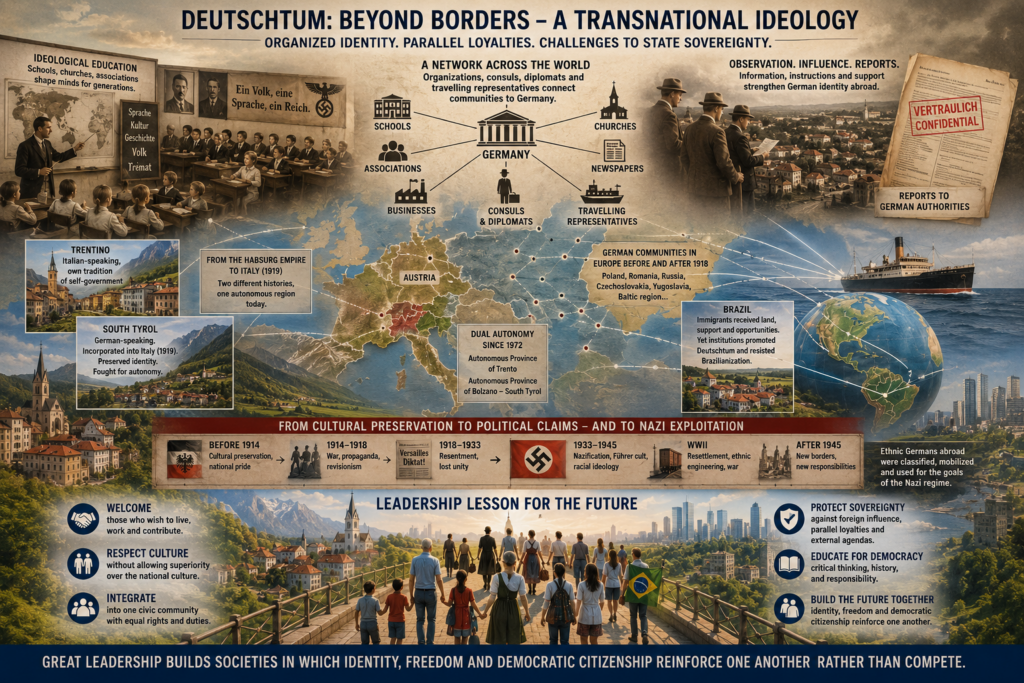
This was not merely the private preservation of family traditions. Through German-language schools, churches, associations, newspapers, publishing houses, youth organisations, commercial networks and cultural institutions, communities abroad could be maintained as distinct German collective bodies within other sovereign countries.
The objective of organised Deutschtum was therefore not simply to preserve memories of Germany.
It was to preserve Germans and their descendants as Germans.
Such structures appeared under different historical circumstances. In immigrant societies such as Brazil, German settlers and their descendants were organised through schools, churches, associations, newspapers and commercial networks that transmitted German language, national memory, political loyalties and ideological conceptions across generations. These local institutions were also connected to German nationalist organisations, diplomatic representatives, consular offices and government departments.
In Central and Eastern Europe, German-speaking populations were increasingly represented as parts of a single transnational German nation, irrespective of the states in which they lived. In South Tyrol, a territorially concentrated German-speaking population maintained a separate national identity after incorporation into Italy.
These cases were not identical. Their common element was the assertion that German national belonging could survive migration, foreign citizenship and changes of sovereignty.
Where such identity became territorially concentrated and politically organised, cultural separation could be converted into demands for special status, institutional autonomy, foreign protection, border revision, territorial separation or incorporation into Germany or Austria.
National Socialism did not create this transnational German world. It inherited its language, organisations, institutions, emotional loyalties and ideological traditions. It then racialised, centralised and militarised them, transforming German communities abroad into potential instruments of political intervention, population transfer, racial classification and territorial expansion.²
From Cultural Memory to a Permanent German National Community
The preservation of language and family traditions is not automatically a political act. Families may transmit customs, religious practices and memories without rejecting the society in which they live.
Organised Deutschtum, however, went beyond cultural memory. It transformed Germanness into a permanent collective affiliation.
A person born in Brazil, Romania, Russia, Poland or another country could be regarded not primarily as a citizen of that country with German ancestry, but as an Auslandsdeutscher or as a member of a wider German Volk. Citizenship connected the individual legally to one state, while Deutschtum connected the same individual culturally, emotionally and nationally to a German people whose existence was declared independent of political borders.
Under this principle, generations could be born abroad without ceasing to be German. Citizenship could change without altering national belonging. Borders could be moved without dissolving the imagined unity of the German people.
The result was an alternative conception of political community.
The sovereign state claimed the individual as a citizen.
Organised Deutschtum claimed that individual as a German.
This conflict was not merely theoretical. It was reproduced through institutions capable of shaping identity from childhood onward.
German schools transmitted language, literature, history, religion, songs, symbols, political loyalties and national memory. Churches often functioned as centres of German-language social life. Newspapers connected settlements abroad with events, debates and ideological developments in Germany. Associations organised education, sport, singing, festivals, theatre, youth activities and commemorations within a German social environment.
Together, these institutions could create a parallel national space within another country.
German Schools and the Reproduction of Deutschtum
Schools occupied a central place in organised Deutschtum because the survival of a distinct German national community depended on the education of children born abroad.
Without institutional reinforcement, an immigrant language normally weakens over successive generations. Children learn the language of the country in which they live, attend its schools, participate in its public life and increasingly identify with its society.
German nationalist organisations frequently regarded this development not as normal integration but as the disappearance of Germanness.
The German school therefore became an instrument for resisting assimilation. Its purpose was to ensure that children born outside Germany continued to grow up within a German linguistic, cultural, emotional and ideological world.
Instruction was not restricted to grammar and vocabulary. German literature, history, religion, poetry, music, patriotic songs, national symbols and carefully selected interpretations of the past were used to shape the children’s understanding of who they were, where they belonged and to whom they owed loyalty.
The classroom, the school festival and the commemorative ceremony did not merely preserve language and cultural memory. They also transmitted political values, national hierarchies and particular conceptions of German identity.
The ideological content changed with the political development of Germany.
During the German Empire, education could cultivate reverence for the Kaiser, loyalty to the Reich, admiration for German military power and belief in Germany’s cultural mission or superiority. Portraits of the Kaiser, imperial anniversaries, flags, patriotic ceremonies and narratives of German national achievement could teach children living abroad that they belonged emotionally and nationally to the German Empire, even when they were citizens of another country.
The Kaiser could therefore be imagined not only as the ruler of the German citizens of the Reich, but also as a symbolic sovereign of Germans throughout the world.
The collapse of the monarchy in 1918 did not automatically dissolve these emotional and ideological attachments. Imperial nostalgia, nationalist resentment, opposition to the Treaty of Versailles and belief in a greater German national community continued within parts of the institutional world of Auslandsdeutschtum.
After 1918, the educational environment could transmit the idea that Germany had been humiliated, unjustly weakened and territorially mutilated. German minorities and descendants abroad could be represented as fragments of a divided nation whose unity remained historically and morally valid despite existing borders.
After Hitler’s rise to power in 1933, ideological mobilisation became substantially more radical.
Admiration for the Kaiser was increasingly overshadowed by the cult of Hitler, the swastika, the Führer principle, racial nationalism, antisemitism and the ideal of a worldwide German Volksgemeinschaft.
Hitler was not presented merely as the head of the German government. He was portrayed as the leader and redeemer of the entire German people, including those living beyond the borders of the Reich.
Children and young people could therefore be taught not merely to value German culture but to admire Nazi Germany, identify themselves as members of a racial German people and place that affiliation above the citizenship and sovereignty of the country in which they lived.
Education thus transmitted successive forms of German nationalism: imperial loyalty and reverence for the Kaiser, post-imperial revisionism and, after 1933, the political and racial ideology of National Socialism.
Research on German schools in Latin America shows that they functioned as community centres and as nodes within international networks connecting local settlements to institutions, educational models, teachers, teaching materials and cultural-political objectives originating in Germany.³
The Allgemeiner Deutscher Schulverein, founded in 1881, was later renamed the Verein für das Deutschtum im Auslandand subsequently the Volksbund für das Deutschtum im Ausland. The successive names expressed the organisation’s central objective: maintaining and strengthening Germanness beyond the borders of the German state.⁴
In Brazil, representatives of the VDA visited German schools, examined their educational work and supported them with books, teaching materials, institutional contacts and teachers from Germany. At the German school in Pelotas, VDA representatives assessed an educational project explicitly connected to the preservation of Deutschtum and to the transmission of German nationalism.⁵
Such a school was not simply a Brazilian institution in which children learned a foreign language.
It could become an institution through which a population living in Brazil continued to reproduce itself culturally, politically and ideologically as German.
Brazil: Immigration, Material Assistance and Resistance to Brazilianisation
The contradiction inherent in organised Deutschtum became especially visible in Brazil.
Many German emigrants left Europe because they lacked land, property or adequate economic opportunities, or because they faced poverty, unemployment, population pressure, political repression or religious conflict.
Brazil did not merely permit their arrival.
Through imperial, provincial and private colonisation programmes, many immigrant families were transported to settlement regions and given access to land on conditions that enabled them to establish an existence that had often been unattainable in Europe.
The specific assistance varied according to the period, province, settlement and colonisation arrangement. Depending on these circumstances, settlers could receive or obtain financial advances, temporary food supplies, seeds, agricultural implements, livestock, building materials, transport assistance or other support intended to make cultivation and permanent settlement possible.
Brazil therefore provided more than territorial refuge.
It offered land, material assistance, economic opportunity and the possibility of social advancement. Immigrants cleared and cultivated Brazilian territory, established farms, workshops and businesses, and constructed schools, churches and settlements within the legal, political and economic order of Brazil.
Their children and grandchildren were born on Brazilian soil, possessed Brazilian citizenship and inherited the opportunities created by their families’ settlement in the country.
Nevertheless, influential German organisations continued to regard them as Germans abroad.
German schools, Protestant and Catholic churches, associations, newspapers, teachers’ organisations and commercial networks did not operate in isolation. They formed part of a broader transnational structure that also included German nationalist organisations, economic interests, the German Foreign Office, the German diplomatic mission in Brazil, professional and honorary consulates and representatives travelling from Germany.⁶
Through this network, the German-settled regions of southern Brazil were visited, observed, evaluated and connected to institutions in Germany.
German diplomats, consuls and other representatives travelled through these regions and maintained contact with schools, churches, associations, businessmen, newspaper editors and community leaders. They gathered information about the geographical distribution, number, economic strength, political attitudes, linguistic development and degree of assimilation of German citizens and German-descended populations. Their observations could be communicated to German authorities and organisations through consular correspondence, travel reports and memoranda.⁷
These journeys were not merely expressions of ordinary consular concern for German citizens.
German-speaking settlement regions were evaluated within broader discussions about German trade, cultural influence, political prestige and the preservation of Deutschtum. Emigrants and their descendants could consequently be regarded as potential carriers of German economic, cultural and political influence within Brazil.⁸
Some journeys, contacts and reports were conducted confidentially. Where the archival record establishes deliberate concealment, confidential instructions or an intention to prevent Brazilian authorities or the wider public from learning about the activity, these episodes must be described explicitly as secret journeys or confidential missions.⁹
Their purposes could include inspecting German institutions, evaluating the condition of Deutschtum, strengthening organisational connections, transmitting instructions, coordinating material assistance and determining the degree to which German communities and their descendants remained available for German cultural, economic or political objectives.
The precise nature of each journey must be established from its documentary record. Not every diplomatic or consular visit was secret, and ordinary consular activity must not automatically be equated with clandestine intervention. At the same time, activities documented as confidential or deliberately concealed must not be softened into neutral descriptions of cultural contact.
German-language schools were therefore only one part of a wider system.
Through educational institutions, German literature, history, religion, songs, symbols and national narratives were transmitted to children. Through nationalist associations, diplomats, consuls, travelling representatives, commercial interests and government departments, local institutions could be linked to structures operating from Germany.
Together, these networks helped reproduce German language, collective identity, loyalty to Germany and political and ideological attachment across generations.
Studies of ethnic German schools in southern Brazil show that German language, German culture and German national consciousness occupied central positions in their educational programmes.¹⁰ Yet the broader objective extended beyond education. German-speaking settlement regions could be regarded as organised parts of Auslandsdeutschtum and as potential instruments of Germany’s cultural, commercial and political ambitions in Brazil.
The adoption of Portuguese and Brazilian identity could be condemned as Verbrasilianerung—Brazilianisation. The term could be employed negatively, as though integration into Brazil represented deterioration, cultural loss or national betrayal.¹¹
This reveals the central conflict.
Brazil was expected to receive immigrants, make territory available, provide material assistance and economic opportunities, recognise their descendants as citizens and permit the construction of their communities.
Organised Deutschtum, however, sought to ensure that these descendants remained members of a German national community.
The country of immigration became the physical, legal and economic space in which the community lived. Germany remained the imagined national centre toward which the community was culturally, emotionally and sometimes politically oriented.
This went beyond gratitude toward ancestral origins. It challenged the principle that immigration should lead to full political and national belonging in the receiving country.
A person could be born in Brazil, possess Brazilian citizenship, receive protection from Brazilian institutions and participate in the Brazilian economy while being educated to regard German national belonging as deeper, older and more permanent than Brazilian identity.
The issue was therefore not that German immigrants spoke German at home.
Nor was the issue simply that they maintained churches, schools, songs, recipes or family traditions.
The political problem arose when institutions organised their Brazilian-born descendants as a continuing segment of a foreign national body, taught them to resist Brazilianisation and cultivated loyalties or ideological attachments directed toward Germany.
A Transnational Nation Beyond Germany’s Borders
The ideology of Deutschtum connected German-speaking communities living under different governments and on different continents.
German populations in Brazil, Argentina, Chile, Paraguay, Romania, Russia, Poland, the Baltic region, Czechoslovakia, Yugoslavia and elsewhere did not share the same history. Nevertheless, German nationalist organisations increasingly represented them as members of one worldwide German people.
This conception created an ethnic map that did not correspond to the political map of sovereign states.
The political consequences varied according to local conditions.
In overseas immigrant societies, the principal objective was often to preserve separate schools, churches, associations and cultural networks and to resist linguistic and national assimilation.
In regions where German-speaking populations were territorially concentrated, cultural difference could be transformed into claims for language rights, separate institutions, political autonomy, border revision, secession or incorporation into Germany or Austria.
The German community was therefore presented not merely as a group of citizens exercising cultural freedom, but as a segment of a wider German nation situated within another state.
This was the political significance of Deutschtum: Germans and German descendants abroad remained nationally and politically relevant to Germany because they were declared members of the German people regardless of citizenship.
Trentino and South Tyrol: One Autonomous Region, Two Different Historical Developments
Any examination of autonomy in this Alpine territory must address the entire Autonomous Region of Trentino–Alto Adige/Südtirol, not South Tyrol alone.
The region consists of two autonomous provinces:
the predominantly Italian-speaking Autonomous Province of Trento;
and the multilingual Autonomous Province of Bolzano–South Tyrol, where the German-speaking population forms the majority and Italian- and Ladin-speaking communities are also officially recognised.
Both territories belonged to the historical County of Tyrol, but they developed distinct linguistic, political and autonomist traditions.
Trentino constituted the predominantly Italian-speaking southern part of historical Tyrol. Its inhabitants were not German settlers in Italy. They were an established Italian-speaking population living within the Habsburg political order and within the wider institutional framework of Tyrol.
Trentino’s demands for self-government did not begin after its incorporation into Italy. They possessed deeper roots in local forms of communal organisation and became politically explicit under Habsburg rule.
During the nineteenth century, Trentino representatives demanded greater political and administrative autonomy for the Italian-speaking territory. They opposed subordination to a Tyrolean structure dominated by German-speaking political institutions and majorities.¹²
Trentino therefore demonstrates an essential fact: autonomy in this region was not exclusively a German-speaking demand.
The Italian-speaking population of Trentino had its own tradition of self-government and its own conflict with German-Tyrolean political predominance.
South Tyrol followed a different historical course.
Its predominantly German-speaking population did not migrate into Italy as an immigrant community. It became part of Italy because the border was moved after the First World War. The Treaty of Saint-Germain placed the territory south of the Brenner Pass under Italian sovereignty.
The German-speaking population therefore became an Italian minority through territorial transfer rather than immigration.
Under Fascism, the Italian state pursued forced Italianisation. German-language schools were suppressed, German public culture was restricted, German place names were replaced by Italian forms, German-language administration was dismantled and the demographic and cultural character of the province was deliberately altered.
These measures violated linguistic and cultural rights. They also reinforced the German-speaking population’s rejection of Italian national integration.
South Tyrol demonstrates the durability of organised German identity across a change of sovereignty. Italian citizenship and Italian control of the territory did not dissolve the German-speaking population’s conception of itself as a distinct national community. Language, family, schools, churches, associations, traditions and collective memory sustained that identity.
The relevant historical question is therefore not whether Trentino or South Tyrol was “originally German” or “originally Italian.” Such formulas reduce a complex history to competing territorial myths.
The more important question is how linguistic identity became institutionally and politically organised within historical Tyrol and later within Italy.
In Trentino, an Italian-speaking population sought autonomy from German-Tyrolean predominance.
In South Tyrol, a German-speaking population incorporated into Italy preserved its separate national identity and eventually transformed it into territorial political autonomy.
These two histories converged after the Second World War.
The First Autonomy Statute and the Conflict Between Region and Provinces
The Gruber–De Gasperi Agreement of 1946 between Austria and Italy established the international basis for protecting the German-speaking population and for developing an autonomous order.
The First Autonomy Statute of 1948 created the Autonomous Region of Trentino–Alto Adige. Substantial legislative and administrative authority, however, was initially concentrated at regional level rather than within the two provinces.
This arrangement had different consequences for Trentino and South Tyrol.
Because the Italian-speaking population of Trentino, together with the Italian-speaking population of the Province of Bolzano, formed a majority within the region, German-speaking South Tyroleans argued that regional autonomy did not provide them with effective political control over their own territory.
Their objective was therefore not merely cultural protection within a bilingual region.
They demanded the transfer of political and administrative authority from the region to the Province of Bolzano itself.
The conflict produced prolonged negotiations, demonstrations, international intervention and acts of political violence.
The resulting South Tyrol Package, approved in 1969, provided the basis for the Second Autonomy Statute, which entered into force in 1972.
The Second Autonomy Statute: Autonomy for Trento and Bolzano
The Second Autonomy Statute did not grant autonomy to South Tyrol alone.
It transferred extensive legislative and administrative powers from the common region to both autonomous provinces: Trento and Bolzano–South Tyrol. The Autonomous Region of Trentino–Alto Adige/Südtirol consequently lost many of its earlier functions, while the two provinces became the principal institutions through which autonomy was exercised.¹³
This distinction is fundamental.
The present system consists neither of an ordinary Province of Trento beside an autonomous South Tyrol nor of a single regional autonomy governed primarily from Trento.
It is a dual provincial structure.
The Autonomous Province of Trento possesses extensive powers grounded in Trentino’s own historical traditions and political demands for self-government.
The Autonomous Province of Bolzano–South Tyrol possesses extensive powers shaped by the protection and political organisation of its German-, Italian- and Ladin-speaking populations.
The common region continues to exist, but its authority is more limited than under the First Autonomy Statute.
The political autonomy of Trentino therefore cannot be treated as a secondary consequence of the South Tyrol conflict. Trentino possessed its own autonomist history, institutions and claim to self-government.
At the same time, South Tyrol demonstrates how a territorially concentrated German-speaking community transformed language, national identity and collective organisation into enduring political power.
Language-group affiliation became a fundamental organising principle of education, public administration, political representation, public employment, housing and the distribution of public resources.
The autonomy system must therefore be understood through both provinces.
Trentino represents the self-government of an Italian-speaking Alpine territory with its own historical autonomist tradition.
South Tyrol represents the territorial institutionalisation of a German-speaking national community that survived incorporation into Italy.
The 1939 Option and the Political Use of South Tyrol
South Tyrol also reveals the instrumental character of National Socialist policy toward German-speaking populations abroad.
Hitler claimed to represent and protect Germans beyond the borders of the Reich. Yet his strategic alliance with Benito Mussolini was more important to him than the right of South Tyroleans to remain in their homeland.
The 1939 Option Agreement pressured German- and Ladin-speaking South Tyroleans to choose between remaining in Italy under continued Italianisation or emigrating to territories controlled by Nazi Germany.
The population was divided between the Optanten, who declared their intention to leave, and the Dableiber, who chose to remain.
The Option revealed that Nazi policy did not defend Germans abroad according to a consistent principle of individual rights, personal freedom or attachment to homeland.
German-speaking populations were treated as political and demographic material.
They could be mobilised, resettled, exchanged or abandoned according to the strategic interests of the Reich.
The Nazi concept of ethnic unity subordinated home, citizenship, family and individual will to Germany’s racial and geopolitical objectives.
National Socialism Inherited the Structures of Deutschtum
National Socialism did not invent the belief that Germans abroad formed parts of a transnational German people.
Before 1933, German nationalist organisations, schools, churches, newspapers, consular networks and cultural associations had already created extensive relationships with German-speaking communities beyond the Reich. They promoted the principle that language, descent and culture connected these populations to the German nation regardless of citizenship or borders.
National Socialism inherited this ideological and institutional infrastructure.
It then transformed Deutschtum into a racial and geopolitical programme.
The term Volksdeutsche designated people regarded as ethnically German although they lived outside Germany and frequently possessed the citizenship of other states.
Under Nazi ideology, supposed blood and ancestry became more important than citizenship.
A person could be legally Polish, Romanian, Yugoslav, Soviet or Brazilian and still be claimed as a member of the German racial community.
At the same time, German citizens classified by the regime as Jewish or racially foreign were excluded from the Volksgemeinschaft.
The Nazi state therefore replaced equal citizenship with racial inclusion and exclusion.
The population was no longer defined primarily by law.
It was classified according to the racial and ideological categories of the regime.
The Volksdeutsche Mittelstelle and Racial Expansion
The Nazi regime sought to organise ethnic Germans outside Germany and place them at the service of the Reich.
The Volksdeutsche Mittelstelle, brought under SS control, became a central institution for coordinating policy toward ethnic Germans abroad. During the Second World War, it participated in the classification, resettlement and political mobilisation of Volksdeutsche in German-occupied Europe.¹⁴
German-speaking populations were evaluated according to racial and political criteria.
Those accepted as sufficiently German could be resettled into territories conquered by the Reich. They could receive homes, land and property taken from Jews, Poles and other persecuted, deported or murdered populations.
The ideology that presented ethnic Germans as victims of foreign rule thus became part of a system that dispossessed and expelled others.
The transnational German community was transformed into an instrument of racial empire.
Nazi Germany used the existence of German minorities to undermine neighbouring states, demand territorial revision and justify intervention.
The Sudeten German question played a central role in the destruction of Czechoslovakia. German populations in occupied Eastern Europe were incorporated into plans for racial reorganisation, colonisation and German domination.
This was not an accidental misuse of an otherwise neutral cultural idea.
It was the radical political consequence of a doctrine that placed ethnic German belonging above citizenship, international law and recognised borders.
Brazil and National Socialist Mobilisation
German communities in Brazil had already developed extensive networks of schools, churches, associations, newspapers, businesses, diplomatic contacts and consular connections before the Nazi Party came to power.
National Socialism did not create these institutions.
It encountered an existing German-language social environment and a population that German organisations had long addressed as part of Auslandsdeutschtum.
Research on relations between Germany and German settlement regions in Brazil demonstrates that German organisations sought to preserve Deutschtum and extend German cultural, economic and political influence. German emigrants and their descendants in southern Brazil were imagined as potential carriers of German prestige and interests abroad.¹⁵
After the First World War, private associations, churches, schools, teachers’ organisations, academic institutions and political-cultural networks continued working to preserve German identity in Brazil. The German-descended population was increasingly incorporated into a wider conception of a transnational German Volksgemeinschaft.
After 1933, the glorification of Hitler and National Socialism became visible in sections of this German-language institutional environment.
Hitler could be celebrated as the leader of all Germans, not merely as the head of the German state. His portraits, symbols and speeches reached communities abroad through newspapers, radio, schools, associations, diplomatic and consular networks and visits by German representatives.
The cult of Hitler represented a far more radical form of ideological attachment than the earlier reverence for the Kaiser.
Imperial loyalty had affirmed attachment to the German Empire and its monarch.
Hitler worship demanded submission to a racial dictatorship that openly rejected democracy, human equality and the sovereignty of states regarded as obstacles to German expansion.
The swastika, the Führer salute, Nazi commemorations, racial doctrine and admiration for Germany’s supposed national rebirth could enter schools, associations, clubs and public celebrations.
The Nazi Party’s Foreign Organisation primarily organised German citizens abroad. Other organisations and institutions, however, addressed the wider German-descended population.
German schools, associations, churches, newspapers, businesses and consular networks became arenas in which Brazilian citizenship, German ethnic identity and National Socialist mobilisation competed with one another.
The essential historical conclusion does not depend on claiming that every German-Brazilian became a National Socialist.
The decisive point is that organised Deutschtum had already created institutions, networks and ideological categories through which people born and living in Brazil could be addressed as members of a German national community extending beyond Brazilian sovereignty.
National Socialism was able to exploit these structures because they already existed.
Deutschtum and the Sovereignty of Other States
Every sovereign state possesses the authority to define political membership through its constitution and citizenship laws.
Cultural freedom permits individuals and communities to speak their language, practise their religion, preserve memories and maintain associations.
It does not give a foreign state or transnational nationalist organisation the right to claim a country’s citizens as permanent members of another political nation.
The central problem with organised Deutschtum was therefore not the use of the German language.
It was the conversion of ancestry and culture into an enduring political affiliation.
Under this doctrine, a Brazilian citizen of German descent could remain nationally German despite birth and citizenship in Brazil. A Polish, Romanian or Russian citizen could be claimed as part of the German people. A German-speaking population transferred to another state could be represented as a fragment of a German national body separated by an allegedly illegitimate border.
This principle limited the receiving state’s claim to the complete political integration of its own population.
It created a nation within the nation: institutionally separate, culturally oriented toward Germany and potentially available for political mobilisation by organisations or governments outside the country.
Where German organisations maintained only cultural contacts, the conflict could remain limited.
Where they taught that ethnic German identity was superior to citizenship, resisted integration, demanded foreign protection, contested existing borders or supported territorial revision, Deutschtum challenged the sovereignty of the states in which German communities lived.
National Socialism brought this principle to its most violent conclusion by asserting that German ancestry created political claims across borders and that the Reich possessed the right to intervene wherever populations classified as German lived.
Conclusion
Deutschtum was not merely affection for German language and culture.
It was an ideology of permanent German national belonging beyond Germany.
Through schools, churches, associations, newspapers, youth organisations, publishing networks, commercial interests, diplomatic missions, consular offices and travelling representatives, German-speaking communities could be reproduced as distinct collective bodies within other sovereign states.
Its institutions could treat assimilation not as a normal consequence of migration but as the disappearance or betrayal of Germanness. They taught that German language, descent, culture and historical memory created a bond more permanent than citizenship and stronger than political borders.
German schools played a central role in this process. They did not merely preserve language. They formed children culturally, emotionally, politically and ideologically.
During the Empire, this formation could include loyalty to the Reich, reverence for the Kaiser and pride in German military and cultural power.
After 1918, imperial nostalgia, nationalist revisionism and resentment of the Versailles settlement preserved the idea of a greater German community extending beyond the borders of the state.
After 1933, the cult of Hitler, the Führer principle, racial Volksgemeinschaft, antisemitism and Nazi expansionism radicalised this inherited structure.
The love of the Kaiser had tied communities emotionally to the German Empire.
The worship of Hitler went further. It demanded loyalty to a dictatorship that claimed authority over Germans everywhere, placed racial belonging above citizenship and used ethnic communities abroad as instruments of geopolitical domination.
In Brazil, this contradiction was particularly serious.
German emigrants and their descendants did not merely find empty space in which to preserve an inherited culture. Many obtained access to land, material assistance, economic opportunities and the prospect of social advancement under Brazilian sovereignty. They cultivated Brazilian territory, established farms and businesses and built their lives within Brazil’s legal and political order.
Nevertheless, German nationalist organisations and sections of the German state continued to regard these settlers and their Brazilian-born descendants as members of a German national body.
Schools, churches and associations transmitted language and national identity. Newspapers and commercial networks maintained intellectual and economic connections. Diplomats, consuls and travelling representatives visited German settlement regions, communicated with community institutions and reported to German authorities and organisations.
Where those activities were confidential or deliberately concealed, they formed part of a hidden political and ideological environment that cannot be reduced to harmless cultural preservation.
The German-speaking regions of Brazil were therefore not shaped only by local schools, churches and family traditions. They were also observed, cultivated and connected through transnational structures involving nationalist organisations, commercial interests, diplomacy, consular activity and German foreign-policy objectives.
In Central and Eastern Europe, territorially concentrated German-speaking populations could be represented as fragments of a wider German nation and mobilised in support of special status, autonomy, separation, border revision or German intervention.
The Autonomous Region of Trentino–Alto Adige/Südtirol must be understood in its entirety.
Trentino and South Tyrol entered the present autonomous order from different historical directions.
Italian-speaking Trentino possessed its own traditions of self-government and had demanded autonomy under Habsburg rule in resistance to German-Tyrolean predominance.
German-speaking South Tyrol, by contrast, was incorporated into Italy through a change of border after the First World War. Its organised linguistic and national identity survived Italian sovereignty, resisted Fascist Italianisation and eventually became the foundation of territorial political autonomy.
Since the Second Autonomy Statute of 1972, extensive powers have been exercised separately by both the Autonomous Province of Trento and the Autonomous Province of Bolzano–South Tyrol. The present order is therefore not autonomy for South Tyrol alone, but a dual provincial system constructed from two distinct historical traditions.
South Tyrol nevertheless remains an important example of the political force of institutionalised German national identity beyond the borders of Germany and Austria.
Its history demonstrates how language, education, associations and collective memory can preserve a separate national community across a change of sovereignty and support demands for territorial political power.
National Socialism therefore did not create the transnational German world of Deutschtum.
It inherited its organisations, networks, schools, concepts, emotional loyalties and ideological traditions.
It then racialised and militarised them, placing them at the service of the Reich.
Under Nazi rule, ethnic Germans abroad became populations to be identified, classified, organised, mobilised, resettled and used in German foreign and territorial policy.
The central historical conclusion is therefore clear:
The ideology of Deutschtum encouraged German-speaking communities beyond Germany to regard themselves as enduring parts of a transnational German people. Its institutions preserved cultural and national separation across borders and generations and formed children not only linguistically and culturally, but also politically and ideologically. In Brazil, this organisation developed among populations that had received land, material support and opportunities under Brazilian sovereignty, while German organisations, diplomats, consuls and travelling representatives continued to cultivate their attachment to Germany. Where this identity became territorially or politically organised, it could produce resistance to integration, demands for special status, autonomy, separation, border revision or intervention by Germany. National Socialism subsequently transformed this pre-existing transnational community into an instrument of Führer worship, racial classification, political domination, forced resettlement and territorial expansion.
Leadership Lesson: Integration, Civic Loyalty and the Protection of National Sovereignty
History teaches that successful immigration depends not only on welcoming newcomers but also on ensuring that integration strengthens a shared civic identity. Great leadership must protect the country’s constitutional order, national sovereignty and social cohesion by preventing any organised movement – whether domestic or foreign – from fostering parallel societies, ideological segregation or political allegiance to external powers. Cultural heritage deserves respect, but no cultural identity should be used to diminish the host nation’s culture, institutions or democratic values.
Bibliography
1. Stefan Manz, Constructing a German Diaspora: The “Greater German Empire,” 1871–1914 (New York and London: Routledge, 2014).
2. Valdis O. Lumans, Himmler’s Auxiliaries: The Volksdeutsche Mittelstelle and the German National Minorities of Europe, 1933–1945 (Chapel Hill and London: University of North Carolina Press, 1993), especially pp. 1–37 and 111–178.
3. H. Glenn Penny, “Material Connections: German Schools, Things, and Soft Power in Argentina and Chile from the 1880s through the Interwar Period,” Comparative Studies in Society and History 59, no. 3 (2017): 519–549; Maria Angela Peter da Fonseca and Elomar Antonio Callegaro Tambara, “Deutsche Schule urbana de Pelotas e Deutschtum: em consonância com Deutsche Schulen urbanas no Brasil? 1900–1930,” Revista Pedagógica 22 (2020).
4. Allen Thomson Cronenberg Jr., The Volksbund für das Deutschtum im Ausland: Völkisch Ideology and German Foreign Policy, 1881–1939 (PhD diss., Stanford University, 1970).
5. Maria Angela Peter da Fonseca and Elomar Antonio Callegaro Tambara, “Deutsche Schule urbana – Collegio Allemão de Pelotas na rota da Verein für das Deutschtum im Ausland (V.D.A.), 1921–1925, 1933,” Revista de História e Historiografia da Educação 2, no. 6 (2018): 80–106.
6. Frederik Schulze, “‘Auslandsdeutschtum’ in Brazil, 1919–1941: Global Discourses and Local Histories,” German History 33, no. 3 (2015): 404–422. This source should be used for the wider transnational network and German cultural-political interest in German communities in Brazil, not as the sole evidence for specific confidential journeys.
7. Insert the precise published or archival sources documenting diplomatic and consular journeys, contacts, reports and memoranda concerning the German settlement regions in Brazil. The citation must identify the author or official, recipient, date, archive, collection, file number and folio or page.
8. Frederik Schulze, “‘Auslandsdeutschtum’ in Brazil,” 404–422; supplement this citation with the relevant German Foreign Office or consular records supporting the specific statements about German commercial, cultural and political objectives.
9. Insert the exact archival documents demonstrating confidential instructions, concealed journeys or an intention to prevent Brazilian authorities or the public from learning of the activity. Required citation format: Politisches Archiv des Auswärtigen Amts or other archive, collection, file number, document title or sender and recipient, date, and folio or page. The words “secret journeys” must be retained only where this documentation establishes secrecy.
10. Ademir Valdir dos Santos, “Educação e colonização no Brasil: as escolas étnicas alemãs,” Cadernos de Pesquisa42, no. 146 (2012): 538–561.
11. Roland Spliesgart, “Verbrasilianerung” und Akkulturation: Deutsche Protestanten im brasilianischen Kaiserreich am Beispiel der Gemeinden in Rio de Janeiro und Minas Gerais (1822–1889) (Wiesbaden: Harrassowitz, 2006).
12. Autonomous Province of Trento, “History of the Special Autonomy of Trentino–South Tyrol,” particularly the sections addressing historical forms of self-government and Trentino’s autonomist demands under Habsburg rule.
13. Autonomous Province of Trento, “Package and Second Autonomy Statute.” The Second Statute entered into force in 1972 and transferred extensive responsibilities from the Autonomous Region of Trentino–Alto Adige/Südtirol to the Autonomous Provinces of Trento and Bolzano.
14. United States Holocaust Memorial Museum, “SS and Nazi Policy,” Holocaust Encyclopedia; Lumans, Himmler’s Auxiliaries. The SS-controlled Volksdeutsche Mittelstelle participated in the classification and resettlement of ethnic Germans and in their settlement on property taken from persecuted and expelled populations.
15. Frederik Schulze, “‘Auslandsdeutschtum’ in Brazil,” 404–422; Isabel Cristina Arendt, Erziehung, Religion und ethnische Identität: Die Allgemeine Lehrerzeitung und das deutsch-evangelische Schulwesen in Rio Grande do Sul, Brasilien (1902–1938) (Berlin: Freie Universität Berlin, 2024).