
The history of Germans in southern Brazil is often presented as a conventional immigration story: families left Europe, cleared land, founded towns and contributed through agriculture, industry, education and commerce to the development of their new country. This account contains important truths, but it is incomplete. German immigration did not produce only individual immigrants and their descendants. In parts of southern Brazil, it also created a dense and durable German-speaking social world, with its own schools, churches, newspapers, publishing houses, associations, commemorations and connections to Germany.
This structure enabled German language and culture to survive across several generations. It also allowed people born in Brazil to continue identifying themselves—or to be identified by others—not merely as Brazilians of German family origin, but as members of a wider German ethnic and cultural community. The concept that expressed this belonging was Deutschtum: a form of Germanness encompassing language, culture, ancestry, education, historical memory and collective consciousness.
Not everything associated with Deutschtum was National Socialist. German-Brazilian communities were neither politically nor religiously homogeneous. Catholics and Protestants frequently maintained separate institutions; liberals, conservatives, nationalists, Brazilian patriots and opponents of Nazism competed over the meaning of German identity. Nevertheless, Deutschtum created the cultural and institutional ground upon which German nationalism—and later National Socialism—could operate.
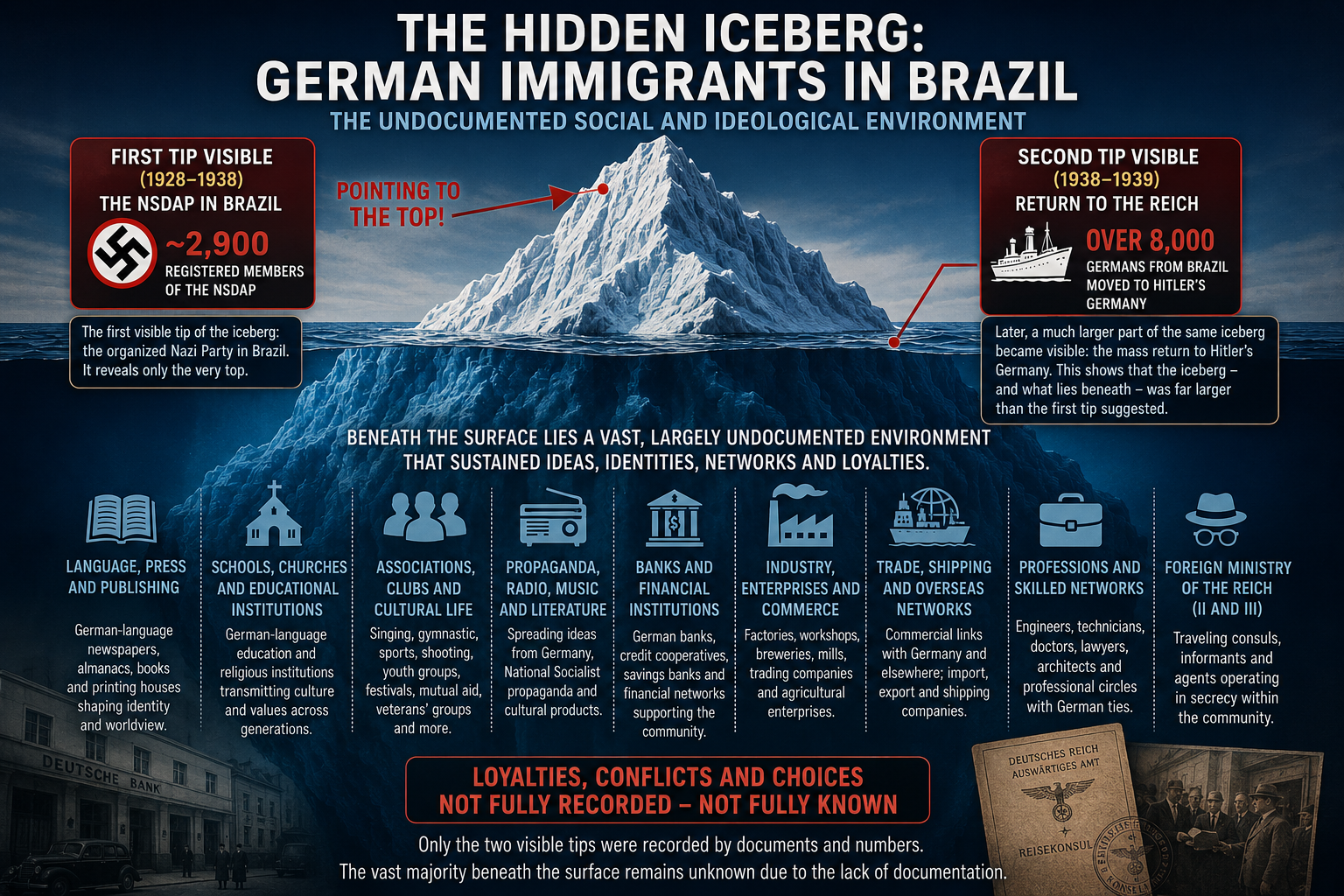
The historical problem can be compared to an iceberg. Unusually, this iceberg became visible through two different tips. The first consisted of approximately 2,900 formally registered members of the NSDAP in Brazil. The second appeared when more than 8,000 people from the German community left Brazil for Hitler’s Germany in the late 1930s. These two visible manifestations were not identical, but together they raise an unavoidable question: how large was the social and ideological formation that remained beneath the surface and was never fully documented?
More than an ordinary immigrant community
German-speaking migrants began arriving in southern Brazil in significant numbers during the nineteenth century. Like other immigrants, they brought family memories, religious traditions, language and customs. But the communities that emerged were not simply temporary shelters for a first immigrant generation. In many settlements, German-language institutions reproduced a distinct social environment over decades.
After the foundation of the German Empire in 1871, the relationship between these communities and Germany acquired new symbolic and organisational importance. In Rio Grande do Sul, German-language newspapers, almanacs, schools, choirs, gymnastic associations, shooting clubs and Protestant institutions multiplied. The Rio Grande Synod, founded in 1886 by the pastor Wilhelm Rotermund, maintained links with the Protestant state church in imperial Germany. Birthdays of the German emperor and of Chancellor Otto von Bismarck could be celebrated in Brazil as ethnic-national occasions. Unified Germany thus became both a symbolic homeland and a material point of reference for institutions operating on Brazilian soil.¹
This did not turn every immigrant into an agent of the German state. It did, however, distinguish parts of the German presence from immigration understood as a one-way process of settlement and incorporation. The German-speaking institutional network was capable of transmitting a separate collective identity to children and grandchildren who had never lived in Germany.
German-language almanacs illustrate the reach of this environment. They circulated even in remote rural settlements and combined practical information with literature, history, religion and representations of German identity. Alongside schools, churches and associations, these publications did not merely preserve a language. They helped define how members of the community understood their past, their social position and their relationship with both Brazil and Germany.
The decisive question was therefore not whether German immigrants made valuable contributions to Brazil. They unquestionably did. The question was whether the institutions built around them encouraged full cultural and political incorporation into Brazil or the permanent reproduction of a separate German national community within Brazilian territory.
Deutschtum and competing loyalties
The concept of Deutschtum went beyond private affection for the country of one’s ancestors. It could express the belief that German language, descent and culture created a community transcending state borders. From this perspective, emigration did not necessarily end membership in the German people. German communities abroad could be understood as parts of a wider German national body.
This distinction between citizenship and ethnic-national belonging became especially problematic for Brazil. A person might hold Brazilian citizenship and still be addressed by German organisations as an Auslandsdeutscher or, depending on status and interpretation, as a member of the German people abroad. The Brazilian state could therefore not determine loyalty merely by examining passports.
The centenary of German immigration in 1924 already revealed this ambiguity. In São Leopoldo, representatives of German-Brazilian associations, schools, churches, the press and intellectual circles organised the celebrations. Yet the organising committee included no representatives of the approximately 31 per cent of the city’s population who were not of German descent. The festivities proclaimed German contributions to Brazil while simultaneously representing the locality through a predominantly German ethnic structure.²
The German presence was therefore neither simply foreign nor simply assimilated. It occupied an intermediate space: territorially Brazilian, economically integrated and often legally Brazilian, yet institutionally capable of reproducing a distinct German collective consciousness.
This did not occur to the same extent among all immigrant populations. Brazilian authorities themselves distinguished between them. In 1941, José Coelho de Souza, education minister of Rio Grande do Sul, argued that the nationalisation problem generally did not exist in Italian colonies, whereas the German settlement regions presented the gravest and most difficult case. He identified German-Brazilian private schools as the principal resistance to the nationalisation of education. The government responded by closing schools, appointing approximately 1,300 teachers and constructing 128 public schools. Even foreign-language inscriptions on gravestones were prohibited, a measure that affected German-speaking communities particularly severely.³
The Estado Novo’s campaign was authoritarian, generalising and frequently unjust. But the contrast between German and Italian communities cannot simply be dismissed as arbitrary prejudice. Language, Protestant institutional structures, long-standing links with Germany and the ideology of Deutschtum made sections of the German population appear more distant from the Portuguese-speaking, predominantly Catholic national centre.
The first visible tip: the NSDAP in Brazil
The rise of Hitler transformed an existing question of identity and integration into a direct political and security problem.
The NSDAP operated in Brazil from 1928 until foreign political parties were prohibited in 1938. It formed part of the Auslandsorganisation der NSDAP, headquartered in Germany and directing branches in 83 countries. With approximately 2,900 registered members, the organisation in Brazil was the largest NSDAP national group outside Germany and operated across 17 Brazilian states. Its structure followed rules and directives issued by the Third Reich. It was accompanied by a wider organisational environment that included National Socialist labour, women’s, youth and teachers’ organisations.⁴
These 2,900 names constitute the first visible tip of the iceberg. They establish beyond serious doubt that National Socialism in Brazil was not merely an imagined threat manufactured by the Vargas government. A formally organised branch of Hitler’s party existed, followed instructions from Germany and attempted to influence German nationals and German-speaking communities in Brazil.
Yet the membership total does not reveal the entire social reach of Nazism. Formal party membership was governed by organisational and nationality requirements. The NSDAP primarily admitted German citizens; many Brazilian-born descendants of Germans were therefore not represented in the formal membership lists, regardless of their political sympathies.
Nor do party records include every person who read or distributed propaganda, attended events, donated money, belonged to associated organisations, admired Hitler, accepted antisemitic ideas or supported the racial doctrine of the Volksgemeinschaft. Between registered membership and active opposition existed a broad range of possible positions: ideological agreement without membership, selective admiration, opportunism, conformity, ethnic nationalism, passive acceptance and political silence.
The party list measures an organisation. It does not measure the full environment in which that organisation operated.
The second visible tip: return to Hitler’s Germany
The second tip of the iceberg appeared in 1938 and 1939, when more than 8,000 people belonging to or connected with the German community in Brazil reportedly left for National Socialist Germany.
This movement cannot be reduced automatically to ideological conviction. Individual motives included employment, family connections, economic uncertainty, dissatisfaction with life in Brazil, the Vargas government’s nationalisation measures and the desire to provide children with German education. Some returnees had been born in Germany and regarded their stay in Brazil as temporary. People migrate for combinations of reasons, and no single motive can be assigned to every family.
Nevertheless, the political context cannot be separated from the decision. While Jews and political opponents were fleeing Germany, the Nazi regime generated enthusiasm among many Germans abroad. Some returnees wanted to participate in the construction of the “Third Reich.” Their migration was administered and observed through institutions such as the Rückwandereramt of the NSDAP’s Foreign Organisation, which registered returnees and examined their political, criminal and “racial” backgrounds.⁵
The movement occurred while National Socialist propaganda was proclaiming that German ancestry created membership in a transnational German people. The ideological principle later associated with Heim ins Reich treated Germans abroad not simply as citizens of other countries with German family backgrounds, but as parts of the German Volk who could be called back into the Reich.
The historical importance of the more than 8,000 returnees lies not in proving that every person among them was a committed Nazi. It lies in the contrast with the approximately 2,900 formally registered party members. The second figure is much larger than the first. It represents not an organisational list but a significant collective movement toward Hitler’s Germany at the height of its racial-national mobilisation.
The two groups also cannot simply be added together. Some NSDAP members were among the returnees, while many returnees were not party members. The figures describe different forms of evidence. Precisely for this reason, they are so revealing: each exposes a different portion of the same historical formation.
Two tips, one hidden structure
The first tip shows formal political commitment: membership in Hitler’s party.
The second shows conduct: thousands of people leaving Brazil for the National Socialist state during a period in which the regime was mobilising Germans abroad, persecuting Jews and opponents, preparing for territorial expansion and defining Germanness through ancestry and race.
Between these two visible tips lay a largely undocumented social area. It included people who were attracted to Nazi Germany but did not join the party; people who supported German ethnic nationalism without accepting every aspect of National Socialism; people active in German associations, schools and churches; people who consumed German propaganda; and people whose convictions were never entered into an official record.
It also included opponents. German-Brazilians did organise against Nazi attempts to appropriate their identity. The Federação 25 de Julho, established in 1936, sought to cultivate German language and culture while educating descendants to become Brazilian citizens. Herbert Guss, head of the Brazilian NSDAP, complained that it had been created as a defensive movement against the party. This demonstrates that the German population was not politically uniform. It also reveals that a serious internal struggle existed over whether German-Brazilian identity would be oriented toward Brazil or toward the German racial-national community.⁶
The existence of opponents therefore does not make the danger imaginary. On the contrary, organised resistance within the community indicates that the pressure exerted by the Nazi movement was substantial enough to require a deliberate counter-position.
What documentation can – and cannot – tell us
Historical documentation favours what institutions recorded. Party organisations produced membership lists. Governments created police files. Migration authorities counted travellers. Associations preserved minutes, correspondence and statutes. These sources make the two visible tips of the iceberg partly measurable.
Private belief is more difficult to recover. Sympathy leaves fewer records than membership. Silence creates no archive. Informal support may appear only indirectly. After 1945, involvement with Nazism became compromising; documents could be destroyed, political biographies rewritten and family memories reshaped. Those who returned to Brazil had strong reasons to emphasise Brazilian citizenship, minimise earlier enthusiasm or present their migration as purely economic.
The absence of documentation therefore cannot be used as proof that sympathy did not exist. But neither may the hidden part of the iceberg be populated with invented numbers. Historical caution requires a distinction between evidence and inference.
The evidence establishes that Brazil contained the largest organised NSDAP group outside Germany; that National Socialism operated through a wider network of institutions; that German identity had been reproduced over generations through schools, churches, publications and associations; and that more than 8,000 members of the German community moved from Brazil toward Hitler’s Germany during a decisive period.
From these facts, a justified inference follows: the social reach of German ethnic nationalism and National Socialist attraction was broader than the formal party membership lists reveal. Its complete extent, however, can no longer be quantified.
Germanisation as a danger to Brazil
The danger to Brazil did not arise from German ancestry itself. Nor was speaking German or maintaining family traditions automatically disloyal. It arose when a foreign ethnic-national project sought to organise people permanently within Brazil according to language, descent and belonging to another national community.
Germanisation became politically dangerous wherever it competed with Brazilian authority over education, public communication, historical memory and national loyalty. The danger increased when German institutions abroad were brought within the ideological orbit of a dictatorship that claimed all people of German “blood” as members of the German people.
This was no abstract concern. Nazi Germany was simultaneously transforming the racial idea of Germanness into state policy. It excluded and persecuted those defined as non-German, annexed territories in the name of ethnic unity and subsequently subjected occupied regions of eastern Europe to brutal Germanisation, displacement and mass murder. The same doctrine that offered belonging to selected ethnic Germans denied dignity, rights and life to millions classified outside the German racial community.
Against this background, Brazil had legitimate reasons to defend its sovereignty and reject the idea that German ancestry could establish an enduring political relationship with a foreign Reich. Yet legitimate security concerns do not justify every measure adopted by the Estado Novo. The Brazilian government often erased distinctions between Nazi activists, German citizens, Brazilian-born descendants, cultural institutions and ordinary families. It subjected people to collective suspicion and used nationalisation to strengthen an authoritarian and homogenising state.
Both aspects must remain visible: there was a real German and National Socialist challenge, and there was also indiscriminate state repression. Recognising the first does not excuse the second. Condemning the second must not erase the first.
The iceberg beneath the commemorative narrative
After 1945, the public representation of German immigration changed. National Socialist involvement receded from commemorative narratives, while work, discipline, education, economic achievement and cultural contribution moved to the foreground. By the 1970s, the military dictatorship could present supposedly German qualities as exemplary Brazilian virtues. The presidency of Ernesto Geisel, a Brazilian of German descent, symbolised the transition from “German danger” to the official celebration of German-Brazilian achievement.
But reconciliation and integration do not eliminate historical responsibility. The traditional success story of German immigration displays what communities later chose to commemorate. The iceberg comparison points toward what remained beneath that representation.
One visible tip consists of the 2,900 registered members of the Nazi Party. Another consists of the more than 8,000 people who moved from Brazil to Hitler’s Germany. Neither number alone describes the German population of southern Brazil. Together, however, they prevent the history from being reduced to an innocent tale of immigrants who merely preserved their language, worked hard and gradually became Brazilians.
They reveal a much more difficult history: a community divided over belonging; a transnational Deutschtum capable of outliving migration; organised National Socialism directed from Germany; resistance by German-Brazilians committed to Brazil; and an unknown number of sympathisers, supporters and silent adherents who left few or no records.
The hidden iceberg cannot be measured retrospectively. But its existence cannot reasonably be denied merely because only parts of it entered the archives.
Footnotes
- Glen S. Goodman, From “German Danger” to German-Brazilian President: Immigration, Ethnicity, and the Making of Brazilian Identities, 1924–1974 (PhD diss., Emory University, 2015), 34–35. Goodman describes the expansion of German-language newspapers, almanacs, schools and associations after German unification, as well as the direct links between the Rio Grande Synod and the Protestant state church in imperial Germany.
- Goodman, From “German Danger” to German-Brazilian President, 47–49. The centenary committee represented German-Brazilian associations and institutions but excluded the approximately 31 per cent of São Leopoldo’s population not of German descent.
- Ibid., 79–81. Goodman cites Coelho de Souza’s distinction between Italian and German settlements and describes the closure of German schools, the appointment of 1,300 teachers and the construction of 128 public schools.
- Ana Maria Dietrich, Nazismo tropical? O Partido Nazista no Brasil (PhD diss., Universidade de São Paulo, 2007). Dietrich identifies approximately 2,900 members in Brazil, organised in 17 states as part of an NSDAP foreign network extending across 83 countries.
- Méri Frotscher, “Retorno à pátria alemã”: migrações de retorno do Brasil para a Alemanha sob o nazismo (1938–1939) (Passo Fundo: Acervus, 2024). Frotscher examines the return movement through personal trajectories, diplomatic records and material from the NSDAP’s Rückwandereramt. The publisher’s description notes the enthusiasm generated by National Socialism among many Germans abroad and the desire of some returnees to participate in building the “Third Reich.”
- Goodman, From “German Danger” to German-Brazilian President, 82–84. The Brazilian NSDAP leader Herbert Guss described the Federação 25 de Julho as a defensive movement against the Nazi Party and acknowledged its objective of educating German-Brazilian youth as Brazilian citizens.