The author is a Brazilian-German journalist, publicist and writer who began his professional career in journalism in Brazil in 1982 and 1983 before moving to Germany and studying Business Administration. He subsequently spent more than three decades working primarily in business development, market development and international activities, much of that time for German IT companies and in professional environments connecting Germany and Brazil.
These experiences, together with his long engagement with both societies, gradually shaped the questions that led him back to historical research and writing. From this background emerged the concepts for The Hidden Iceberg and for a broader study of the historical origins, transformations and persistence of the German collective “Wir” into the present.
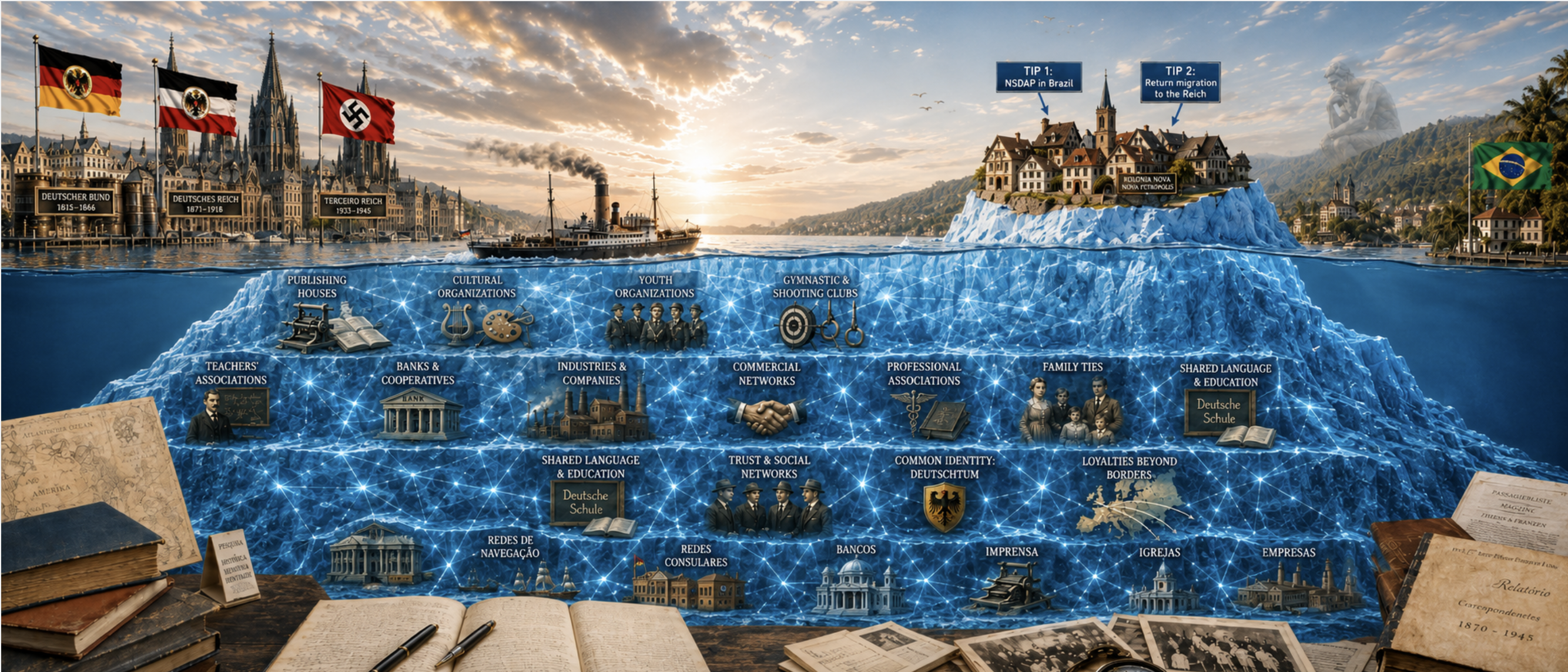
The Hidden Iceberg grew out of a question that gradually became more difficult to ignore: how much of the history of German immigration to Brazil can be understood if attention is concentrated primarily on immigration, settlement and cultural contribution, while the institutional, ideological, economic and transnational environment surrounding those communities receives considerably less attention?
Looking at this history from both sides of the Atlantic opens a broader field of observation. Germany can be examined not only through its own historical narratives, but also from the perspective of Brazil, a country that received hundreds of thousands of German immigrants and became home to one of the largest German-speaking communities outside Europe.
Brazil, for its part, can be understood not simply as a destination of European migration, but as a sovereign society in which German immigrant communities developed institutions that maintained extensive cultural, economic and organizational ties with Germany.
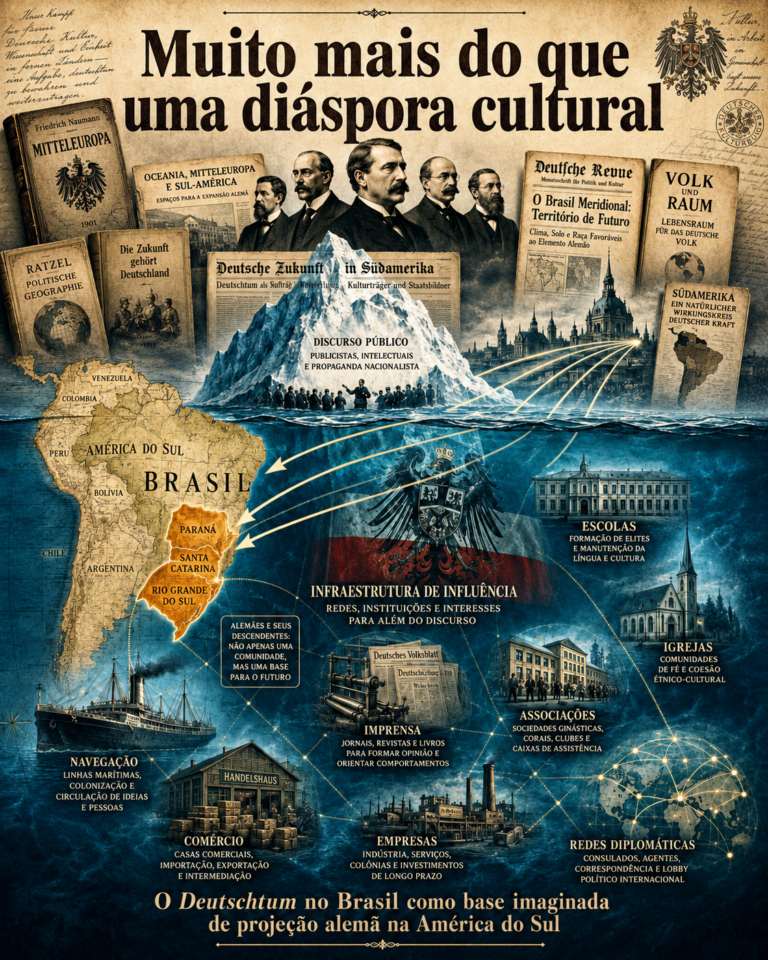
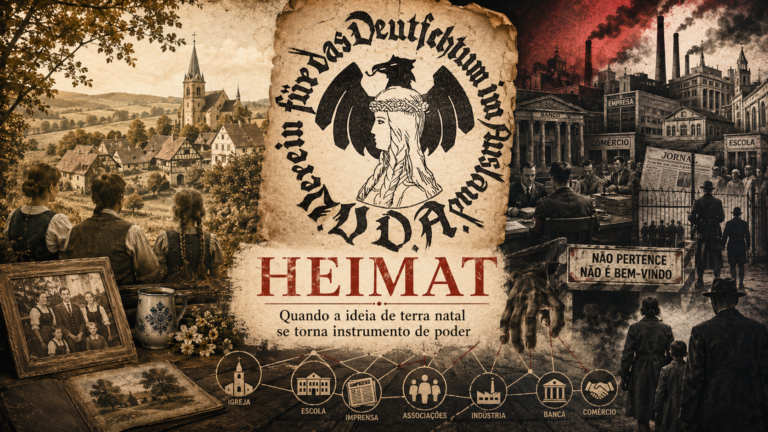
The motivation for this book emerged from the growing realization that the familiar history of German immigration tells only part of the story. Schools, churches, newspapers, associations and agricultural colonies are well known. Less frequently examined as parts of the same historical environment are companies, industries, banks, commercial networks, shipping lines, consulates, diplomatic activities, nationalist organizations and institutions in Germany dedicated to maintaining Deutschtum abroad.
Considered separately, many of these institutions may appear unremarkable. Considered together and across several generations, they reveal a much larger transnational structure.
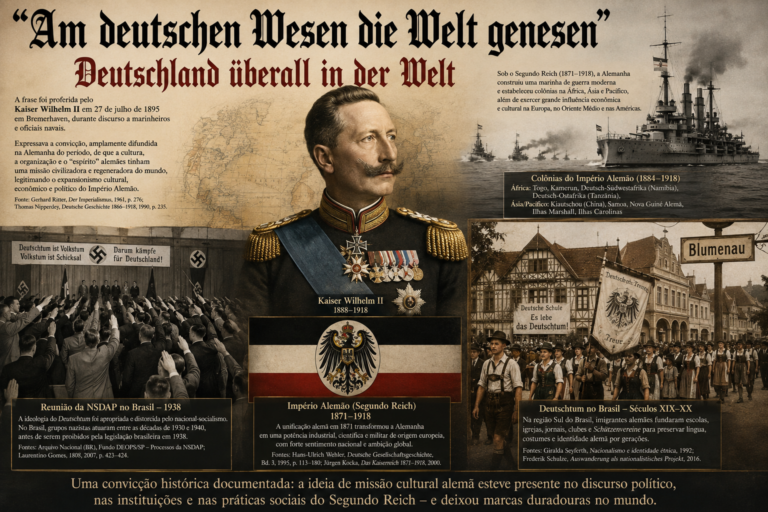
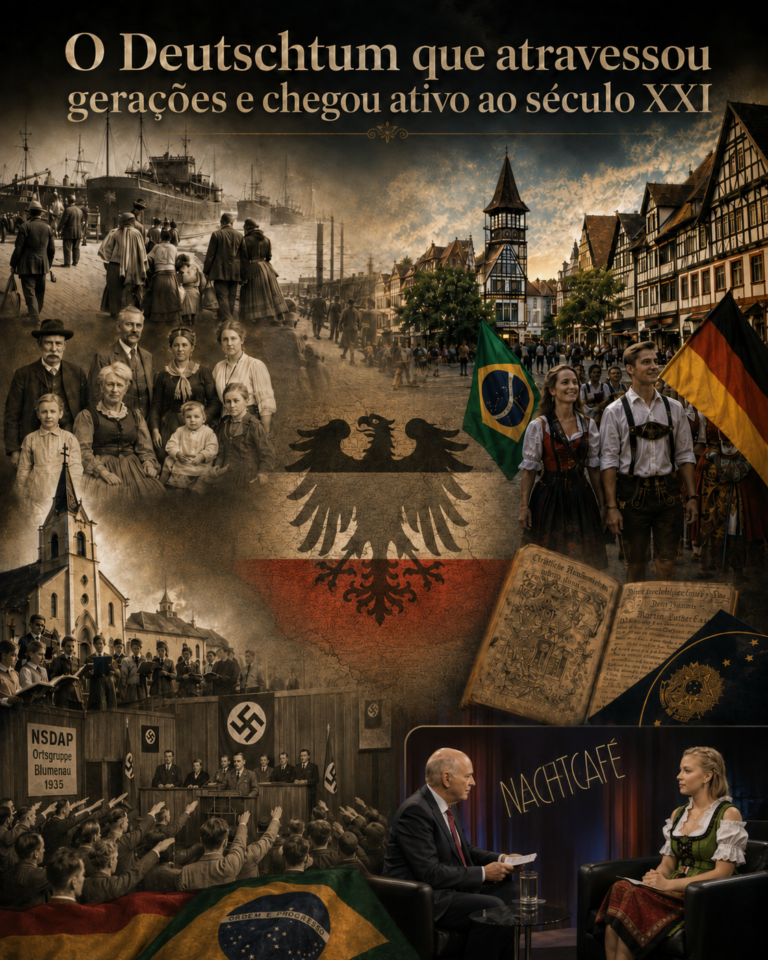
This is the origin of the iceberg metaphor. The documented presence of the NSDAP in Brazil and the migration of thousands of German citizens and their families from Brazil to National Socialist Germany during the late 1930s are highly visible historical facts.
The more difficult question is what existed beneath those visible developments: which institutions, networks, concepts of belonging and forms of social authority had developed before National Socialism appeared and subsequently provided channels through which German nationalism could operate.
Investigating this history also requires changing the direction from which some of the questions are asked. German-Brazilian history cannot be understood exclusively through German institutions describing their activities abroad. Brazil possessed its own interests, laws, expectations and sovereignty. Its archives, newspapers, political debates and experiences form an indispensable part of the same history.
Looking at events from both sides can reveal relationships and conflicts that disappear when the history of migration is reconstructed principally from the perspective of the country of origin.
The subject also reaches beyond Brazil. It raises a fundamental question of modern migration history: where is the boundary between preserving cultural heritage and maintaining a transnational political community? Language, traditions, schools and associations can enrich a plural society. But institutions connecting emigrants and their descendants with nationalist projects in another state can acquire a very different significance.
The history of Deutschtum abroad offers an important case through which that boundary can be studied.
The purpose of The Hidden Iceberg is therefore to make a complex historical environment visible. It brings together developments that are often studied separately and asks how culture, identity, education, economic power, diplomacy, nationalism and political organization interacted over time. It does not begin with a predetermined judgment about individuals. It begins with institutions, documents, relationships and historical consequences.
History becomes particularly valuable when it allows societies to recognize structures before only their most dramatic consequences become visible. The iceberg is a metaphor for precisely this problem: when the political tip finally appears above the surface, the structures beneath it may already have been developing for generations.
The history examined in this book also has significance beyond the past. Countries can maintain close and even friendly relations while at the same time competing with one another economically, scientifically, technologically, intellectually and in many other fields in which they seek influence, opportunities or advantages. Friendship between states does not abolish competition; both can exist simultaneously. In such a world, good leadership requires more than national confidence or strategic ambition.
It also requires a realistic understanding of other societies, their historical experiences, sensitivities, institutions, interests and ways of interpreting the actions of others. Knowledge of one another does not eliminate competition, nor should it. It can, however, help prevent competition from being distorted by prejudice, cultural arrogance, political manipulation or claims of superiority.
The value of historical understanding lies precisely here: not in turning history into a catalogue of moral lessons, but in recognizing patterns, ambitions and consequences that can inform better judgment. Leadership for a better future therefore depends not only on the ability to advance one’s own society, but also on the capacity to understand how one’s actions are perceived and experienced by others.
History cannot provide ready-made answers, but it can make leaders and societies less blind to the consequences of their choices.
Understanding those structures is the motivation for this book.