German Immigrants in Brazil – The Undocumented Social and Ideological Environment
„The visible organizations of history are often only the surface. Beneath them lie social structures, institutions, networks and loyalties that shape events long before they become visible.“
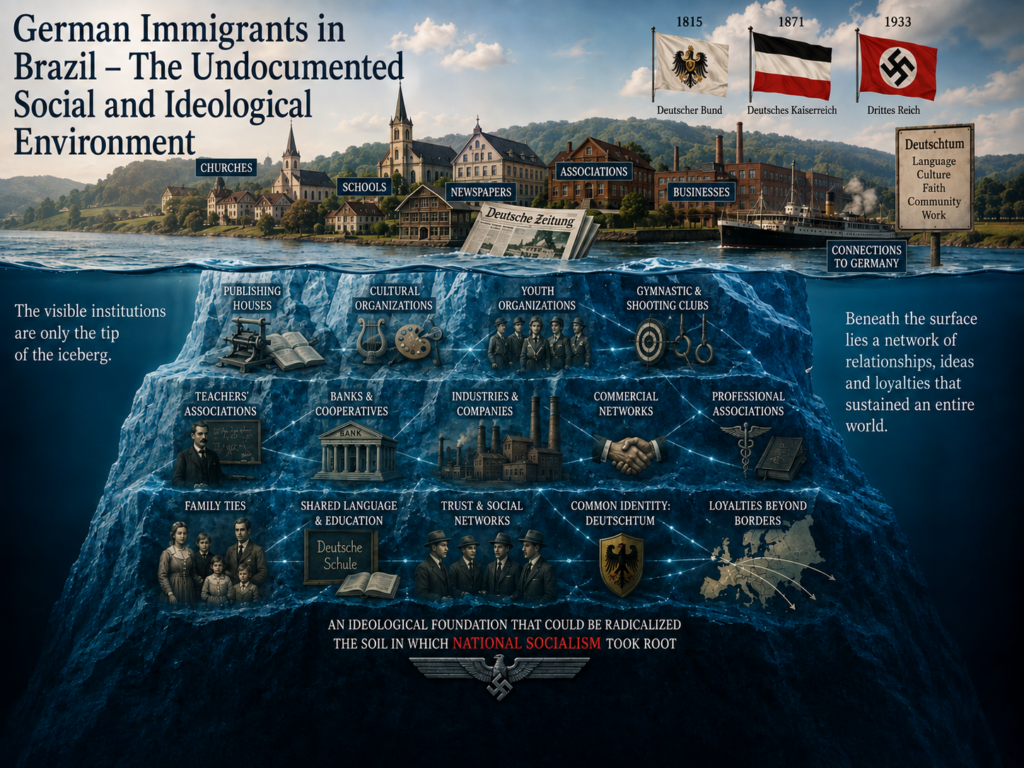
German immigration to Brazil was not merely the movement of individuals and families across the Atlantic. It produced one of the most extensive German-speaking institutional environments established outside Europe.
Beginning with the organized settlement of German immigrants in São Leopoldo in 1824, German-speaking populations founded agricultural colonies, schools, churches, newspapers, publishing houses, mutual-aid societies, cultural associations, commercial enterprises, industries, banks, cooperatives and professional organizations. These institutions contributed substantially to the development of southern Brazil. They cultivated land, expanded regional commerce, introduced technical knowledge, created employment and established educational and religious services in areas where the Brazilian state was often only weakly represented.¹
Brazil allowed this institutional world to develop over several generations. German immigrants and their descendants received broad space to preserve their language, religion, family traditions and forms of community organization. German-language schools educated children, churches maintained congregational life, newspapers created a common public sphere and associations organized social and cultural activities. German-speaking merchants, industrialists, professionals and financial institutions acquired an increasingly important position in regional society.
This openness was not respected by all of the German institutions that became involved.
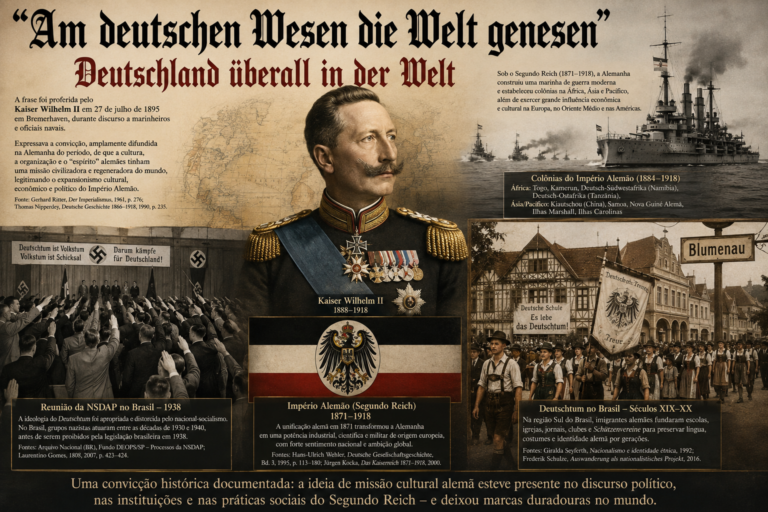
During the nineteenth and early twentieth centuries, influential German nationalist organizations, economic actors, diplomatic representatives, and institutions devoted to Germans abroad increasingly regarded German emigrants and their descendants not merely as residents or citizens of the countries in which they lived, but as members of a transnational German community. This perception was reinforced by the fact that many of them preserved the German language, cultural traditions, religious ties, forms of community life, and historical ideas across generations. From the interaction of these elements emerged a broader understanding of German belonging that increasingly came to be described by the term Deutschtum.
The previously discussed actors within the German state, economy, churches, and civil society formed networks with German emigrants and their descendants in their countries of citizenship. These networks sought to preserve and reinforce the attachment of German emigrants and their descendants to the German-speaking lands and to a broader German cultural and national community. After the establishment of the German Empire in 1871, influential sectors increasingly directed this attachment toward the new German nation-state rather than encouraging full integration into the societies of which the emigrants and their descendants had become residents or citizens. The German language, German-language schools, churches serving German communities, associations, newspapers, publishing houses, commercial enterprises, industries, banks, cooperatives, and professional organizations served not only to reinforce a distinct German historical consciousness, but also to provide German emigrants and their descendants with the education, resources, professional networks, and institutional support through which they could attain positions of influence in the societies in which they lived, including Brazil.² Assimilation was therefore frequently portrayed as a loss not only of members of the German people and of German culture, but also of German economic capacity, commercial influence, institutional reach, and international power.
The resulting German-speaking institutional environment in Brazil was therefore more than a collection of immigrant organizations. It became part of a wider transnational structure connecting communities inside Brazil with German publishers, churches, educational institutions, commercial firms, shipping companies, banks, consulates, diplomatic missions and nationalist organizations.³
The relationship was not limited to culture.
German trading houses connected settlements and regional markets with German industry. German machinery, manufactured goods, books, newspapers and teaching materials entered Brazil through commercial networks. Brazilian agricultural products and raw materials were exported through the same structures. German businesses created employment and influenced professional advancement. Banks and credit institutions supplied capital. Shipping companies maintained the physical connection across the Atlantic. Career consuls and honorary consuls protected German interests, gathered information and maintained relationships with locally influential actors.
Culture, education, commerce, finance and diplomacy reinforced one another.
Schools trained future teachers, pastors, clerks, technicians, merchants and professionals. Churches strengthened linguistic and social cohesion. Newspapers distributed information and interpretations of political events. Associations connected families and local leaders. Companies offered employment. Banks provided credit. Consulates connected local networks with the German state.
The power of this environment did not arise from one institution alone. It arose from the cumulative interaction of many institutions operating over long periods.
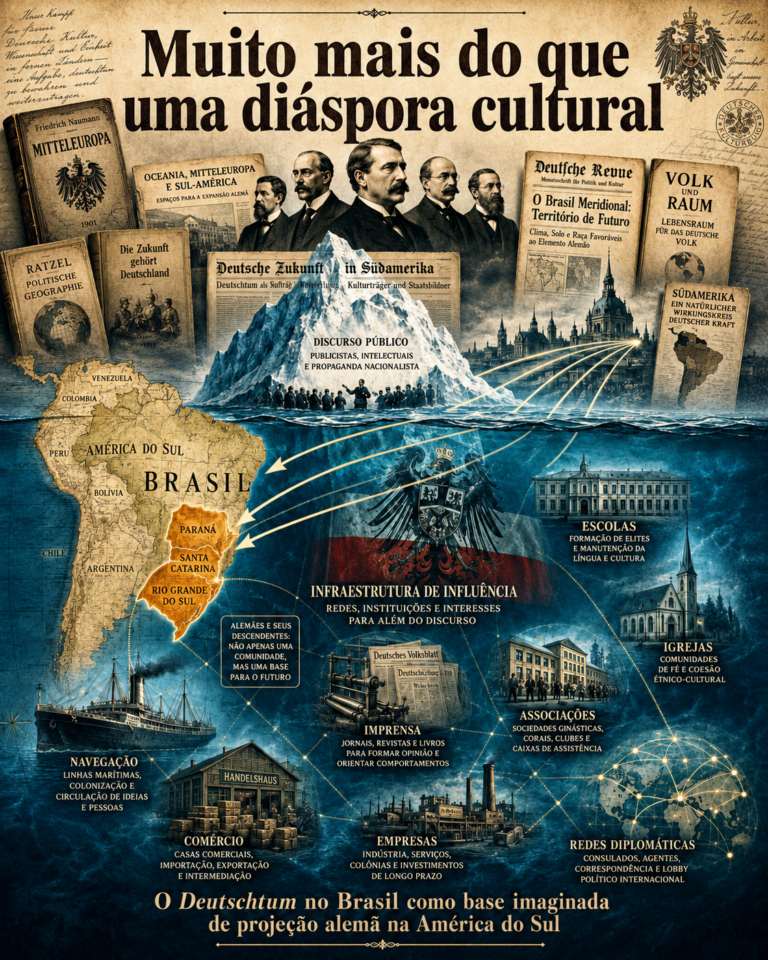
This is the hidden iceberg examined in this book.
The visible tips
The metaphor of the iceberg begins with two historical developments that became clearly visible in the surviving records.
The first was the organization of the National Socialist German Workers’ Party in Brazil.
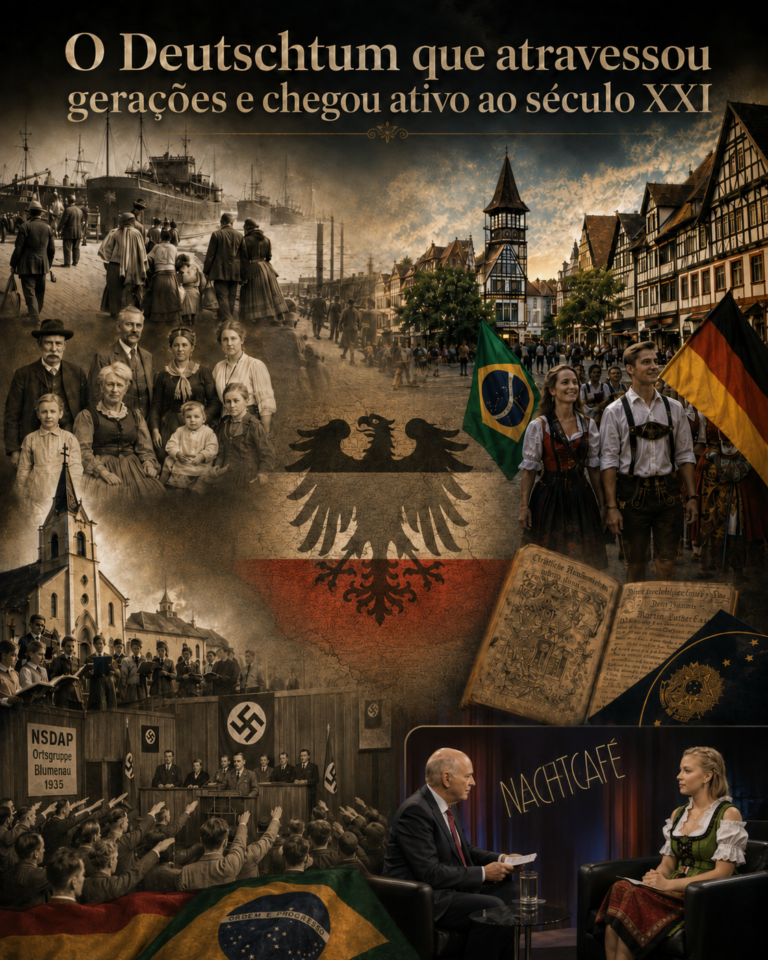
A local NSDAP organization was established in Timbó, Santa Catarina, in 1928, before Hitler came to power in Germany. After 1933, the Brazilian organization became more firmly integrated into the NSDAP’s Foreign Organization. Surviving documentation records 2,822 formal party members, commonly rounded in the historiography to approximately 2,900.4
Formal membership was largely restricted to German citizens. The figure therefore does not measure the wider influence of National Socialism among German-speaking institutions, German descendants, sympathizers, employers, readers, donors or people exposed to German nationalist propaganda.
It records only those whose membership could be formally demonstrated.
The party did not enter an empty social environment. It operated within a landscape already containing German-language schools, churches, newspapers, cultural associations, employers, commercial firms, banks, shipping connections, consulates and organizations committed to the preservation of Deutschtum.
National Socialism did not create this institutional world. It inherited it, entered it and attempted to direct it.
The second visible development was the movement of thousands of German nationals and their families from Brazil to National Socialist Germany during the years preceding the Second World War.
Official German statistical records register 8,384 German citizens arriving from Brazil during 1937, 1938 and 1939. The return migration included families with German, Brazilian or dual citizenship. Among those registered as return migrants were at least 1,099 people identified as former members of the NSDAP in Brazil.⁴
Economic difficulties, family circumstances, employment opportunities and Brazil’s nationalization policies influenced individual decisions. Yet the movement was also promoted and organized through National Socialist return-migration institutions, German consular information, political assessments, employment mediation and financial assistance.
The Reich regarded Germans abroad as human resources that could be recovered, classified and reintegrated into National Socialist society.
The movement to Hitler’s Germany revealed something that party membership alone could not show. The attraction exercised by the Reich extended beyond the documented local structure of the NSDAP. Thousands of people were willing to relocate their families to a dictatorship that presented itself as the political and racial homeland of the German people.
The party organization and the return migration were two visible parts of the same historical structure. Beneath them lay the larger iceberg: the institutions, identities, loyalties, economic interests and social relationships that had developed during the preceding century.
Why the iceberg remained hidden
The hidden character of this environment does not mean that every institution operated secretly. German schools, churches, newspapers, associations, companies and banks were publicly visible.
What remained less visible was their cumulative effect. Historical archives preserve party membership cards, diplomatic correspondence, statutes, government decisions, shipping records and official reports more readily than they preserve everyday political attitudes and informal relationships.
A registered NSDAP member can be identified in a surviving list. A person who admired Hitler but did not join the party may have left no comparable record. A formal donation may appear in an account book; private assistance may remain undocumented. An official political speech may survive; conversations within families, workplaces, churches or associations generally do not.
Employment recommendations, commercial trust, social pressure, inherited loyalties and silent approval are difficult to quantify retrospectively.
The absence of documentation does not permit unsupported accusations. It also does not justify reducing the history to the small part that produced formal records.
The task is to reconstruct the institutional environment within which political choices became possible.
The iceberg metaphor therefore distinguishes among three levels of historical knowledge.
- The first consists of documented events: organizations, memberships, laws, correspondence, migration records and institutional decisions.
- The second consists of relationships that can be reconstructed through the interaction of institutions: educational networks, commercial connections, diplomatic contacts, employment structures, financial support and channels of communication.
- The third consists of attitudes and choices that left insufficient evidence and must therefore remain partly unknown.
The purpose of this distinction is not to transform uncertainty into guilt. It is to prevent the surviving membership list from being mistaken for the entire political and social reality.
From cultural continuity to organized Deutschtum
Cultural continuity is not identical to nationalism.
Immigrants commonly preserve language, religion, family memory and inherited customs. Schools, churches and mutual-aid societies often emerge because public institutions are absent or inadequate. Such organizations can assist integration by providing education, stability and social support.
The German-Brazilian history became politically consequential because German cultural preservation was increasingly connected with an organized conception of Deutschtum. The term Deutschtum cannot be translated adequately by a single English or Portuguese word. Depending upon the context, it may refer to Germanness, German culture, German national character or the collective existence of people defined as German through language, descent and historical inheritance.
During the nineteenth century, the concept acquired an increasingly political meaning.
German emigrants and their descendants could be regarded as members of the German people even when they lived outside Germany and possessed another citizenship. Their schools, language, churches and associations could therefore be treated as parts of a wider German national presence.
This idea blurred the distinction between culture and political membership.
A Brazilian citizen of German ancestry could be regarded from Germany as belonging simultaneously to a German national community. Brazilian territory could contain institutions that operated legally inside Brazil but understood their deeper cultural mission in relation to Germany.
Such layered identities do not automatically produce political conflict. They become dangerous when institutions located abroad claim the authority to determine the identity, loyalty and historical purpose of citizens of another state.
This was the central sovereignty problem created by organized Deutschtum.
Brazil had accepted German immigrants on the expectation that they would settle, work, contribute and become members of Brazilian society. German nationalist organizations increasingly treated integration as a threat to be resisted. They sought to preserve German-language institutions and maintain identification with Germany beyond the immigrant generation.
Brazilian patience was thereby exploited.
The institutional autonomy permitted by Brazil became the space in which German organizations could preserve a separate national consciousness, maintain relationships with Germany and resist the transformation of immigrant communities into fully integrated components of Brazilian society.
Under National Socialism, this contradiction became explicit.
The Nazi state claimed authority over German citizens abroad and attempted to influence people classified as ethnically German even where they were citizens of other states. Language, ancestry, education and institutional affiliation became potential instruments of political mobilization.
The conflict was therefore not created originally by Brazilian hostility toward German culture. It arose because influential German actors transformed cultural continuity into a transnational national project.
Brazil’s later defence of linguistic integration, political sovereignty and common citizenship must be understood within this chronology.
The restrictive measures adopted during the Estado Novo did not create the German institutional environment. They responded to an environment that had existed for decades and whose political significance had become increasingly visible through German nationalism, foreign political organization and National Socialist intervention.
The Brazilian response must be examined historically, but it must not be used to reverse cause and consequence.
The longer history of the German Wir
The German-Brazilian iceberg cannot be understood solely through immigration history. It belongs to a much longer history of how a German collective “we” – a German Wir – was constructed, expanded and distinguished from corresponding images of the Others.
This book does not claim that a modern German nation already existed among ancient Germanic peoples, the Franks or the inhabitants of the medieval Empire. Such a claim would project later nationalism backward into societies organized through different forms of law, religion, dynasty, locality and political allegiance. The investigation begins with earlier historical formations because they supplied categories that later nationalists could reinterpret: origin, ancestry, law, language, rulership, religious order, imperial memory and collective distinction. The German Wir did not emerge fully formed at one moment. It accumulated through historical reinterpretation.
Medieval political and religious structures created layered forms of belonging. Language gradually acquired greater importance as a marker of community. The Reformation intensified confessional boundaries. Historical writing, literature, education and scholarship contributed to the construction of a German cultural nation. Nineteenth-century nationalism joined language, ancestry, historical memory and political destiny into a claim for national unity.⁵
The establishment of the German Empire in 1871 gave this national imagination a powerful state.
The borders of the new state did not coincide completely with the imagined boundaries of the German people. Some citizens inside the Empire were treated as culturally or politically alien. At the same time, German-speaking populations outside the Empire could be claimed as members of a wider German national community.
German belonging therefore became narrower than citizenship internally and wider than state territory externally. This contradiction formed the historical basis of Auslandsdeutschtum: the organized conception of Germans abroad as parts of a national community transcending political borders. National Socialism radicalized this structure. It transformed inherited Germanness into racial classification, political obligation and territorial entitlement. People designated as Volksdeutsche could be mobilized as instruments of German foreign policy, occupation and population reordering. The catastrophic consequence was the destruction of the individual’s protection against the claims of the racial community.
After 1945, the racial and expansionist German Wir was defeated. It did not disappear. It was reconstructed through constitutional democracy, economic achievement, West German integration into Western institutions, East German antifascism, European cooperation, reunification, migration and historical responsibility.
The book therefore follows the German Wir across different political forms. It does not search for a permanent national character. It examines the repeated construction of belonging and the institutions through which belonging became politically effective.⁶
Economic, diplomatic and academic power
The institutional history of Deutschtum cannot be reduced to schools, churches and cultural associations. Economic power formed part of the iceberg from the beginning.
Commercial firms connected German settlements with regional and international markets. Industries created employment and technical expertise. Banks and credit institutions supplied capital. Employers influenced professional opportunities. Chambers of commerce connected companies and political decision-makers. Shipping companies moved people, goods and information across the Atlantic.
These institutions supplied the material resources through which cultural organizations survived.
They also gave German-speaking networks social authority. A community able to educate its children, employ its members, finance its enterprises, publish its newspapers and support its associations possessed a capacity for institutional reproduction extending far beyond private family tradition.
German diplomacy reinforced this structure.
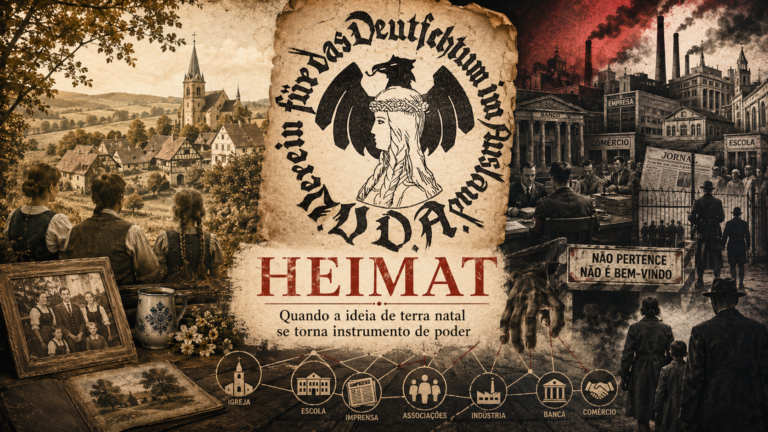
Consuls and diplomatic officials observed German-speaking communities, protected German economic interests and reported developments to Berlin. Organizations such as the Pan-German League, the Verein für das Deutschtum im Ausland and the Deutsches Ausland-Institut sought to preserve German identity beyond Germany’s borders. Their methods differed, but they shared the conviction that emigration should not terminate the relationship between Germany and German-speaking populations abroad.⁷
Academic knowledge also formed part of this international presence.
German professors, universities, scientific organizations and cultural institutions participated in the production and circulation of knowledge about Germany, German immigration and German-Brazilian relations. Their research cannot be treated automatically as neutral merely because it was presented as academic.
The same principle applies to company-sponsored history.
Institutions possess interests. Governments seek influence and prestige. Companies seek reputational protection. Universities compete for authority, funding and international partnerships. Cultural organizations pursue foreign-policy objectives even when they also produce genuine educational benefits.
After 1945, German foreign cultural policy abandoned the openly racial language of Deutschtum, but it continued to use schools, language instruction, academic exchange, scholarships, cultural institutions and professional networks to restore Germany’s international presence.⁸
German governments also attempted to influence how German history was interpreted abroad. The management of Holocaust memory in the United States demonstrates that historical remembrance became a matter of diplomacy, reputation and national interest.⁹
In Brazil, German companies and cultural institutions continued to exercise substantial influence after the Second World War. Industrial investment, banking, technology transfer, academic cooperation and cultural relations created new forms of power. Under the Brazilian military dictatorship, the documented cooperation of Volkswagen do Brasil with the political repression of workers showed that German economic presence could not be separated automatically from authoritarian politics.10
This study therefore treats knowledge production itself as part of the historical field.
German diplomatic reports, corporate histories, academic studies and cultural-policy publications are not granted privileged credibility because they originate from prestigious German institutions. They are examined according to authorship, financing, institutional position, archival access and political purpose.
Events in Brazil must not be reconstructed from German records alone.
Brazilian legislation, newspapers, labour history, judicial proceedings, police archives, victims’ testimony, local publications and Brazilian scholarship are indispensable for correcting narratives in which German institutions define both their own conduct and the meaning of Brazil’s response.
Method and responsibility
The analytical unit of this book is not ancestry.
A surname does not establish an ideology. German descent does not prove political loyalty to Germany. Membership in a church, school or cultural association does not by itself demonstrate National Socialist commitment. The subjects of investigation are institutions, policies, leadership networks, documented relationships and political conduct. Responsibility is determined through action, authority, participation, benefit and decision-making power.
This distinction does not weaken the analysis. It prevents two opposite falsifications.
The first would assign one political conviction to every German immigrant and descendant. The second would use the obvious diversity of individuals to deny the existence and influence of organized institutional structures.
A political network does not require unanimous support. A party does not need to enrol an entire population in order to exercise influence. An employer, newspaper, school director, pastor, consul or association leader may affect many people without representing every member of the community.
The history must therefore distinguish individual responsibility while retaining institutional responsibility.
The question is not whether every German in Brazil was a nationalist or National Socialist. The question is how German nationalist institutions acquired access to communities, resources, schools, publications, employment structures, cultural authority and diplomatic protection – and what they did with that access.
Brazil and the wider international problem
Brazil is the principal case examined in this book because the density and duration of its German-speaking institutional environment make the country especially revealing. The same history cannot be transferred mechanically to Argentina, Chile, Paraguay, the United States or other destinations of German migration. Each country possessed different laws, political traditions, immigration patterns and relationships with Germany. Nevertheless, the cases raise common questions.
- How long may a country of origin claim a relationship with emigrants and their descendants?
- When does cultural support become foreign political intervention?
- When does the preservation of language become a programme of national separation?
- Can an immigrant community maintain cultural institutions without developing political loyalties that conflict with citizenship?
- What obligations do receiving states possess toward cultural freedom, and what rights do they possess when foreign organizations attempt to mobilize their citizens?
These questions are not limited to German history. They arise wherever migration, external nationalism and institutional power intersect. The German case is especially important because it demonstrates the possible progression from cultural preservation to organized transnational nationalism and, ultimately, to a racial state claiming authority over people beyond its borders.
Structure of the book
Chapter 1 reconstructs the hidden iceberg: the German-speaking institutional landscape in Brazil. It examines schools, churches, newspapers, publishing, associations, companies, industries, banks, cooperatives, professional networks, consulates and transatlantic connections.
Chapter 2 traces the formation of German collective identity and the organized promotion of Deutschtum abroad. It examines how language, culture, education, commerce and foreign policy were connected to the preservation of German communities beyond Europe.
Chapter 3 follows the transformation of the German national Wir from the Empire of 1871 through the First World War, defeat, Weimar radicalization and National Socialism. It examines how an imperial power-Wir became an injured victim-Wir and ultimately a racial and annihilating Volksgemeinschaft. Brazil appears within this history through German wartime mobilization, National Socialist organization, diplomatic intervention and return migration.
Chapter 4 examines the German Wir after 1945. It investigates denazification, selective memory, the Federal Republic, the GDR, reunification, migration, citizenship, economic power, foreign cultural policy and German moral self-representation. It also follows the reconfiguration of German cultural, academic and economic influence in Brazil.
Chapter 5 draws the historical development together. It asks what persisted, what changed and what a democratic reconstruction of collective belonging requires.
The purpose of this study
German immigrants and their descendants made substantial contributions to Brazil. They also built institutions that preserved a separate German-speaking social environment over generations. German nationalist organizations sought to maintain this environment as part of a transnational German community. German diplomatic, cultural and economic actors used it to preserve influence. National Socialism later attempted to mobilize it according to the racial and political objectives of Hitler’s Germany.
All of these statements can be true simultaneously. Contribution does not erase political responsibility. Economic development does not make institutional power innocent. Cultural activity does not cease to be political merely because it takes place in schools, churches or associations.
Historical research fails when it makes unpleasant developments more acceptable through euphemism, artificial symmetry or selective silence. The German institutional world in Brazil must be described as it developed: initially tolerated and often welcomed by Brazil; increasingly self-reinforcing; connected with German cultural, commercial and diplomatic interests; influenced by organized Deutschtum; and later penetrated and mobilized by National Socialism.
Brazil did not create this history by reacting to it.
The visible political conflict was the consequence of structures established long before the Brazilian state adopted its most restrictive measures.
The hidden iceberg is therefore more than a metaphor for missing documents. It describes the relationship between visible political events and the institutional world that made them possible. By the time the tip appeared, the iceberg had already been forming for generations. History cannot change the past. It can, however, prevent the institutions, interests and ideologies beneath political events from remaining invisible.
That is the purpose of this book.
Footnotes
- Jean Roche, A colonização alemã e o Rio Grande do Sul, 2 vols., trans. Emery Ruas (Porto Alegre: Editora Globo, 1969), vol. 1, pp. 19–152; Emílio Willems, A aculturação dos alemães no Brasil: estudo antropológico dos imigrantes alemães e seus descendentes no Brasil (São Paulo: Companhia Editora Nacional, 1946), pp. 35–194; Frederick C. Luebke, Germans in Brazil: A Comparative History of Cultural Conflict During World War I(Baton Rouge: Louisiana State University Press, 1987), pp. 1–82.
- Jean Roche, A colonização alemã e o Rio Grande do Sul, 2 vols., trans. Emery Ruas (Porto Alegre: Editora Globo, 1969), vol. 2, pp. 521–694, especially the sections on education, associations, commerce, communications and institutional development; Emílio Willems, A aculturação dos alemães no Brasil: estudo antropológico dos imigrantes alemães e seus descendentes no Brasil (São Paulo: Companhia Editora Nacional, 1946), pp. 195–358; Giralda Seyferth, “A ideia de cultura teuto-brasileira: literatura, identidade e os significados da etnicidade,” Horizontes Antropológicos 10, no. 22 (2004): 149–197; Jeffrey Lesser, Negotiating National Identity: Immigrants, Minorities, and the Struggle for Ethnicity in Brazil (Durham, NC: Duke University Press, 1999), pp. 79–119; Ademir Valdir dos Santos, “Cultura e língua alemãs na escola de Santa Catarina: construção histórica da germanidade,” EntreVer: Revista das Licenciaturas 3, no. 5 (2013): 116–141, especially pp. 119–137.
- Roche, A colonização alemã, vol. 2, pp. 521–694; Willems, A aculturação dos alemães no Brasil, pp. 195–358; Giralda Seyferth, “A ideia de cultura teuto-brasileira: literatura, identidade e os significados da etnicidade,” Horizontes Antropológicos 10, no. 22 (2004): 149–197; Gerhard Brunn, Deutschland und Brasilien 1889–1914(Cologne: Böhlau, 1971), pp. 126–216.
- João Fábio Bertonha and Rafael Athaides, O nazismo e as comunidades alemãs no exterior: o caso da América Latina (Maringá: Edições Diálogos, 2021), pp. 74–79; Ana Maria Dietrich, Nazismo tropical? O Partido Nazista no Brasil (São Paulo: Todas as Musas, 2012); René E. Gertz, O fascismo no sul do Brasil: germanismo, nazismo, integralismo (Porto Alegre: Mercado Aberto, 1987).
- Méri Frotscher, “Retorno à pátria alemã”: migrações de retorno do Brasil para a Alemanha sob o nazismo, 1938–1939 (Passo Fundo: Acervus Editora, 2024), pp. 91, 113–138 and 169–188.
- Len Scales, The Shaping of German Identity: Authority and Crisis, 1245–1414 (Cambridge: Cambridge University Press, 2012), pp. 1–31; Eric J. Hobsbawm, Nations and Nationalism since 1780: Programme, Myth, Reality, 2nd ed. (Cambridge: Cambridge University Press, 1992), pp. 1–13; Benedict Anderson, Imagined Communities: Reflections on the Origin and Spread of Nationalism, rev. ed. (London: Verso, 1991), pp. 5–7.
- Shmuel N. Eisenstadt and Bernhard Giesen, “The Construction of Collective Identity,” Archives Européennes de Sociologie 36, no. 1 (1995): 72–102; Heike Delitz, Kollektive Identitäten (Bielefeld: transcript, 2018), pp. 11–30.
- Roger Chickering, We Men Who Feel Most German: A Cultural Study of the Pan-German League, 1886–1914(Boston: Allen & Unwin, 1984); Stefan Manz, Constructing a German Diaspora: The “Greater German Empire,” 1871–1914 (New York and Abingdon: Routledge, 2014), pp. 1–94; Frederik Schulze, “‘Auslandsdeutschtum’ in Brazil (1919–1941): Global Discourses and Local Histories,” German History 33, no. 3 (2015): 405–422.
- Nikolaus Barbian, Auswärtige Kulturpolitik und „Auslandsdeutsche“ in Lateinamerika 1949–1973 (Wiesbaden: Springer VS, 2014), pp. 108–135 and 385–400; Eckard Michels, Von der Deutschen Akademie zum Goethe-Institut: Sprach- und auswärtige Kulturpolitik 1923–1960 (Munich: Oldenbourg, 2005), pp. 239–245.
- Jacob S. Eder, Holocaust Angst: The Federal Republic of Germany and American Holocaust Memory since the 1970s (Oxford: Oxford University Press, 2016).
- Marcelo Almeida de Carvalho Silva, Pedro Henrique Pedreira Campos and Alessandra Costa, “A Volkswagen e a ditadura: a colaboração da montadora alemã com a repressão aos trabalhadores durante o regime civil-militar brasileiro,” Revista Brasileira de História 42, no. 89 (2022): 141–164.