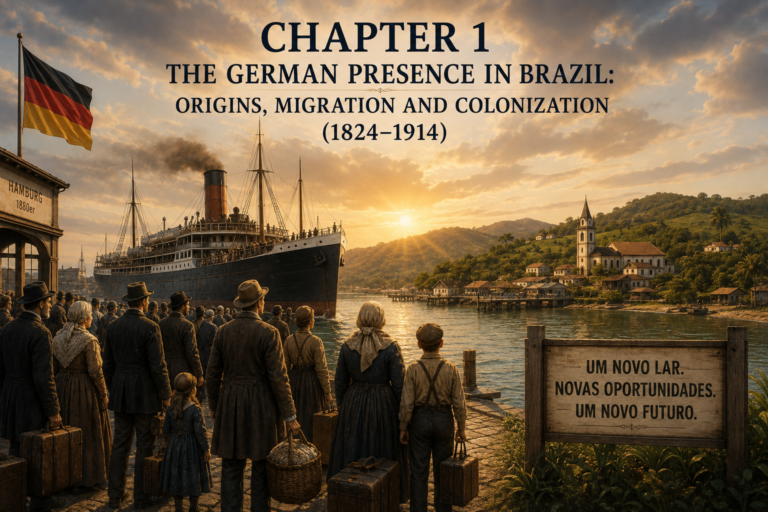
German immigration to Brazil did not begin as an ideological project. It originated as part of the Brazilian Empire’s colonization policy following independence in 1822. Facing an immense territory with a comparatively small population, the Imperial government sought European settlers who could cultivate land, establish permanent communities and reinforce Brazilian sovereignty, particularly in the southern provinces.¹
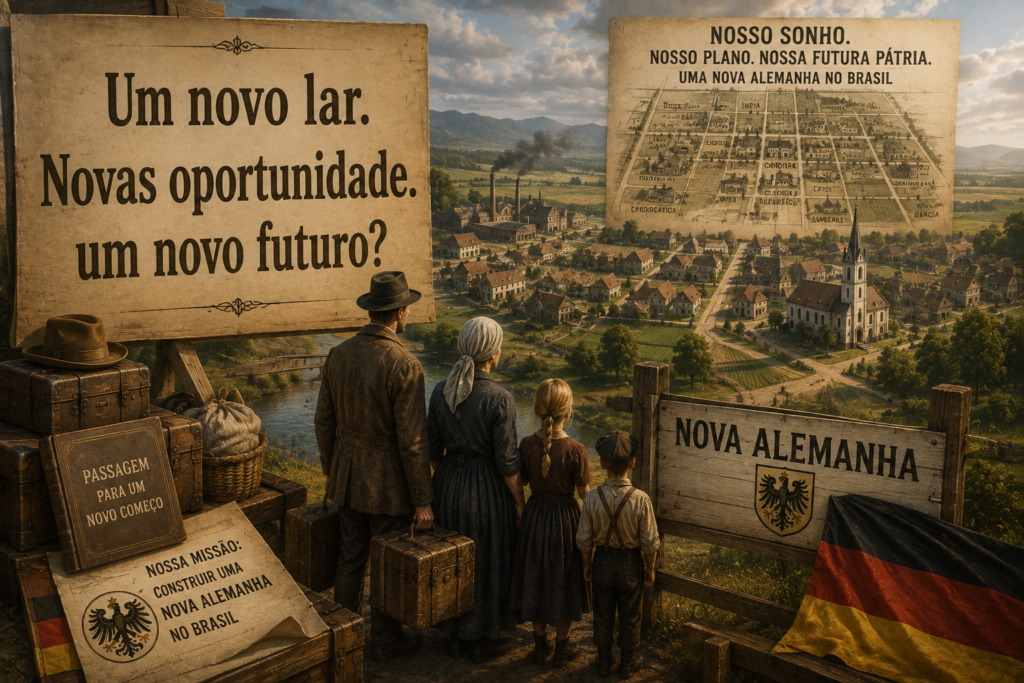
On 25 July 1824, the first officially organized group of German-speaking immigrants arrived at São Leopoldo in the Province of Rio Grande do Sul. This date is generally regarded as the beginning of systematic German immigration to Brazil.² During the following decades, additional immigration waves reached southern Brazil, establishing settlements throughout Rio Grande do Sul, Santa Catarina and Paraná, while smaller communities emerged in Espírito Santo, São Paulo and other provinces.³
It is important to emphasize that these immigrants did not originate from a unified German nation-state. Before the proclamation of the German Empire in 1871, Germany consisted of numerous kingdoms, grand duchies, duchies, principalities and free cities, each possessing its own government, legal traditions and regional identity. Consequently, the expression German immigrants refers primarily to a linguistic and cultural community rather than to citizens of a single political state.⁴
Religious diversity reflected this political fragmentation. Lutheran and Roman Catholic immigrants frequently settled in neighbouring colonies while maintaining distinct ecclesiastical structures. Regional traditions also varied considerably. Bavarians, Prussians, Württembergers, Hessians and Pomeranians often differed in dialect, customs and political culture. Social backgrounds were equally heterogeneous, including farmers, craftsmen, merchants, teachers, physicians, engineers and members of the clergy.⁵
These differences prevent any historically accurate characterization of German immigration as a politically or culturally homogeneous movement.
Instead, German-speaking Brazil gradually evolved into a mosaic of communities sharing language and many cultural traditions while preserving significant regional and confessional differences.
2.1 From Settlements to Communities
The first immigrant colonies faced conditions very different from those many settlers had anticipated before leaving Europe.
Most families received land covered by dense subtropical forest. Roads were scarce or entirely absent. Medical assistance was limited, markets remained distant and governmental support frequently proved insufficient. During the first decades, survival depended largely upon cooperation among settlers themselves.⁶
This necessity encouraged the rapid creation of local institutions.
Schools often appeared before permanent church buildings had been completed. In many settlements, classes initially took place in private houses, temporary wooden structures or rooms shared with religious congregations. Teachers enjoyed considerable social prestige because education occupied an important position within many German-speaking communities long before emigration. Literacy rates among German immigrants were generally higher than those prevailing in large parts of rural Brazil during the nineteenth century, increasing the demand for organized instruction.⁷
Teachers frequently exercised responsibilities extending well beyond education.
They acted as choir directors, librarians, community secretaries, musicians and organizers of cultural activities. In smaller settlements they often became among the principal intellectual leaders of local society. Their influence therefore reached far beyond classroom instruction.
Religious institutions developed in a similar manner.
Whether Lutheran or Catholic, churches rapidly became centres of community life. Beyond religious services they organized charitable activities, maintained parish registers, celebrated community festivals, mediated local conflicts and frequently supported educational initiatives. In many colonies, church and school constituted the first stable public institutions established after settlement.⁸
The establishment of these institutions followed practical rather than political considerations.
Parents desired education for their children.
Families required religious services.
Communities sought mutual assistance during illness, crop failures and other hardships.
Consequently, the institutional development of German-speaking Brazil cannot be interpreted retrospectively through the political conflicts of the twentieth century.
Its origins belonged to the practical realities of nineteenth-century immigrant life.
2.2 Language as the Foundation of Institutional Continuity
Among the many elements contributing to institutional cohesion, language occupied a particularly important position.
German served simultaneously as the language of family life, religious worship, education, commerce and cultural activities. Because many first-generation immigrants possessed only limited knowledge of Portuguese, schools naturally conducted instruction in German. Religious services likewise continued in the language familiar to their congregations. Newspapers, books and almanacs imported from Europe reinforced this linguistic continuity.⁹
Language preservation should not be interpreted automatically as political separatism.
Throughout the nineteenth century, immigrant communities across the Americas maintained their native languages while simultaneously participating in the civic and economic life of their adopted countries. Italian, Polish, Ukrainian and Japanese immigrants in Brazil developed comparable educational and cultural institutions. German-speaking communities therefore reflected a broader international pattern rather than a uniquely German phenomenon.¹⁰
Nevertheless, language produced important institutional consequences.
Schools required teachers.
Teachers required textbooks.
Textbooks encouraged publishing.
Publishing stimulated newspapers.
Newspapers fostered reading societies.
Reading societies created libraries.
Libraries encouraged literary and cultural associations.
Over successive generations these institutions became increasingly interconnected, creating a German-speaking public sphere extending far beyond individual settlements.
This development preceded the emergence of National Socialism by many decades.
It therefore constituted an historical framework rather than a political project.
2.3 The Emergence of an Institutional Landscape
By the beginning of the twentieth century, German-speaking Brazil possessed an extensive institutional network.
Hundreds of schools operated in immigrant communities.
Numerous Lutheran and Catholic congregations maintained churches throughout southern Brazil.
German-language newspapers circulated regularly among dispersed settlements.
Choirs, orchestras, theatrical groups, gymnastic associations (Turnvereine), shooting clubs (Schützenvereine), singing societies, agricultural cooperatives and mutual assistance organizations became characteristic features of community life.¹¹
Commercial development accompanied institutional growth.
German-speaking merchants established import and export companies linking Brazil with Germany.
Industrial enterprises emerged in sectors including textiles, metallurgy, brewing, food processing and machinery.
Banks and commercial agencies facilitated financial transactions between Brazil and Europe.
Professional associations connected physicians, engineers, teachers, lawyers and businessmen sharing linguistic and cultural backgrounds.¹²
These institutions varied considerably in size, purpose and political orientation.
Many operated entirely at the local level.
Others maintained regional or even international connections.
Most pursued educational, religious, commercial or cultural objectives without direct involvement in partisan politics.
Collectively, however, they formed an institutional landscape unprecedented among immigrant communities in Brazil.
It was within this landscape—not within isolated rural settlements—that the political developments of the twentieth century would later unfold.
2.4 More Than Economic Improvement: The Reproduction of German Institutional Life
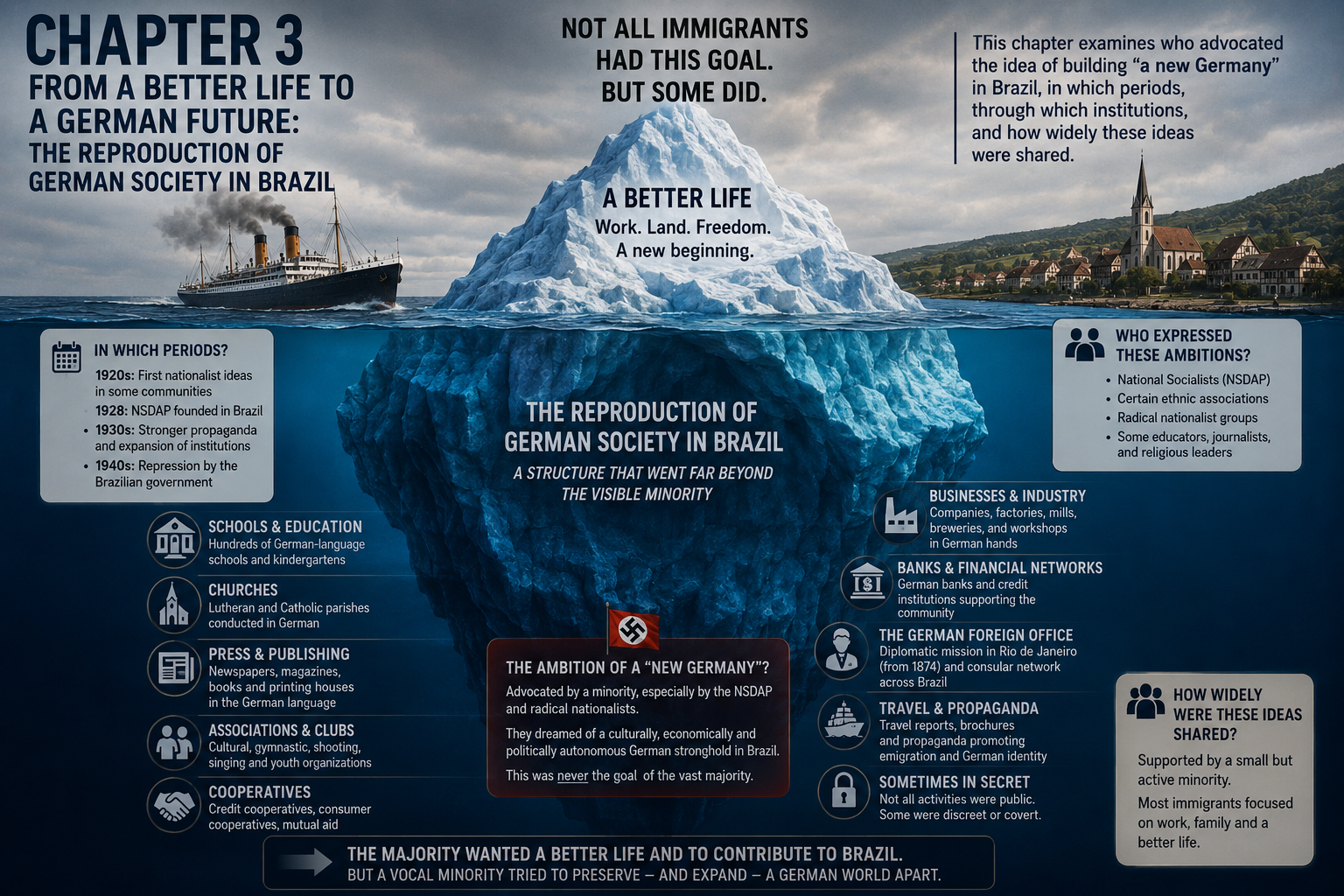
German immigration to Brazil cannot be understood exclusively as the movement of individuals seeking land, employment, security, or improved economic conditions. Those motives were unquestionably important, and for many emigrants they were decisive. Yet the communities that developed in southern Brazil did more than create livelihoods. They reproduced an extensive German-speaking social world through schools, churches, newspapers, publishing houses, associations, commercial firms, industrial enterprises, banks, cooperatives, professional networks, and transatlantic connections.
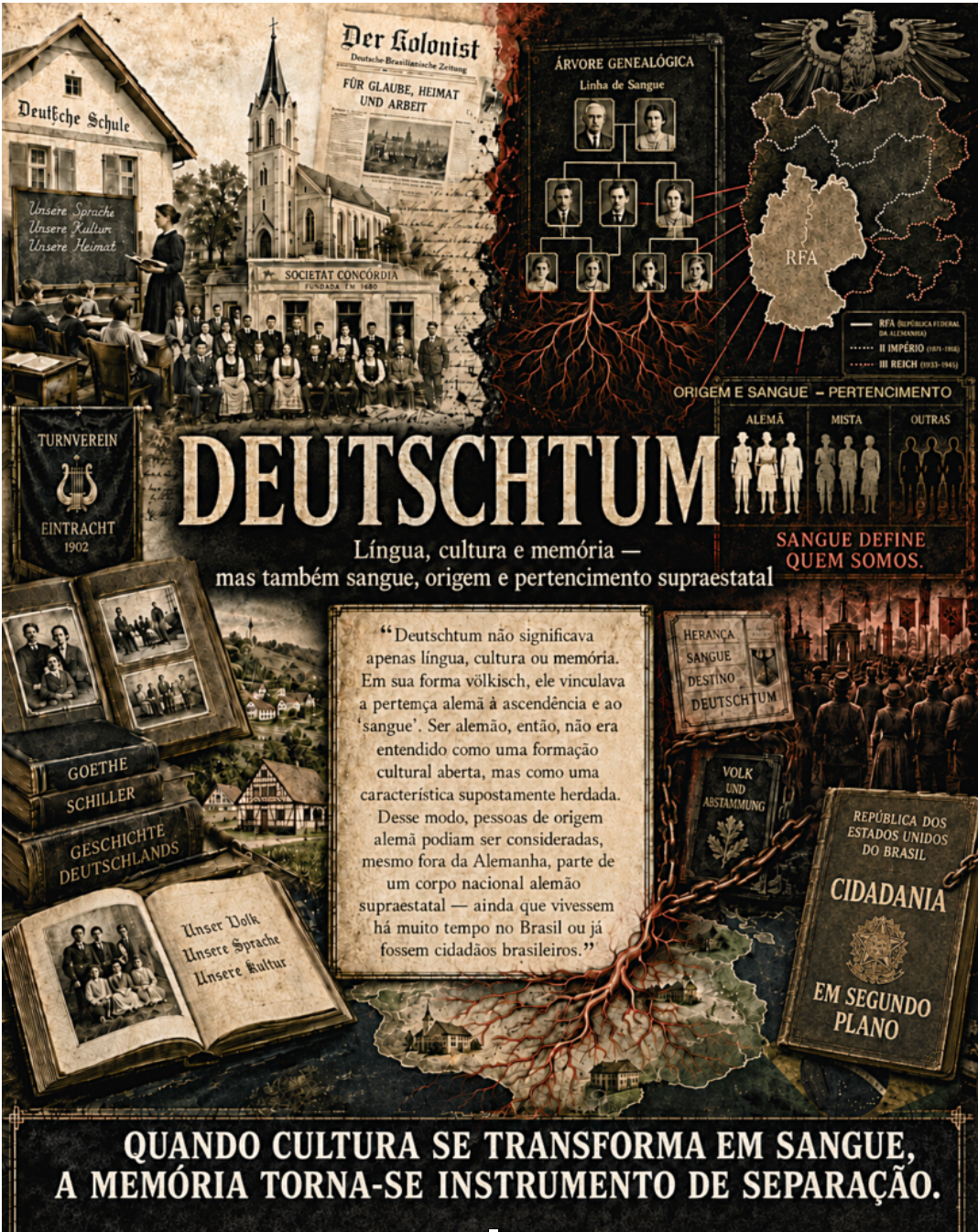
This institutional construction was not merely the unintended result of immigrants living near one another. In important sectors of German-Brazilian society, the preservation of language, customs, education, religion, and collective identity became an explicit objective. The German-language school was especially important because it transmitted language and cultural identity to generations born in Brazil. Research on Santa Catarina describes such schools not simply as educational establishments but as institutions central to the historical construction of germanidade, or Deutschtum.¹
The same function was performed by churches, associations, newspapers, and the written word. Historical studies emphasize that these institutions preserved and transmitted ethnic values from one generation to the next and helped distinguish German-speaking communities from surrounding Brazilian society.² By 1930, more than 1,200 institutions identified as German schools reportedly existed in Brazil, including primary, secondary, vocational, and advanced educational establishments.³ The scale of this network indicates that the maintenance of German language and cultural continuity was neither incidental nor confined to private family life.
The objective was not necessarily the establishment of a separate sovereign German state on Brazilian territory. Such a claim would require specific evidence and cannot be attributed indiscriminately to every immigrant. Nevertheless, influential sectors sought something substantially more ambitious than private cultural remembrance. They aimed to reproduce a durable German social and institutional environment within Brazil: German-speaking children educated in German schools; religious communities organized around German traditions; newspapers and publishers sustaining a German public sphere; associations cultivating German customs; and businesses, industries, banks, and commercial organizations reinforcing a connected German-Brazilian economic society.
The economic dimension was indispensable to this project. Cultural institutions could not endure for generations without material support. Merchants, entrepreneurs, industrialists, banks, cooperatives, insurers, and commercial associations supplied employment, capital, communication, organizational leadership, and financial resources. In cities such as Curitiba, German-owned commercial establishments had acquired a conspicuous position by the end of the nineteenth century, while German-Brazilian ways of life remained publicly visible through religious, cultural, and civic organizations.⁴ Economic success itself could also be interpreted within the ideology of germanidade: productive work, discipline, prosperity, and institutional achievement were presented by some actors as expressions of supposed German collective qualities.⁵
The resulting environment was therefore not merely a collection of immigrant institutions. It represented the reproduction of a German-oriented society inside Brazil, even though its members lived under Brazilian sovereignty and increasingly included Brazilian-born descendants. The concept of Deutschbrasilianertum expressed this dual condition: an identity claiming a place in Brazil while preserving a distinct German cultural and ethnic inheritance. Historical scholarship describes this identity as emerging through social, political, and cultural expressions of Deutschtum formed during the interaction between German immigrants and Brazilian society.⁶
This development also contained an inherent conflict. Brazil was not an empty space upon which Europeans could simply reproduce their society without consequence. German settlements existed within a sovereign country possessing its own population, languages, cultures, institutions, and political order. Where cultural preservation became social separation, or where German traditions were treated as superior to Brazilian culture, the project ceased to be merely one of immigrant continuity. It became a struggle over belonging, authority, education, and the cultural character of Brazilian territory.
The density of schools, churches, newspapers, associations, industries, companies, banks, and consular connections therefore requires a more critical interpretation. These institutions served practical and legitimate functions, but collectively they could also sustain an alternative social space in which German identity remained stronger than identification with Brazil. The central historical question is not whether every German immigrant wanted to create a “new Germany.” The question is how far influential organizations and social leaders worked to ensure that areas settled by Germans would remain permanently German in language, culture, institutions, economic organization, and collective consciousness.
Footnotes – Chapter 2
1. Jean Roche, A colonização alemã e o Rio Grande do Sul, 2 vols., translated from the French by Emery Ruas (Porto Alegre: Editora Globo, 1969). The work reconstructs the development of German settlement from São Leopoldo in 1824 and examines its demographic, agricultural, urban, educational, cultural, and economic structures.
2. Jean Roche, A colonização alemã e o Rio Grande do Sul, 2 vols., translated from the French by Emery Ruas (Porto Alegre: Editora Globo, 1969), vol. 1.
3. Emílio Willems, A aculturação dos alemães no Brasil: estudo antropológico dos emigrantes alemães e seus descendentes no Brasil, Biblioteca Pedagógica Brasileira, Série V, Brasiliana, vol. 250 (São Paulo: Companhia Editora Nacional, 1946).
4. Jean Roche, A colonização alemã e o Rio Grande do Sul, 2 vols., translated from the French by Emery Ruas (Porto Alegre: Editora Globo, 1969), especially the sections concerning education, linguistic continuity, and the institutional organization of the colonies.
5. Martin Norberto Dreher, Igreja e germanidade: estudo crítico da história da Igreja Evangélica de Confissão Luterana no Brasil (São Leopoldo: Editora Sinodal, 1984).
6. Emílio Willems, A aculturação dos alemães no Brasil: estudo antropológico dos emigrantes alemães e seus descendentes no Brasil, Biblioteca Pedagógica Brasileira, Série V, Brasiliana, vol. 250 (São Paulo: Companhia Editora Nacional, 1946), especially the chapters concerning language, education, the press, associations, and cultural change.
7. Jean Roche, A colonização alemã e o Rio Grande do Sul, 2 vols., translated from the French by Emery Ruas (Porto Alegre: Editora Globo, 1969), especially the sections concerning commerce, foreign trade, urban development, and the economic integration of the German colonies.
8. Warren Dean, The Industrialization of São Paulo, 1880–1945 (Austin: University of Texas Press, 1969); Jean Roche, A colonização alemã e o Rio Grande do Sul, 2 vols., translated from the French by Emery Ruas (Porto Alegre: Editora Globo, 1969), vol. 2, especially the sections concerning crafts, manufacturing, industrialization, and German-Brazilian entrepreneurship.
9. Jean Roche, A colonização alemã e o Rio Grande do Sul, 2 vols., translated from the French by Emery Ruas (Porto Alegre: Editora Globo, 1969), vol. 2, especially the sections concerning credit, commercial capital, cooperatives, banks, insurance, and relations between agricultural production and industrial development.
10. Jean Roche, A colonização alemã e o Rio Grande do Sul, 2 vols., translated from the French by Emery Ruas (Porto Alegre: Editora Globo, 1969), vol. 2, especially the sections concerning merchants, industrialists, urban professionals, commercial associations, and German-Brazilian economic networks.
11. Jean Roche, A colonização alemã e o Rio Grande do Sul, 2 vols., translated from the French by Emery Ruas (Porto Alegre: Editora Globo, 1969), especially the sections concerning ports, river and railway transport, postal communication, migration routes, and commercial connections between the colonies and overseas markets.
12. Politisches Archiv des Auswärtigen Amts, Berlin, records of the German diplomatic and consular representations in Brazil, particularly the holdings concerning emigration, consular administration, shipping, commerce, German nationals, and German-Brazilian economic relations. A specific archival signature must be added only after the relevant file has been consulted.
13. Jean Roche, A colonização alemã e o Rio Grande do Sul, 2 vols., translated from the French by Emery Ruas (Porto Alegre: Editora Globo, 1969); Emílio Willems, A aculturação dos alemães no Brasil: estudo antropológico dos emigrantes alemães e seus descendentes no Brasil, Biblioteca Pedagógica Brasileira, Série V, Brasiliana, vol. 250 (São Paulo: Companhia Editora Nacional, 1946); Jeffrey Lesser, Negotiating National Identity: Immigrants, Minorities, and the Struggle for Ethnicity in Brazil (Durham, NC, and London: Duke University Press, 1999).
14. Ademir Valdir dos Santos, „Cultura e língua alemãs na escola de Santa Catarina: construção histórica da germanidade,“ EntreVer: Revista das Licenciaturas, vol. 3, no. 5 (July–December 2013): 116–141.
15. Giralda Seyferth, Imigração e Cultura no Brasil (Brasília: Editora Universidade de Brasília, 1990).
16. Giralda Seyferth, „A Colonização Alemã no Brasil: Etnicidade e Identidade,“ Revista Brasileira de Ciências Sociais.
17. Jean Roche, A Colonização Alemã e o Rio Grande do Sul. 2 vols. Porto Alegre: Editora Globo, 1969.
18. Emílio Willems, A Aculturação dos Alemães no Brasil: Estudo Antropológico dos Emigrantes Alemães e Seus Descendentes no Brasil. Biblioteca Pedagógica Brasileira, Série V, Brasiliana, vol. 250. São Paulo: Companhia Editora Nacional, 1946.
19. Martin Norberto Dreher, Igreja e Germanidade: Estudo Crítico da História da Igreja Evangélica de Confissão Luterana no Brasil. São Leopoldo: Editora Sinodal, 1984.
20. Arthur Blásio Rambo, A Escola Comunitária Teuto-Brasileira Católica. São Leopoldo: Editora UNISINOS.
21. Jeffrey Lesser, Negotiating National Identity: Immigrants, Minorities, and the Struggle for Ethnicity in Brazil. Durham, NC: Duke University Press, 1999.
22. Márcio de Oliveira, „A Cidade de Curitiba e os Imigrantes Alemães Durante a Primeira Guerra Mundial: Uma Análise da Imprensa Local,“ Cadernos CERU, vol. 23, no. 2 (2012): 175–196.
23. Giralda Seyferth, „Etnicidade, Política e Ascensão Social: Um Exemplo Teuto-Brasileiro,“ Mana, vol. 5, no. 2 (1999): 61–88.
24. Giralda Seyferth, „A Ideia de Cultura Teuto-Brasileira: Literatura, Identidade e os Significados da Etnicidade,“ Horizontes Antropológicos, vol. 10, no. 22 (2004): 149–197.
25. Giralda Seyferth, „A Dimensão Cultural da Imigração,“ Revista Brasileira de Ciências Sociais, vol. 26, no. 77 (2011): 47–62.
26. René E. Gertz, O Fascismo no Sul do Brasil: Germanismo, Nazismo, Integralismo. Porto Alegre: Mercado Aberto, 1987.