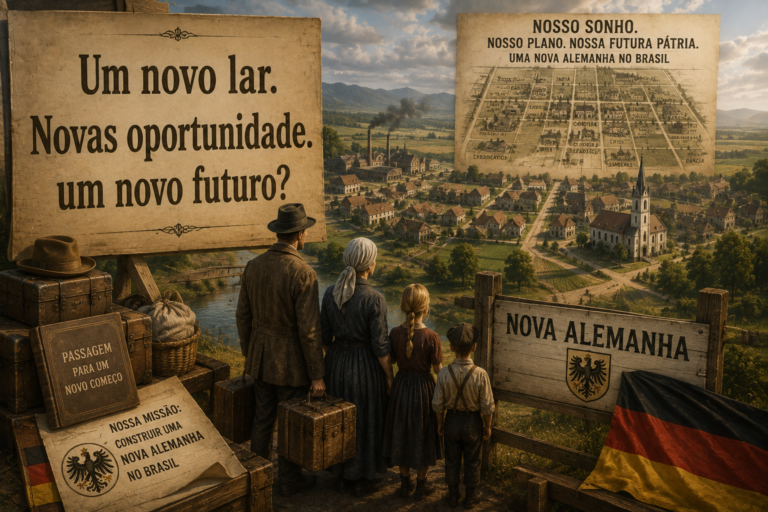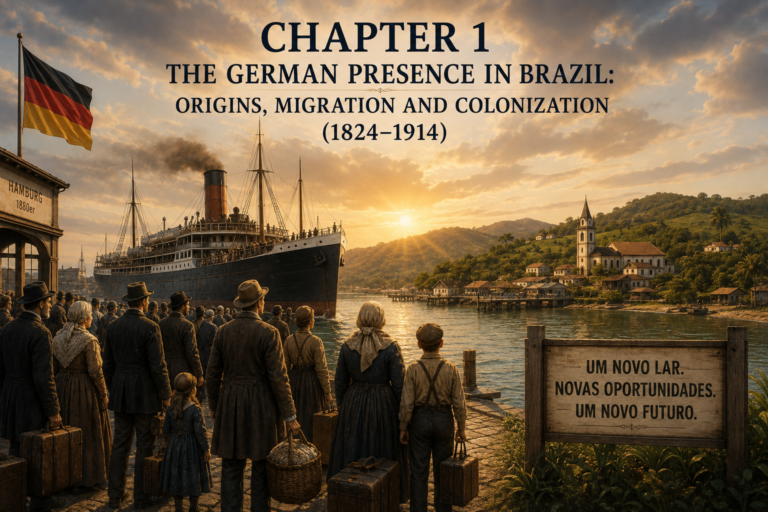
The first German immigrants who arrived in Brazil sought, above all, land, security, religious freedom, economic opportunity and a better future for themselves and their families. Their motivations were diverse and changed over time. No single explanation can account for the decisions of the hundreds of thousands of German-speaking immigrants who settled in Brazil during the nineteenth and early twentieth centuries.¹
Yet immigration does not end when a ship reaches its destination.
The more significant historical question concerns what immigrants attempted to build after their arrival.
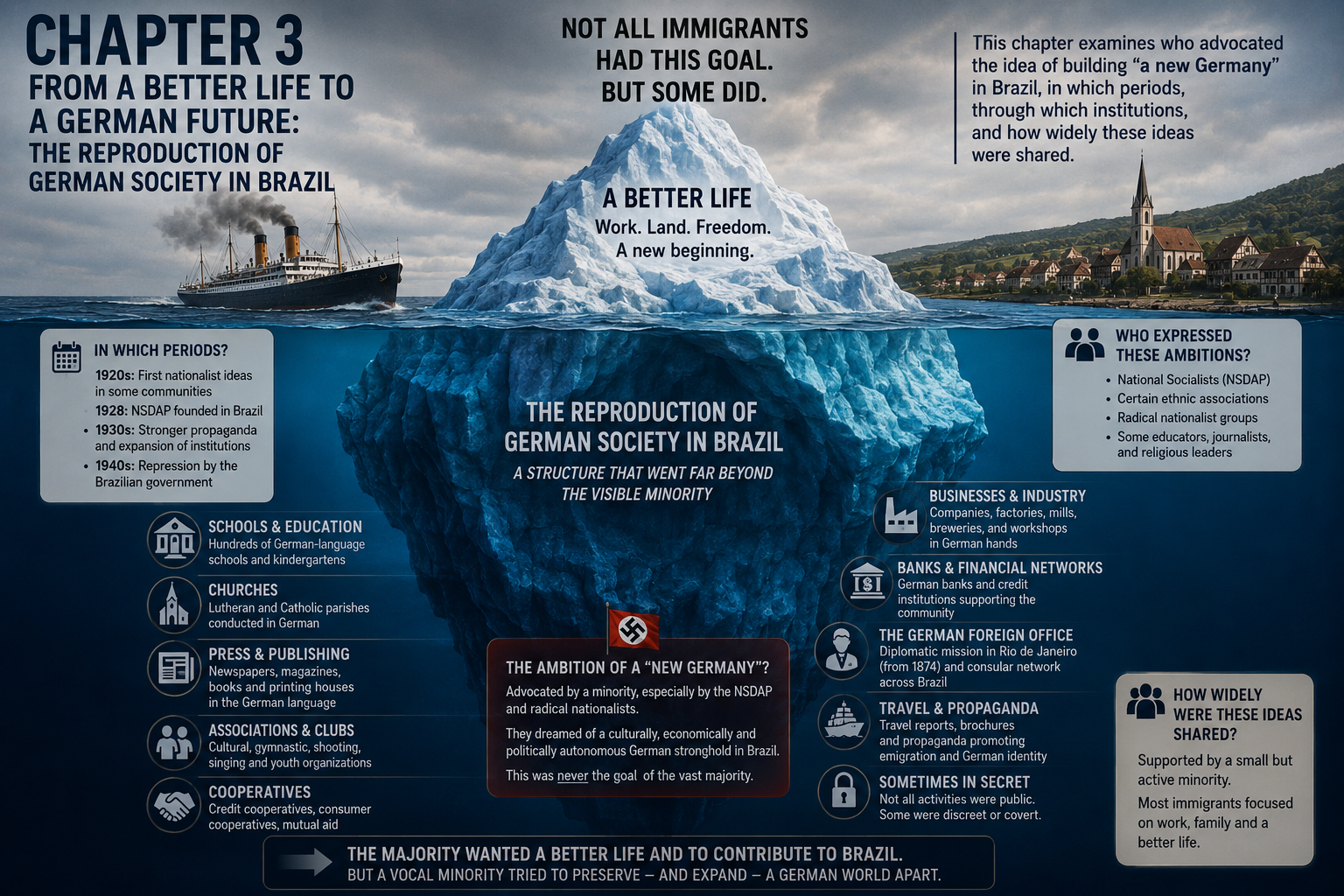
The German-speaking communities established in Brazil did not simply cultivate farms or open businesses. Over successive generations they created schools, churches, newspapers, publishing houses, cultural associations, gymnastic societies, singing clubs, commercial companies, banks, industrial enterprises, professional organizations, charitable institutions and diplomatic connections. These institutions formed an increasingly dense social environment that allowed German language, traditions and collective identity to continue long after settlement.²
This raises a fundamental historical question.
Were these institutions created merely to preserve the cultural heritage of immigrant communities?
Or did at least some influential individuals and organizations understand them as part of a broader project to reproduce a lasting German society in Brazil?
This chapter examines that question.
It does not assume that all German immigrants shared such ambitions. Nor does it suggest that every German institution pursued political objectives. Instead, it investigates which individuals, organizations and intellectual currents promoted the preservation of Deutschtum (Germanness), how they understood the relationship between Germany and German communities abroad, and whether parts of this institutional landscape sought something more ambitious than cultural continuity.
3.1 Immigration or Institutional Reproduction?
Every immigrant community preserves elements of its culture.
Language, religion, customs and family traditions commonly survive migration. Such continuity, by itself, does not distinguish German immigration from that of Italians, Poles, Japanese or many other groups that settled in Brazil.
The German case nevertheless presents a particular historical characteristic.
Within a relatively short period, German-speaking immigrants established an exceptionally extensive institutional network that functioned largely in their own language and according to their own educational, religious, economic and cultural traditions. Schools taught in German. Newspapers circulated in German. Churches conducted services in German. Associations organized cultural life in German. Commercial enterprises maintained close economic links with Germany. Banks financed businesses connected with German-speaking entrepreneurs. Consulates and diplomatic representatives maintained regular contact with immigrant communities.³
The resulting environment allowed many descendants born in Brazil to grow up inside a largely German-speaking institutional world.
For some contemporaries, this represented the successful preservation of cultural heritage.
For others, it represented something more: the continuation of German society beyond the borders of Europe.
3.2 Deutschtum: More Than Language
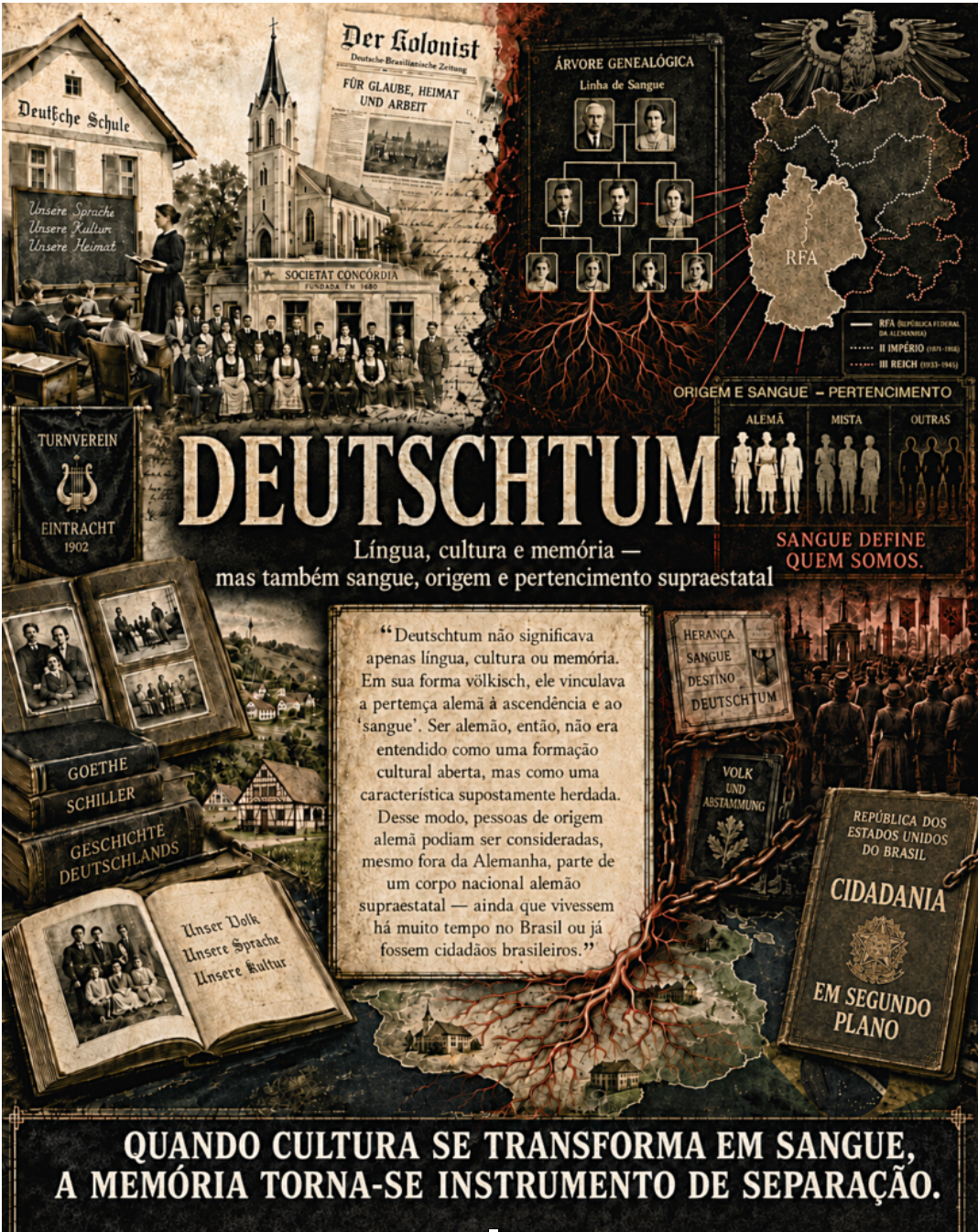
The concept of Deutschtum occupies a central place in understanding German communities abroad.
The word cannot be translated simply as „German culture.“ It referred to a broader idea encompassing language, historical memory, education, traditions, religion, moral values, social organization and collective identity.
During the nineteenth century, organizations devoted to German communities overseas frequently argued that emigrants should not cease to be Germans merely because they had settled in another country. Schools, churches, newspapers and associations therefore acquired a mission extending beyond their immediate practical functions: they became guardians of Deutschtum.⁴
This objective did not necessarily imply political separatism or hostility toward Brazil.
For many participants it meant preserving language and cultural heritage.
Others, however, envisioned German settlements as permanent centres of German civilization abroad.
It is precisely this distinction that requires careful historical examination.
3.3 A German Society Inside Brazil?
By the beginning of the twentieth century, southern Brazil contained areas where German institutions shaped everyday life from childhood to adulthood.
Children attended German schools.
Families worshipped in German churches.
Newspapers informed readers in German.
Associations organized social life.
Businesses employed German-speaking workers.
Banks financed commercial activity.
Industrial enterprises produced goods through networks largely controlled by German-speaking entrepreneurs.
Shipping companies maintained commercial links with Germany.
Consulates represented German governmental interests.
Taken individually, none of these institutions demonstrates an intention to establish „a new Germany.“
Collectively, however, they raise an important historical question.
At what point does the preservation of immigrant culture become the reproduction of an alternative society?
This question cannot be answered through ideology alone.
It requires the examination of speeches, newspapers, educational policies, organizational statutes, commercial correspondence and diplomatic archives.
Only then is it possible to determine whether some influential actors regarded southern Brazil not merely as a place where Germans lived, but as a place where German society itself should continue to exist and expand.
3.4 The Iceberg Beneath the Institutions
The previous chapter described the visible institutional landscape.
This chapter examines its underlying purpose.
The schools, churches, newspapers, associations, companies, banks, industries, shipping lines and diplomatic networks did not exist independently of one another. Together they created an interconnected social environment capable of transmitting language, identity, values, information, economic resources and collective memory across generations.
The visible institutions therefore represent only the upper part of the historical phenomenon.
Beneath them lay a deeper ideological layer composed of ideas about identity, belonging, loyalty, nation, ethnicity and the future of German communities outside Europe.
Understanding this deeper layer is essential because it helps explain why institutional continuity proved remarkably resilient over more than a century.
Whether these ideas amounted merely to cultural preservation or, in some circles, to the ambition of reproducing a lasting German society in Brazil is the central question investigated in the following sections.