Whenever particularly harsh peace treaties in European history are discussed, the name Versailles almost inevitably comes up. In German historical memory, the 1919 treaty became the symbol of a humiliating “dictated peace”: Germany lost territories and colonies, was required to disarm, pay reparations, and accept responsibility for the damage caused by the war.
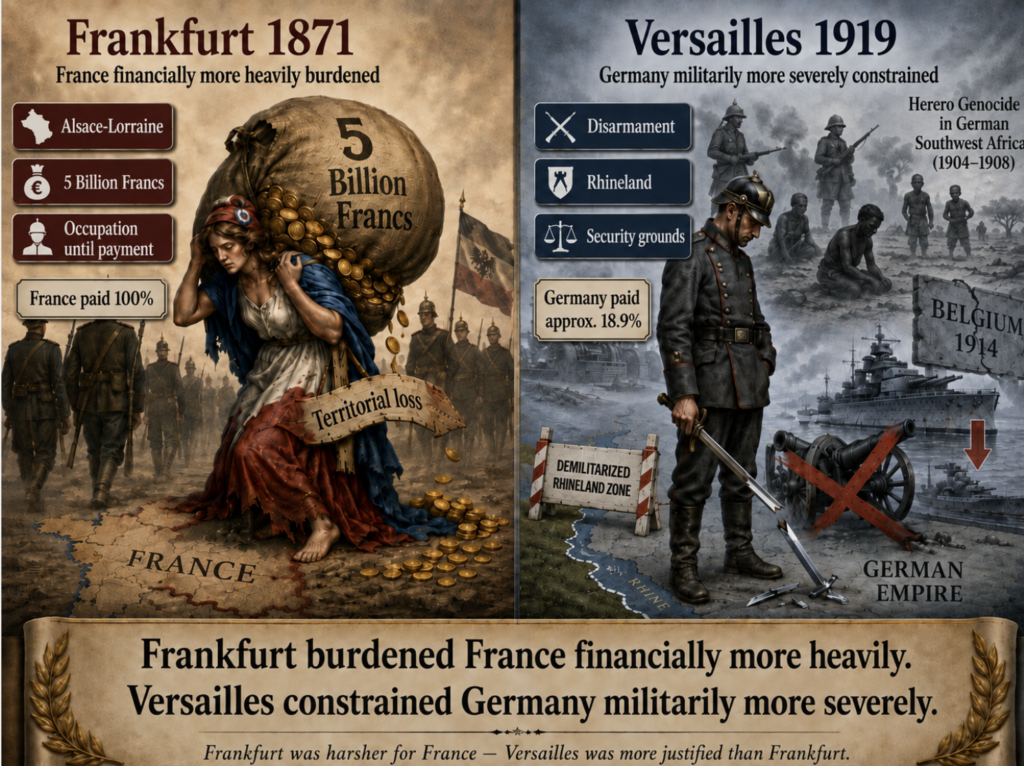
Far less often is it remembered that only 48 years earlier, the German Empire itself had imposed conditions on a defeated neighbor that were likewise extraordinarily severe. The Treaty of Frankfurt of May 10, 1871, which ended the Franco-Prussian War, forced France not only to cede Alsace and parts of Lorraine but also to pay an enormous war indemnity. German troops remained on French soil as security until France had paid.¹
The question, therefore, is: Which treaty was actually harsher – Frankfurt for France or Versailles for Germany?
The answer is less clear-cut than the cultures of remembrance in the two countries might suggest.
France in 1871: Territorial Loss, a Demand for Billions, and Occupation
Following its military defeat, France was forced in 1871 to cede large parts of Alsace and Lorraine to the newly founded German Empire. Around 1.6 million people lived in the ceded territories. France thus lost not only territory and population, but also economically important regions.²
Even more extraordinary was the financial demand.
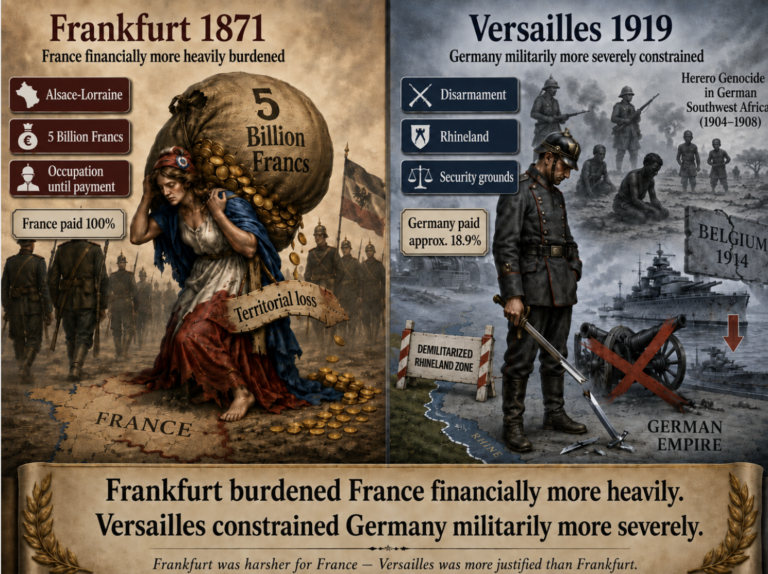
France had to pay five billion gold francs to Germany. The amount had to be raised within three years. Until the payments had been secured or completed, parts of France remained occupied by German troops.³
The demand was by no means merely an abstract figure on paper. When the French government argued during the negotiations that it would be unable to raise an indemnity of five billion francs, Bismarck made it clear that Germany would use its military superiority and the continuation or further extension of the occupation of France as a means of pressure. The subsequent peace settlement put this principle into practice: the evacuation of occupied French territory was tied to the progress of the payments. France therefore faced a very concrete alternative: pay, or continue to endure German occupation.⁴
The scale of the demand becomes understandable only when it is compared not with present-day euro amounts, but with France’s economic output at the time. A recent economic-historical study by Simon Hinrichsen estimates the five billion francs at approximately 25 percent of one year’s French economic output. And France actually paid it.⁵
That is the crucial difference from many later reparations demands: the amount did not merely exist on paper.
France mobilized enormous amounts of capital both domestically and abroad and paid off the obligation even faster than required. By September 1873, the last German occupation troops were able to leave France.
The logic of the Frankfurt peace settlement was therefore remarkably direct:
Cede territory. Pay billions. Until payment is complete, the victor remains militarily present in the country.
There was also an enormous symbolic burden. The German Empire had been proclaimed on January 18, 1871, of all places in the Palace of Versailles, while France was losing the war. France was subsequently forced to accept the cession of French territory. Alsace-Lorraine became a central problem in Franco-German relations for decades.⁶
Germany in 1919: A Far More Comprehensive Peace Regime
Versailles, however, went considerably further than Frankfurt in one important respect.
The 1919 treaty was not limited to territorial cessions and financial demands. It intervened deeply in Germany’s military and foreign-policy freedom of action.
As a result of the Treaty of Versailles, Germany lost approximately 13 percent of its pre-war European territory. This figure alone, however, can create a misleading impression, because not all the affected territories had historically been uncontested German territory. Alsace-Lorraine, which Germany had taken from France following its defeat in 1871, was returned to France; the Treaty of Versailles explicitly described this return as the correction of the wrong committed against France in 1871. A substantial part of the territories transferred to the re-established Polish state had likewise belonged to the Polish state before the Partitions of Poland and had come under Prussian and later German rule only as a result of Prussian annexations in the late eighteenth century. Territorially, Versailles therefore did not consist exclusively of reducing Germany as punishment for losing the war; it also partly reversed earlier annexations and restored state sovereignty that had been extinguished or lost. Other border decisions, by contrast, were considerably more complex and reflected not only historical claims but also ethnic, economic, and strategic considerations; plebiscites were therefore provided for in several disputed territories.⁷
Particularly severe were the military provisions. The German army was limited to 100,000 men, the navy was drastically reduced, and Germany was prohibited from maintaining a military air force. The Rhineland was demilitarized; parts of western German territory were to remain temporarily occupied by Allied troops. The treaty provided, in principle, for an occupation of the Rhineland lasting up to 15 years.⁸
In this respect, Versailles was undoubtedly more comprehensive than Frankfurt.
France had been defeated and temporarily occupied in 1871, but after fulfilling its obligations it remained fundamentally free to rebuild its army and resume its role as a major European power. Versailles, by contrast, was intended to place institutional limits on Germany’s military power.
The different treatment of France in 1871 and Germany in 1919 cannot, moreover, be understood merely as different degrees of harshness toward a defeated state. The victorious powers of 1919 could not, of course, know how Germany would develop over the following decades. They did, however, have good reason, based on concrete experience, to fear renewed German aggression. German imperialism, Pan-German and ethno-nationalist movements, the colonial violence of the German Empire, and finally Germany’s attack on France through neutral Belgium in 1914 had demonstrated that German power politics could extend far beyond the defense of its own national territory.⁹
At the same time, the rapid industrialization of the German Empire created the economic and technological foundation for military power on an entirely new scale. What mattered was not simply that Germany was producing ever greater quantities of coal, iron, and steel. A substantial part of this industrial capacity was deliberately made available for the expansion of the machinery of war. Krupp developed not only into one of the largest industrial enterprises in the Empire, but also into its most important armaments manufacturer; German cast-steel cannon, artillery, and later armor plating for warships became products of a highly developed arms industry. The state likewise invested heavily in military infrastructure, armaments, the army, and the navy. Remarkably, part of the war indemnity imposed on France in 1871 was itself used to strengthen German fortifications, establish an Imperial War Chest, and expand the navy.
Particularly far-reaching was the naval expansion pursued from the end of the nineteenth century onward. Through the Naval Laws of 1898, 1900, 1908, and 1912, the German Empire under Alfred von Tirpitz built a High Seas Fleet that ultimately became second only to Britain’s. The 1900 Naval Law aimed to double the German battle fleet. This military build-up was not intended merely to protect Germany’s coastline. It was linked to Germany’s claim to global standing and was intended to enable the country to exert power-political pressure even on Britain, the world’s leading naval power. At the same time, the army was also expanded further; its peacetime strength increased from around 622,000 men in 1910 to more than 800,000 in 1914. For Germany’s neighbors, its industrial expansion therefore represented more than the rise of an economic competitor. It was accompanied by a deliberate and costly transformation of economic strength into military power.¹⁰
The military restrictions imposed on Germany at Versailles were therefore not merely punishment of a defeated country, but also an attempt to contain what had already been experienced as a genuine threat to the European security order. The peacemakers of 1919 could not have known that some nationalist, ethno-nationalist, and expansionist ideas would later be taken up by National Socialism and developed in still more radical form.
What they did not have to merely speculate about, however, after the experiences up to 1918, was that a Germany once again militarily dominant could constitute a serious security risk.¹¹
And What About the Famous German Reparations?
This is where the comparison becomes particularly interesting.
The Treaty of Versailles itself did not yet establish a final total amount of 132 billion gold marks. That figure was determined only in 1921 by the Reparations Commission. Article 231 created the legal basis for this by establishing the responsibility of Germany and its allies for the damage resulting from the war of aggression they had waged. The article is frequently referred to as the “War Guilt Clause,” although its specific legal purpose was primarily to establish the basis for reparations claims.¹²
The nominal amount of 132 billion gold marks was enormous. But the story does not end with that figure.
The payment conditions were changed repeatedly. The Dawes Plan of 1924 and later the Young Plan fundamentally altered the system. At the same time, Germany received extensive international loans. With the onset of the Great Depression, the reparations system eventually largely collapsed.¹³
Germany therefore never came close to paying the originally stipulated nominal sum of 132 billion gold marks in full.
Estimates of the amounts actually transferred vary considerably depending on the method of calculation. Yet precisely this uncertainty reveals a fundamental difference from 1871: France paid the amount imposed on it in full; Germany paid only part of the reparations demand subsequently established.
For the second half of the 1920s, economic-historical studies estimate the reparations actually paid by Germany at approximately 2.5 percent of German gross domestic product per year. They were therefore by no means insignificant, but their actual economic weight differed considerably from the propagandistic impact of the figure of 132 billion gold marks.¹⁴
This produces a striking contrast:
France in 1871: approximately one quarter of one year’s economic output, actually transferred within a few years.
Germany after 1919: a nominally much larger and longer-term demand, but one that was repeatedly reduced, restructured, and ultimately only partially fulfilled.
Financially, therefore, the claim that Versailles was simply harsher than Frankfurt is problematic.
Occupation Versus Occupation
Military occupation also reveals an interesting parallel.
In 1871, Germany explicitly used the occupation of French territory as security for the payment of the indemnity. Only after France had paid did the German troops withdraw completely.
In 1919, the Allies did something structurally comparable. The occupation of territories on the left bank of the Rhine likewise served as a guarantee that the peace terms would be fulfilled. Versailles provided for a phased occupation lasting up to 15 years.¹⁵
Germany in 1919 was therefore confronted with an instrument that the German Empire itself had used against France in 1871: the military presence of the victor as a means of pressure to enforce a peace treaty.
This does not mean that the two systems were identical. The Rhineland arrangements under Versailles were considerably broader and longer-term. Nevertheless, the parallel is unmistakable.
The Psychological Difference
Why, then, did Versailles become a much more powerful national trauma in Germany than Frankfurt did in France?
One reason lies in the political circumstances.
Despite its defeat, France was able relatively quickly in 1871 to demonstrate that it had remained economically and politically capable of action. The spectacularly rapid payment of the German demand even became a demonstration of French financial strength.¹⁶
Germany, by contrast, was in the midst of a profound systemic rupture in 1919. The Empire had collapsed, a new republican order was still being established, millions of soldiers were returning from a four-year world war, and revolutionary conflicts were shaking the country. In this situation, Versailles became directly associated with the new democratic order.
During the decades of the German Empire, a powerful national consciousness had developed around military achievement, rapid industrial expansion, cultural prestige and Germany’s claim to Weltgeltung. Nationalist and Pan-German circles promoted Deutschtum not only within the Reich but also among German communities abroad, while ideas of a specifically German cultural mission increasingly accompanied imperial and world-power ambitions. The much-invoked formula that the world should benefit from the “German character” (am deutschen Wesen die Welt genesen) became part of this wider nationalist discourse. National monuments, military symbolism and monumental forms of representation likewise gave visible expression to a political culture in which Germany was increasingly presented as a rising world power. This outlook was not shared uniformly across German society, but it constituted a powerful current in the public culture of the Wilhelmine Empire. The defeat of 1918 therefore represented more than the loss of a war. It shattered a national self-image that had been built over decades around military strength, economic dynamism, cultural significance and expectations of international power. For many Germans, the sudden transition from imperial Weltgeltung to defeat, disarmament, territorial losses and Allied occupation of parts of western Germany was consequently experienced as a profound loss of national status and prestige.17
The nature of this psychological rupture is particularly well illustrated by the public culture of the German Empire before 1914. A surviving 1913 sound recording commemorating the defeat of Napoleon provides a striking contemporary example of the national self-image being publicly cultivated at the time. Napoleon is described as having proudly called himself “master of the world”; later, after portraying his defeat and flight, the narration declares Napoleon judged and the enemy destroyed. The narrative then culminates in an appeal for Germans to stand firmly together, in repeated affirmations of German identity, and finally in the singing of “Deutschland, Deutschland über alles, über alles in der Welt.” The significance lies not in reading these words as a literal programme of German world conquest, but in the striking confidence with which national unity, military victory and German identity were publicly celebrated. Against such a cultural background, the defeat of 1918, the collapse of the Empire and the restrictions of Versailles represented not merely military and political setbacks, but a profound reversal of an imperial national self-image that had been cultivated only a few years earlier.18
The German Historical Museum points out that the treaty was rejected far beyond the political right and that its opponents described it as a “dictated peace” and a “shameful peace.” Nationalist forces later systematically used Versailles against the Weimar Republic.19
The political impact of a peace treaty is therefore not identical to its economically measurable severity.
Was Versailles Harsher, Then?
It depends on what is meant by “harshness.”
Militarily and in terms of sovereignty, Versailles was harsher. Germany was required to reduce its armed forces drastically, lost its colonies, accepted the demilitarization of the Rhineland, and was subjected to years of international controls and occupation arrangements. Frankfurt contained no comparably comprehensive system of permanent military restrictions for France.
Territorially, both treaties hit the defeated country hard, although Germany’s territorial losses in 1919 were spread across a wider range of areas. For France, however, the loss of Alsace and parts of Lorraine was politically and emotionally extraordinarily significant.
When it comes to the financial burden that was actually and immediately enforced, however, there is much to suggest that Frankfurt was at least equally harsh, and probably even harsher. France actually had to raise a sum equivalent to approximately one quarter of its annual economic output at the time within only a few years. The German reparations demand after the First World War was nominally much larger, but it was spread over a longer period, repeatedly modified, and never paid in full.
This changes the conventional historical picture.
Versailles was not an entirely novel act in which a previously unknown principle was applied to Germany. Less than half a century earlier, the German Empire itself had forced a defeated neighbor to cede territory, pay an enormous financial indemnity, and accept an occupation tied to payment.
For Whom Was It Harshest?
Seen from these perspectives, Versailles appears not only different but, overall, more justifiable than the Frankfurt peace settlement. Versailles restricted Germany militarily more comprehensively, but these restrictions were imposed against the background of an already concretely experienced security threat: the very creation of the German Empire had been closely connected with a sequence of wars – the war fought by Prussia and Austria against Denmark in 1864, the Austro-Prussian War of 1866, and the Franco-Prussian War of 1870–71. These conflicts, later described as the Wars of German Unification, were not identical in their causes or responsibilities, but under Bismarck they served substantially to establish Prussian supremacy and ultimately to create a German nation-state under Prussian leadership. In 1870, France had formally declared war, but Bismarck had deliberately intensified the preceding diplomatic crisis through his editing of the Ems Dispatch; the subsequent war became the decisive instrument for completing German unification. The German Empire had transformed its economic and industrial strength on a massive scale into military power, pursued an expansionist Weltpolitik, attacked France through neutral Belgium in 1914, and had already committed colonial violence that culminated in the genocide of the Herero and Nama. The victorious powers in 1919 therefore did not have to rely on theoretical speculation to conclude that a Germany once again allowed to rearm without restriction could pose a serious risk.20
The Frankfurt peace settlement of 1871, by contrast, rested to a much greater extent on the power of the victor over the defeated. Germany took Alsace-Lorraine from France, demanded five billion francs, and secured payment through the continued occupation of French territory. France paid the imposed indemnity in full. Part of those payments was subsequently even used to strengthen the German military apparatus.
Versailles undoubtedly also contained harsh and, in some cases, controversial provisions. Territorially, however, the treaty did not merely impose new losses on Germany; in part, it also reversed earlier annexations. This is particularly evident in the case of Alsace-Lorraine, whose return to France was explicitly justified as a correction of the wrong committed in 1871. The military restrictions, too, pursued a concrete security-policy objective in addition to punishing the defeated country.21
If one therefore takes into account not only the formal severity of individual treaty provisions but also their historical background, purpose, actual enforcement, and the responsibility of the states involved, there is much to support the conclusion that the Treaty of Versailles was more justifiable than the Treaty of Frankfurt. France was subjected in 1871 to a more immediate and fully enforced financial burden, even though it posed no threat to the European order comparable to German power and expansionist policies up to 1918. Germany, by contrast, did not fully pay the nominal reparations sum established in 1921: according to one widely used calculation, approximately 25 billion gold marks of the stipulated 132 billion gold marks were actually paid – around 18.9 percent of the nominal total.22 Germany was subjected to greater military restrictions in 1919, but those restrictions had an understandable security-policy basis.
Taking historical background, purpose, and actual enforcement into account, France was subjected by the Treaty of Frankfurt to a financially harsher and less justified burden. Germany was more severely restricted militarily by Versailles, but there were concrete security reasons for this in light of German power politics, armaments policy, and warfare up to 1918.
Perhaps this is the most important historical insight to emerge from the comparison: The harshness and the justice of Versailles cannot be seriously assessed without taking Frankfurt into account. Anyone who looks only at what was imposed on Germany in 1919, but not at what Germany itself had imposed on a defeated France in 1871, is looking at only half of Franco-German history.
References
- Friedens-Vertrag zwischen dem Deutschen Reich und Frankreich, Frankfurt am Main, May 10, 1871, Deutsches Reichsgesetzblatt 1871, No. 26, pp. 223–244, especially Arts. 1 and 7, pp. 223–229. The treaty regulated both the territorial provisions and the French indemnity payment, as well as the gradual evacuation of occupied territories.
- On the population of the territory ceded in 1871 and the citizenship status of its approximately 1.6 million inhabitants: Encyclopédie d’histoire numérique de l’Europe (EHNE), “The Option of Nationality,” section on the annexation of Alsace-Lorraine in 1871.
- Friedens-Vertrag zwischen dem Deutschen Reich und Frankreich, May 10, 1871, Art. 7, Deutsches Reichsgesetzblatt 1871, No. 26, p. 228 ff. Article 7 established the payment schedule and explicitly linked individual payment installments to the evacuation of French départements.
- Geoffrey Wawro, The Franco-Prussian War. The German Conquest of France in 1870–1871, Cambridge University Press, Cambridge 2003, p. 305. Drawing on Robert I. Giesberg, Wawro reports that Thiers stated that France could not raise five billion francs, whereupon Bismarck replied that Prussia would occupy France and then see whether the five billion could not be obtained after all; Robert I. Giesberg, The Treaty of Frankfort: A Study in Diplomatic History, Sept. 1870–Sept. 1873, University of Pennsylvania Press, Philadelphia 1966, p. 110.
- Simon Hinrichsen, When Nations Can’t Default. A History of War Reparations and Sovereign Debt, Cambridge University Press, Cambridge 2023, chap. 6: “Franco-Prussian War Indemnities,” pp. 104–111, on the scale of the French indemnity and its financing; Robert I. Giesberg, The Treaty of Frankfort: A Study in Diplomatic History, Sept. 1870–Sept. 1873, University of Pennsylvania Press, Philadelphia 1966, pp. 211–244, on the accelerated repayment and the gradual termination of the occupation.
- Geoffrey Wawro, The Franco-Prussian War. The German Conquest of France in 1870–1871, Cambridge University Press, Cambridge 2003, pp. 282–283, on the proclamation of the German Emperor on January 18, 1871, in the Hall of Mirrors at Versailles and its symbolic significance.
- United States Holocaust Memorial Museum, Holocaust Encyclopedia, “German Territorial Losses, Treaty of Versailles, 1919,” on the scale of Germany’s territorial losses; Treaty of Peace between the Allied and Associated Powers and Germany, Versailles, June 28, 1919, Art. 51 and Arts. 87–93, on Alsace-Lorraine and Poland; Papers Relating to the Foreign Relations of the United States, The Paris Peace Conference, 1919, “Reply of the Allied and Associated Powers to the Observations of the German Delegation on the Draft Treaty of Peace,” section “Poland,” on the historical justification of the Polish border arrangements.
- Treaty of Peace between the Allied and Associated Powers and Germany, Versailles, June 28, 1919, especially Arts. 42–44, 159–160, 181–198, and 428–432; reproduced in: Papers Relating to the Foreign Relations of the United States, The Paris Peace Conference, 1919, Vol. XIII. Article 160 limited the German army to 100,000 men; further provisions concerned the navy, air forces, the Rhineland, and Allied occupation.
- On the programmatic objectives of the Alldeutscher Verband: Alfred Kruck, Die Geschichte des Alldeutschen Verbandes 1890–1939, Wiesbaden 1954, p. 10 f.; on colonial violence and the genocide of the Herero and Nama: Jürgen Zimmerer, “Krieg, KZ und Völkermord in Südwestafrika. Der erste deutsche Genozid,” in: Jürgen Zimmerer/Joachim Zeller (eds.), Völkermord in Deutsch-Südwestafrika. Der Kolonialkrieg (1904–1908) in Namibia und seine Folgen, Berlin 2003, pp. 45–63; on the German attack through neutral Belgium in 1914 and its contemporary assessment: Reply of the Allied and Associated Powers to the Observations of the German Delegation on the Conditions of Peace, June 16, 1919, in: Papers Relating to the Foreign Relations of the United States, The Paris Peace Conference, 1919, Vol. XIII, Washington 1947, pp. 44–46.
- On the industrial development of the German Empire and the importance of Krupp as an armaments company: Deutsches Historisches Museum, LeMO, “Industrie und Wirtschaft”; on the use of the French war indemnity of 1871 for military purposes: F. Hirsch (ed.), Gebhardts Handbuch der Deutschen Geschichte, 6th ed., Vol. 3, Stuttgart 1923, pp. 740–741; reproduced in Johannes Hohlfeld, Deutsche Reichsgeschichte in Dokumenten 1849–1934, Berlin 1927, pp. 85–86; on army armament: Gerd Hohorst/Jürgen Kocka/Gerhard A. Ritter (eds.), Sozialgeschichtliches Arbeitsbuch. Materialien zur Statistik des Kaiserreichs 1870–1914, Vol. 2, Munich 1975, pp. 171–172; on naval construction and its global-political objectives: Deutsches Historisches Museum, LeMO, “Der Flottenbau”.
- On the persistence of völkisch and nationalist currents and their adoption and radicalization under National Socialism: Deutsches Historisches Museum, LeMO, “Die Völkische Bewegung” and “Die NS-Volksgemeinschaft”; on the security-policy assessment of Germany by the victorious powers in 1919: Reply of the Allied and Associated Powers to the Observations of the German Delegation on the Conditions of Peace, June 16, 1919, in: Papers Relating to the Foreign Relations of the United States, The Paris Peace Conference, 1919, Vol. XIII, Washington 1947, pp. 44–46; on concerns regarding renewed German aggression against France: Agreement between the United States of America and France respecting Assistance to France in the Event of Unprovoked Aggression by Germany, Versailles, June 28, 1919, ibid., pp. 758–760.
- Treaty of Versailles, Arts. 231–233; Papers Relating to the Foreign Relations of the United States, The Paris Peace Conference, 1919, Vol. XIII; U.S. Department of State, Office of the Historian, “The Dawes Plan, the Young Plan, German Reparations, and Inter-allied War Debts,” on the subsequent determination of 132 billion gold marks.
- U.S. Department of State, Office of the Historian, “The Dawes Plan, the Young Plan, German Reparations, and Inter-allied War Debts,” on the restructuring of German payments through the Dawes and Young Plans and on international loans.
- Max Hantke/Mark Spoerer, “The Imposed Gift of Versailles: The Fiscal Effects of Restricting the Size of Germany’s Armed Forces, 1924–9,” in: The Economic History Review, Vol. 63, No. 4 (2010), pp. 849–864, especially pp. 849–850, on the actual reparations burden during the second half of the 1920s.
- Friedens-Vertrag zwischen dem Deutschen Reich und Frankreich, May 10, 1871, Art. 7, Deutsches Reichsgesetzblatt 1871, No. 26, p. 228 ff.; Robert I. Giesberg, The Treaty of Frankfort, Philadelphia 1966, pp. 127–244, on the connection between payment and the evacuation of France; Treaty of Versailles, Arts. 428–432, as well as “Agreement with regard to the military occupation of the territories of the Rhine,” Versailles, June 28, 1919, on the phased occupation of the Rhineland as security for compliance with the treaty.
- Simon Hinrichsen, When Nations Can’t Default, Cambridge 2023, chap. 6, pp. 104–111, on France’s access to domestic and foreign capital, its foreign assets, and the financing of the indemnity payment.
- On Reich nationalism, the military character of national monuments, Deutschtum as a conception of cultural superiority, the Wilhelmine idea of a German “cultural mission,” and the increasingly nationalist use of the formula am deutschen Wesen die Welt genesen: Wolfgang Kruse, “Nation und Nationalismus”, Bundeszentrale für politische Bildung (bpb), Das Deutsche Kaiserreich, 2026; on the Pan-German combination of German Weltgeltung, aggressive nationalism, imperialist objectives, and the promotion of Deutschtum abroad: Deutsches Historisches Museum, LeMO, “Alldeutsche”.
- Stiftung Deutsches Rundfunkarchiv, Aus großer Zeit, 1913, Archivnummer 1731300; audio recording and transcript published in German History Intersections, “Aus großer Zeit (1913)”. The recording describes Napoleon as having proudly called himself “Herr der Welt” and later declares “Napoleon war gerichtet, vernichtet war der Feind”, before culminating in appeals to German unity and the singing of “Deutschland, Deutschland über alles, über alles in der Welt.”
- Deutsches Historisches Museum, LeMO, “Versailler Vertrag,” on the widespread rejection of the treaty as a “Diktat-” or “Schandfrieden” and its political instrumentalization against the Weimar Republic.
- On German Weltpolitik, military expansion and the security concerns of the victorious powers in 1919: Deutsches Historisches Museum, LeMO, “Das Kaiserreich”; Reply of the Allied and Associated Powers to the Observations of the German Delegation on the Conditions of Peace, June 16, 1919, in: Papers Relating to the Foreign Relations of the United States, The Paris Peace Conference, 1919, Vol. XIII, Washington 1947, pp. 44–46.
- On the German annexation of Alsace-Lorraine in 1871 and the associated power-political and security-policy motives: Deutsches Historisches Museum, LeMO, “Das Reichsland Elsass-Lothringen”. On the security-policy assessment of Germany by the victorious powers in 1919: Reply of the Allied and Associated Powers to the Observations of the German Delegation on the Conditions of Peace, June 16, 1919, in: Papers Relating to the Foreign Relations of the United States, The Paris Peace Conference, 1919, Vol. XIII, Washington 1947, pp. 44–46.
- On the reparations sum of 132 billion gold marks established in 1921 and the approximately 25 billion gold marks actually paid: Deutsches Historisches Museum, LeMO, “Reparationen”; U.S. Department of State, Office of the Historian, “The Dawes Plan, the Young Plan, German Reparations, and Inter-allied War Debts.” Relative to the nominal sum of 132 billion gold marks established in 1921, 25 billion gold marks correspond to approximately 18.9 percent.