1.1 The Hidden Iceberg
Historical developments rarely emerge in isolation. Political movements, ideological conflicts and institutional crises are generally the visible manifestations of much longer social, cultural, economic and institutional processes. Historians, however, face an important methodological challenge. The surviving documentary record preserves the activities of governments, political parties, public authorities and formal organizations far more extensively than the countless interactions of everyday social life. Consequently, the visible dimensions of history are usually easier to reconstruct than the broader institutional environments from which they emerged.¹
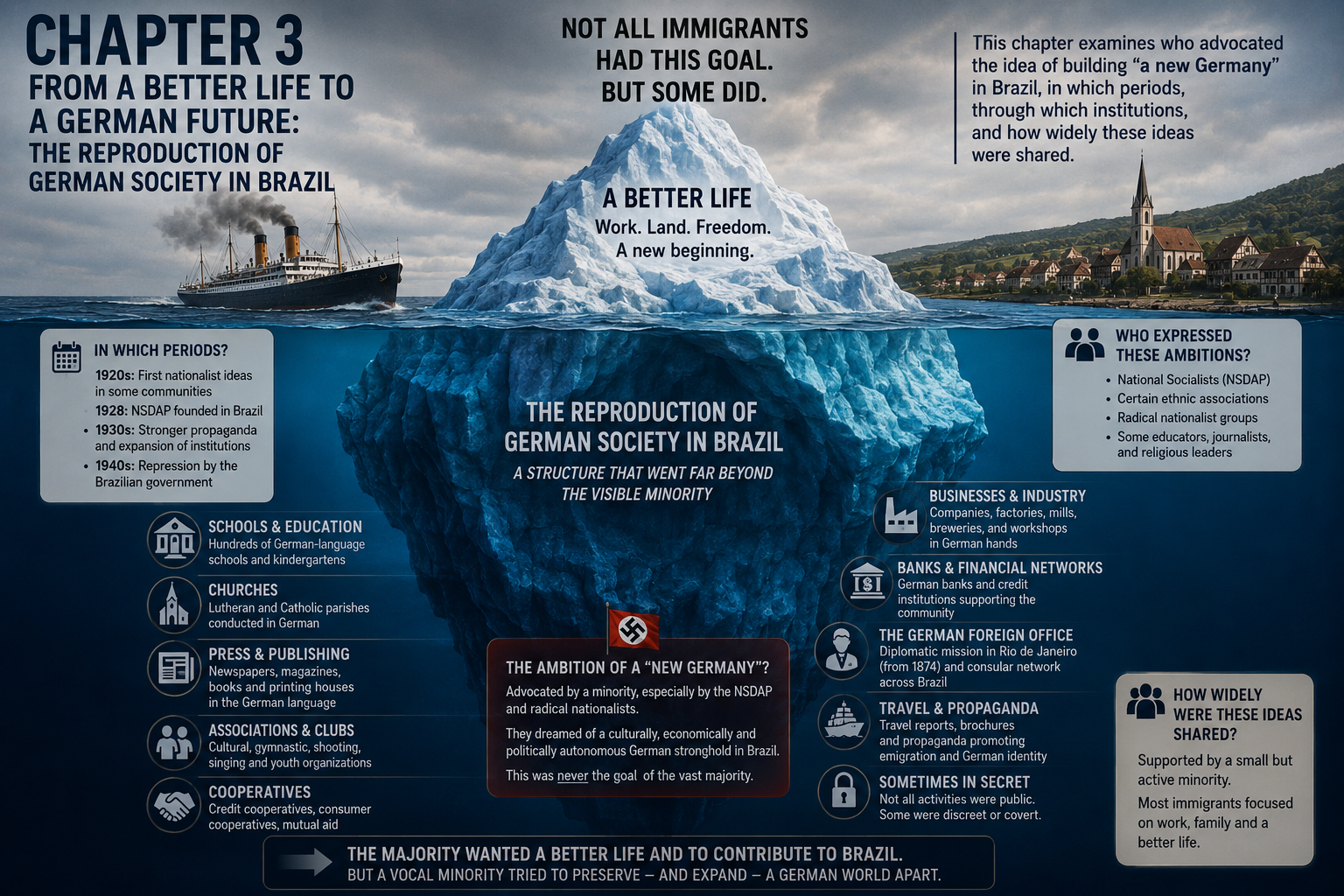
The history of German immigration to Brazil illustrates this methodological problem particularly well. Since the arrival of the first organized German settlers in São Leopoldo in 1824, German-speaking communities progressively developed one of the most extensive institutional landscapes created by any immigrant population in Latin America. Over more than a century, they established schools, churches, newspapers, publishing houses, charitable organizations, cultural associations, commercial enterprises, industries, banks, cooperatives and professional organizations that became firmly rooted in the principal regions of German settlement.²
Considered individually, these institutions fulfilled legitimate and often indispensable functions. Schools educated children in regions where public education remained limited. Churches provided religious guidance and community leadership. Newspapers informed dispersed settlements and created a common public sphere. Associations promoted educational, cultural, charitable and recreational activities. Commercial enterprises and industries stimulated regional economic development, while banks and cooperatives supplied financial resources for agriculture, commerce and investment. Viewed separately, none of these institutions was exceptional, nor did its existence necessarily imply political ambitions beyond the ordinary needs of immigrant communities.³
Their historical significance becomes apparent only when they are examined as components of an integrated institutional environment. Schools educated future teachers, professionals and community leaders. Churches strengthened social cohesion and transmitted shared values across generations. Newspapers connected geographically dispersed settlements through a common language and a continuous flow of information. Associations organized cultural and civic life. Companies, industries and commercial organizations generated employment and economic opportunities, while banks and credit institutions facilitated investment and commercial expansion. Together, these institutions progressively developed into a dense institutional network whose influence extended far beyond the original agricultural colonies.⁴
This institutional environment also maintained continuous relations with Germany. Books, newspapers, educational materials and religious publications circulated across the Atlantic. Commercial firms imported machinery, manufactured goods and technical knowledge while exporting Brazilian products to European markets. German consulates and diplomatic representatives maintained regular contact with German-speaking communities, reporting political, economic and cultural developments to the Auswärtiges Amt. Educational, ecclesiastical and cultural organizations devoted to Germans living abroad encouraged the preservation of the German language and cultural traditions, thereby reinforcing institutional connections between Germany and its emigrant communities. German-speaking communities in Brazil therefore developed not merely as isolated immigrant settlements but as components of a broader transnational environment whose educational, economic and cultural relationships extended beyond Brazilian borders.⁵
The cumulative significance of these developments cannot be understood by examining schools, churches, newspapers, companies or diplomatic institutions separately. Their interaction produced a complex institutional ecosystem that shaped education, economic activity, cultural life, social relations and community leadership over successive generations. This institutional environment formed the structural foundation upon which later ideological and political developments unfolded.
For this reason, the present study adopts the metaphor of the hidden iceberg. The organizations and political events that dominate much of the historiography represent only the visible portion of a much broader historical reality. Beneath that visible surface existed an extensive institutional landscape composed of educational, religious, cultural, economic and transnational structures whose interaction sustained the German-speaking communities in Brazil for more than a century. Reconstructing this hidden environment is therefore an indispensable prerequisite for understanding the historical evolution of Deutschtum and the later political developments examined in the following chapters.⁶
Footnotes
1. Marc Bloch, The Historian’s Craft, trans. Peter Putnam (Manchester: Manchester University Press, 1954); John Lewis Gaddis, The Landscape of History: How Historians Map the Past (Oxford: Oxford University Press, 2002).
….
1.2 Building an Institutional World
The first German settlements established in southern Brazil during the nineteenth century originated primarily as agricultural colonies. For most immigrants, migration represented an opportunity to acquire land, improve their economic circumstances and secure a more stable future for their families. Like many other immigrant communities throughout the Americas, they initially created institutions that responded to immediate practical needs. Schools educated children, churches organized religious life, and mutual-aid associations provided solidarity in communities that were often geographically isolated and only weakly connected to Brazilian state structures.⁷
Had institutional development remained confined to these basic functions, the German experience would not have differed fundamentally from that of numerous other immigrant communities. Italians, Poles, Ukrainians, Japanese and many other immigrant populations likewise established schools, religious institutions and cultural associations while adapting to Brazilian society. The historical importance of the German-speaking settlements therefore lies not simply in the existence of these institutions but in the remarkable breadth, density and continuity of the institutional landscape that gradually emerged over more than a century.
During the second half of the nineteenth century and the early decades of the twentieth century, this institutional environment expanded far beyond its original educational and religious functions. German-language newspapers connected geographically dispersed communities and created a common public sphere through which information, opinions and cultural values circulated. Publishing houses produced newspapers, books, calendars, school textbooks and religious literature. Teachers‘ associations coordinated educational activities and promoted the continued use of German-language instruction. Choirs, theatre groups, Turnvereine, Schützenvereine, charitable organizations and numerous cultural associations became permanent components of community life, reinforcing social cohesion within the German-speaking population.⁸
Education occupied a particularly significant position within this expanding institutional structure. German schools did considerably more than teach literacy and numeracy. They preserved the German language, introduced successive generations to German literature, geography, history and cultural traditions, and prepared future teachers and community leaders. In many settlements, schools simultaneously functioned as educational institutions, cultural centres and visible symbols of collective continuity. Churches complemented this educational mission by providing religious instruction, strengthening social cohesion and organizing important aspects of communal life.⁹
The German-language press performed an equally important function. Newspapers not only informed readers about local developments but also maintained communication among geographically separated colonies and reported political, cultural and economic events in Germany. They announced educational initiatives, commercial activities and cultural events, creating a common German-language public sphere that extended across southern Brazil. Publishing houses ensured the continuous circulation of books, school materials, newspapers and religious publications that sustained this network of communication and reinforced cultural continuity.¹⁰
The significance of this institutional landscape did not result from the existence of individual organizations considered separately but from the manner in which they interacted. Schools educated future professionals and community leaders. Churches reinforced moral authority and social cohesion. Newspapers connected settlements through a shared language and continuous communication. Publishing houses supplied educational and cultural materials. Associations organized social, cultural and civic life. Together these institutions created an integrated organizational framework through which language, traditions, collective memory and institutional experience could be transmitted across successive generations.
This gradual interaction transformed originally isolated agricultural settlements into an interconnected institutional world extending across the principal regions of German settlement in southern Brazil. Increasingly, the continuity of this environment no longer depended exclusively upon individual families but upon permanent institutions capable of educating new generations, preserving organizational structures and reproducing community leadership over long periods.
The significance of this development becomes even more apparent when these educational, religious and cultural institutions are examined together with the economic structures that emerged during the same period. Commercial enterprises, industrial companies, banks, cooperatives and professional organizations progressively became integral parts of the same institutional environment, strengthening both its material foundations and its organizational continuity. Understanding this interaction between educational, cultural and economic institutions is essential because it reveals that the hidden iceberg consisted not of isolated organizations but of an integrated institutional ecosystem whose influence reached far beyond the original settlements.¹¹
Footnotes
…
1.3 Economic Power, Preferential Networks and Institutional Continuity
The institutional landscape of German-speaking Brazil cannot be understood solely through schools, churches and cultural associations. Its continuity depended equally upon the gradual development of an extensive economic infrastructure that provided the material foundations necessary to sustain educational, religious and cultural institutions over successive generations. Schools required buildings, teachers and teaching materials; newspapers depended upon printing presses, subscribers and advertisers; churches and associations relied upon financial support, property and organizational leadership. Economic development therefore did not merely accompany German settlement; it became one of the principal foundations upon which the wider institutional landscape rested.¹²
During the nineteenth and early twentieth centuries, German-speaking immigrants established an increasingly diversified economic structure. Merchants founded trading houses that connected agricultural settlements with regional, national and international markets. Industrial enterprises expanded into sectors such as brewing, textiles, food processing, woodworking, metallurgy and agricultural equipment. Commercial firms imported machinery, books, manufactured goods and technical expertise from Germany while exporting Brazilian agricultural and industrial products to European markets. Banks, credit cooperatives and insurance institutions supplied capital for investment, agricultural production and commercial expansion, thereby reinforcing the long-term stability of the German-speaking institutional environment.¹³
Economic development produced consequences extending well beyond commercial activity. Contemporary descriptions of the colonies repeatedly associated German settlement with productivity, discipline, education and material progress. Prosperous farms, workshops, mills, commercial houses and industrial enterprises were frequently presented as evidence of the success of German colonization and as expressions of supposedly distinctive German virtues. These descriptions did more than celebrate individual achievement. They contributed to the construction of a collective narrative in which economic success, institutional organization and educational attainment increasingly appeared as characteristics of German cultural identity.¹⁴
Educational institutions occupied a central position within this broader social and economic environment. German schools prepared not only future teachers and pastors but also merchants, technicians, engineers, physicians, pharmacists, administrators and entrepreneurs who would later participate in the institutional life of their own communities. Churches reinforced social cohesion and transmitted shared moral values, while newspapers, teachers‘ associations and cultural organizations maintained communication among geographically dispersed settlements. The interaction of these institutions created an environment in which educational qualifications, professional competence and social trust increasingly reinforced one another.¹⁵
The economic sphere extended this institutional continuity into professional and commercial life. German-speaking companies, workshops, commercial houses, industries, cooperatives and financial institutions generated employment, investment opportunities and commercial partnerships. Historical evidence does not justify the conclusion that every German-owned enterprise systematically excluded Brazilians of other origins from employment or commercial cooperation. Nevertheless, common language, attendance at the same schools, participation in the same churches and associations, family relationships and long-established personal trust naturally facilitated cooperation among members of the same institutional environment.
The cumulative significance of these mechanisms deserves particular attention. Schools educated future professionals. Churches and associations strengthened relationships of confidence. Newspapers circulated information throughout the German-speaking public sphere. Merchants and industrialists created employment and commercial opportunities. Banks and cooperatives supplied financial resources for economic expansion. Through the interaction of these institutions, opportunities for education, employment, professional advancement and commercial cooperation increasingly circulated within the same social environment. Cultural continuity and economic development therefore reinforced one another in a mutually sustaining process.
This institutional ecosystem also exerted influence beyond the original immigrant colonies. German-speaking entrepreneurs participated actively in regional economic development. Industrial enterprises became important employers. Members of the German-speaking professional elite increasingly occupied respected positions within commerce, industry, education and municipal life. Consequently, the institutional landscape extended beyond its own communities and became an important component of the broader economic and social development of southern Brazil.
The historical significance of this economic infrastructure therefore cannot be reduced to the existence of individual companies, banks or commercial enterprises. Its deeper importance lay in the interaction between economic resources, educational institutions, churches, associations, newspapers and professional networks. Together these elements created a remarkably dense institutional environment capable of preserving language, strengthening collective identity, generating economic influence and reproducing community leadership across successive generations.
This conclusion does not imply that every individual of German origin pursued identical objectives or participated equally in these institutional networks. Nor does it demonstrate that all professional opportunities resulted exclusively from ethnic preference. It does indicate, however, that the exceptional density of the German-speaking institutional environment created favourable conditions for preferential cooperation within the collective. In this context, the distinction between Wir and die Anderen could acquire practical significance not only in the sphere of cultural identity but also in education, employment, professional advancement, commercial cooperation and access to economic resources.
The economic infrastructure therefore constituted an essential component of the hidden iceberg. It supplied the material basis upon which schools, churches, newspapers and associations could survive, expand and reproduce themselves over time, while simultaneously creating pathways through which members of the German-speaking communities could educate, employ, finance and support one another. The interaction of these institutions transformed the German-speaking settlements into a remarkably cohesive institutional world whose influence extended well beyond its demographic size and whose continuity would shape the historical developments examined in the following chapters.¹⁶
Footnotes
12. Jean Roche, A colonização alemã e o Rio Grande do Sul, 2 vols., trans. Emery Ruas (Porto Alegre: Editora Globo, 1969), vol. 2; Emílio Willems, A aculturação dos alemães no Brasil: estudo antropológico dos imigrantes alemães e seus descendentes no Brasil, 2nd ed. (São Paulo: Companhia Editora Nacional, 1980).
13. Jean Roche, A colonização alemã e o Rio Grande do Sul, vol. 2; Warren Dean, The Industrialization of São Paulo, 1880–1945 (Austin: University of Texas Press, 1969), for the broader context of industrial development in Brazil.
…
1.4 Beyond Brazil: A Transnational Institutional Network
The institutional landscape reconstructed in the preceding sections did not develop in isolation from Germany. Throughout the nineteenth and early twentieth centuries, German-speaking communities in Brazil maintained educational, religious, commercial, diplomatic and cultural relations that extended far beyond the geographical boundaries of individual settlements. These connections did not automatically transform the communities into political extensions of the German state. They did, however, create a transnational institutional environment in which people, publications, ideas, capital and organizational practices circulated continuously between Germany and Brazil.¹⁷
The circulation of information constituted one of the defining characteristics of this transnational environment. German-language newspapers informed readers not only about local developments but also about political, economic and cultural events in Germany. Publishing houses imported books, school textbooks, scientific works, newspapers and religious literature, thereby ensuring that educational and cultural life in Brazil remained closely connected with intellectual developments in the German-speaking world. Teachers relied upon educational materials prepared in Germany, while pastors maintained theological contacts with ecclesiastical institutions that continued to influence religious education and church life within the immigrant communities.¹⁸
…..
Diplomatic and consular relations formed another significant element of this transnational environment. German consulates maintained regular contact with German-speaking communities throughout Brazil, protected the interests of German nationals, reported political and economic developments to the Auswärtiges Amt and facilitated communication between Germany and its emigrant population. Their activities demonstrate that emigration did not terminate institutional relations with Germany. Instead, official diplomatic channels complemented the educational, cultural, commercial and religious connections that had developed independently over many decades.²⁰
These transnational relationships should not be interpreted as evidence of political disloyalty toward Brazil. Comparable connections existed among numerous immigrant communities during the nineteenth and early twentieth centuries. Italians, Poles, Japanese and many other immigrant populations likewise maintained educational, religious, commercial and cultural relations with their countries of origin while simultaneously participating in Brazilian society. The mere existence of international institutional connections therefore does not, by itself, demonstrate political intentions extending beyond the ordinary preservation of language, culture and economic relations.
The German-speaking case nevertheless possessed distinctive characteristics. …
By the beginning of the twentieth century, German-speaking communities in southern Brazil therefore represented considerably more than successful agricultural settlements. They had developed an interconnected institutional world extending from the classroom to the factory, from the church to the newspaper office, from commercial houses and banks to cultural associations and professional organizations, while simultaneously maintaining continuous educational, cultural and economic relations with Germany. The historical significance of this institutional landscape lay not merely in the existence of its individual institutions but in the cumulative effect of their interaction.
…..
1.5 Synthesis: The Hidden Iceberg Reconstructed
The preceding sections have reconstructed the principal components of the German-speaking institutional landscape that developed in Brazil from the beginning of organized immigration in 1824 until the early decades of the twentieth century. Schools, churches, newspapers, publishing houses, cultural associations, commercial enterprises, industries, banks, cooperatives, professional organizations and transnational relations each fulfilled legitimate and often indispensable functions when considered individually. Their broader historical significance emerges only when they are examined collectively as parts of an integrated institutional environment.²³
…..
Taken together, these institutions constituted what this study has described as the hidden iceberg. The political organizations and historical events that later attracted the greatest attention from historians rested upon a much broader social, cultural, economic and institutional foundation that had developed over more than a century. Political movements did not arise within an institutional vacuum. They operated within environments whose organizational structures, leadership networks, educational systems and cultural traditions had long preceded them.
…. German-speaking immigrants differed in regional origin, religion, social background, political convictions and degrees of integration into Brazilian society. Many sought nothing more than economic security, religious freedom and improved living conditions for their families. Nor should the existence of German schools, churches, companies or associations be interpreted retrospectively as evidence of National Socialist intentions.
Historical analysis nevertheless requires recognizing that institutions influence the preservation of identity, the organization of cooperation and the transmission of collective values across generations. ….
….
Footnotes
….