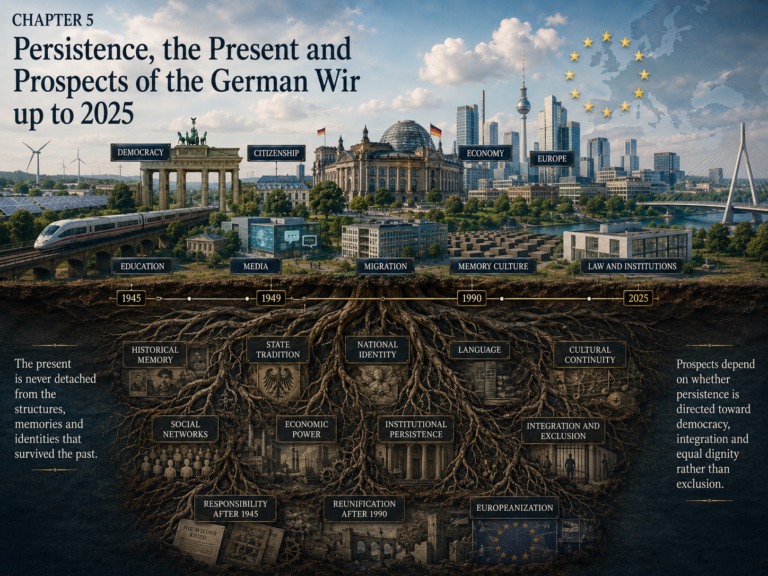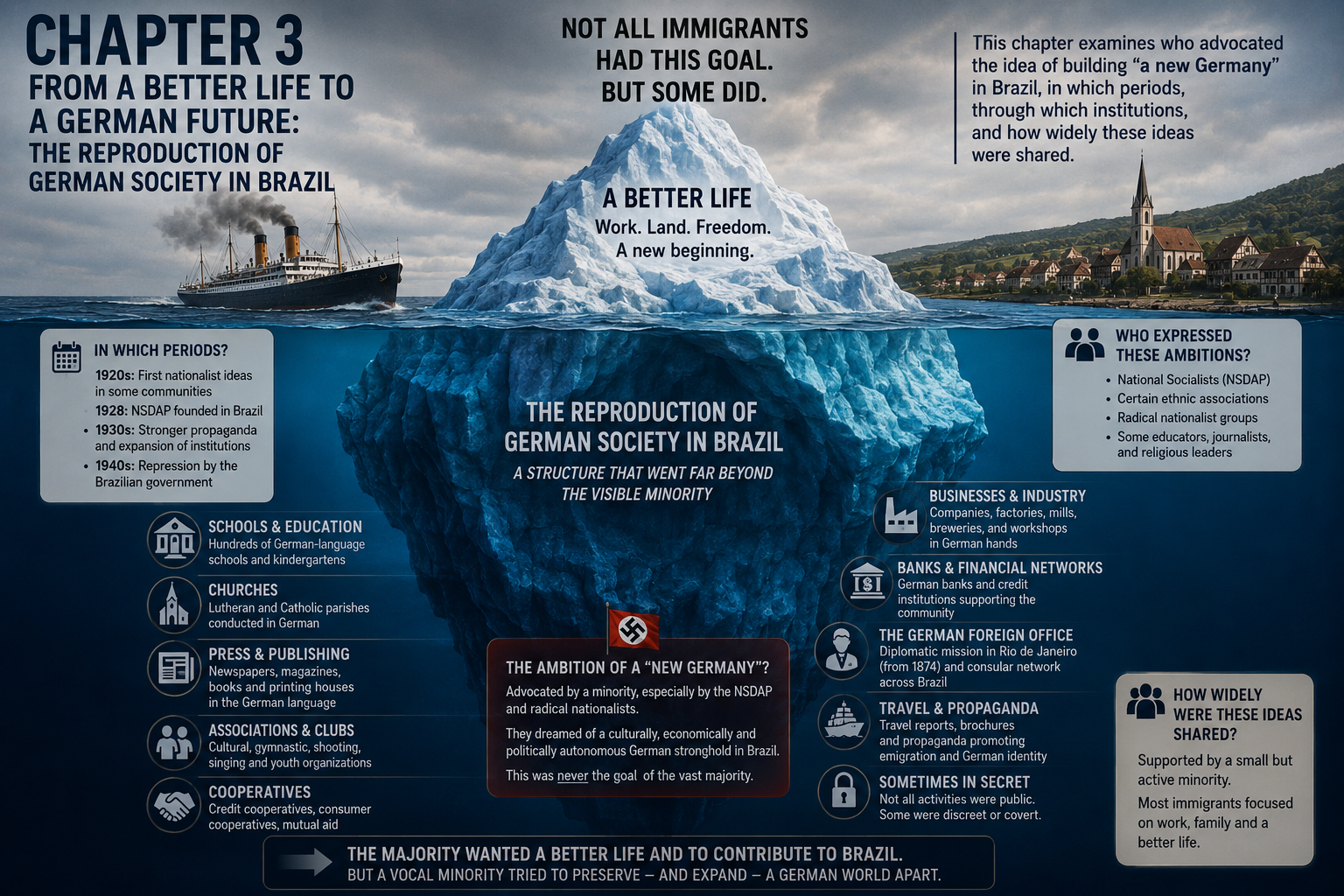
….
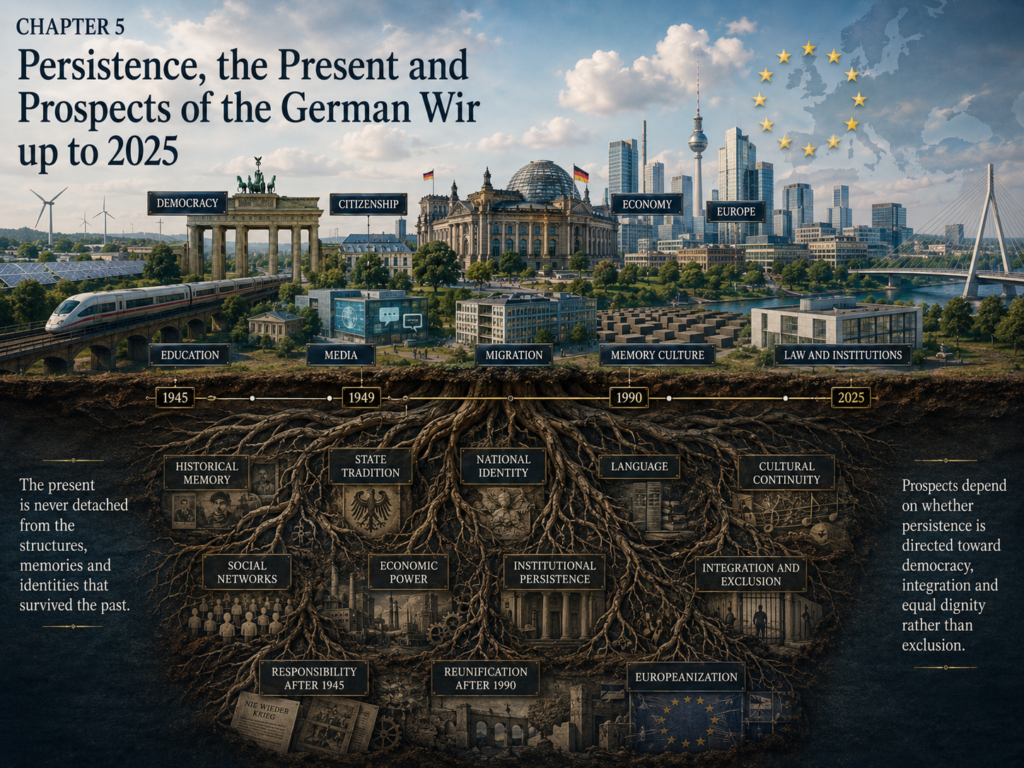
5.7 The Necessary Reinvention of the German Wir
The preceding analysis could end with the demand that German collective identity remain democratically limited. Yet historical analysis remains politically incomplete if it identifies the persistence of the German Wir without asking what form this Wir must assume in the future.
The answer cannot be the abolition of collective belonging. ….
The longing for recognition gradually became a longing for greatness.
….
A democratic reinvention must begin from the opposite principle. The individual does not exist for the nation. The nation exists to protect the freedom, rights and dignity of individuals….
….
A reinvention of the German Wir must also reject the assumption that the past can provide an innocent national foundation…
……
Migration is one of the clearest tests of this reinvention. The democratic German Wir cannot continue to distinguish between people who are German through inherited familiarity and people who are German only through legal admission. Citizenship must not create a hierarchy between original members and later participants…..
…
The same principle must govern Germany’s relationship with German-descended populations abroad.
The preservation of German language, family memory and cultural traditions in Brazil and other countries is legitimate. Cultural inheritance can enrich a plural society. It becomes politically dangerous when it is joined to ethnic superiority, contempt for the surrounding culture, social segregation or the idea that ancestry creates a political loyalty extending beyond citizenship.
German descendants in Brazil are not external possessions of Germany. They are Brazilian citizens whose cultural histories form part of Brazil.
Germany may support language instruction, educational exchange and cultural cooperation. It must not reconstruct the old assumption that people of German descent belong to a transnational German national body.
….
Political self-limitation does not require Germany to become weak, silent or incapable of leadership. It requires leadership through consent, reciprocity and openness to correction.
A responsible Germany does not lead because it considers itself morally superior. It leads only where others freely recognize the legitimacy of its contribution.
It does not use Europe to enlarge German power. It uses its power to strengthen a Europe in which no state may dominate the others.
…….
Partnership exists only where both sides remain capable of defining their own interests.²⁵⁵
The reinvention of the German Wir also requires a new understanding of strength.
German history repeatedly associated strength with unity, obedience, organization, military effectiveness, industrial capacity and international influence. Even after 1945, economic performance could become the peaceful successor to national military power.
A society requires productive capacity, effective administration and institutional reliability. Weak institutions do not protect freedom. Economic failure can destroy social trust and create conditions in which authoritarian promises become attractive.
The problem is therefore not strength itself. It is the moral and political purpose assigned to strength.
…..
The criterion of national success must consequently change.
A successful Germany is not the Germany that exports the most, exercises the greatest influence or receives the most international praise for having confronted its past.
- It is the Germany in which a child’s opportunities are not determined by ancestry, postal code or family income.
- It is the Germany in which citizenship produces actual recognition rather than formal membership combined with social suspicion.
- It is the Germany in which victims of discrimination trust that state institutions will recognize them as members of the community rather than as representatives of a foreign milieu.
- It is the Germany in which companies cannot purchase political impunity through employment and economic importance.
- …..
- ….
- ….
- ….
……
The German destiny today does not call for renewed greatness. It calls for an end to the old longing for greatness….
……..
Footnotes
- Shmuel N. Eisenstadt and Bernhard Giesen, “The Construction of Collective Identity,” Archives Européennes de Sociologie 36, no. 1 (1995): …; Bernhard Giesen and Robert Seyfert, “Collective Identities, Empty Signifiers and Solvable Secrets,” European Journal of Social Theory 19, no. 1 (2016): ….
- Jürgen Habermas, “Geschichtsbewusstsein und posttraditionale Identität: Die Westorientierung der Bundesrepublik,” in Eine Art Schadensabwicklung (Frankfurt am Main: Suhrkamp, 1987), ….; Stefan Berger, The Search for Normality: National Identity and Historical Consciousness in Germany since 1800(Providence, RI, and Oxford: Berghahn Books, 1997), …..
- Norbert Frei, 1945 und wir: Das Dritte Reich im Bewußtsein der Deutschen (Munich: C.H. Beck, 2005), …; E. Dresler-Hawke and J. H. Liu, “Collective Shame and the Positioning of German National Identity,” Psicología Política 32 (2006): …..
- Naika Foroutan, Die postmigrantische Gesellschaft: Ein Versprechen der pluralen Demokratie (Bielefeld: transcript, 2019), pp. 42–65; Rogers Brubaker, Citizenship and Nationhood in France and Germany (Cambridge, MA: Harvard University Press, 1992), ….; Ingo von Münch, Die deutsche Staatsangehörigkeit: Vergangenheit – Gegenwart – Zukunft (Berlin: De Gruyter, 2007), ….
- Nina Barbian, Auswärtige Kulturpolitik und „Auslandsdeutsche“ in Lateinamerika 1949–1973 (Wiesbaden: Springer VS, 2014), ….; Glen S. Goodman, From “German Danger” to German-Brazilian President: Immigration, Ethnicity, and the Making of Brazilian Identities, 1924–1974 (PhD dissertation, Emory University, 2015), …..
- …..
- …..