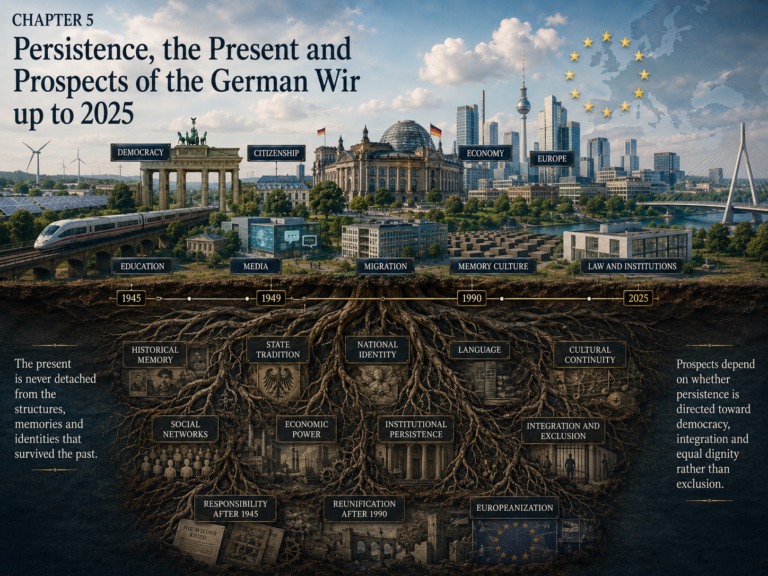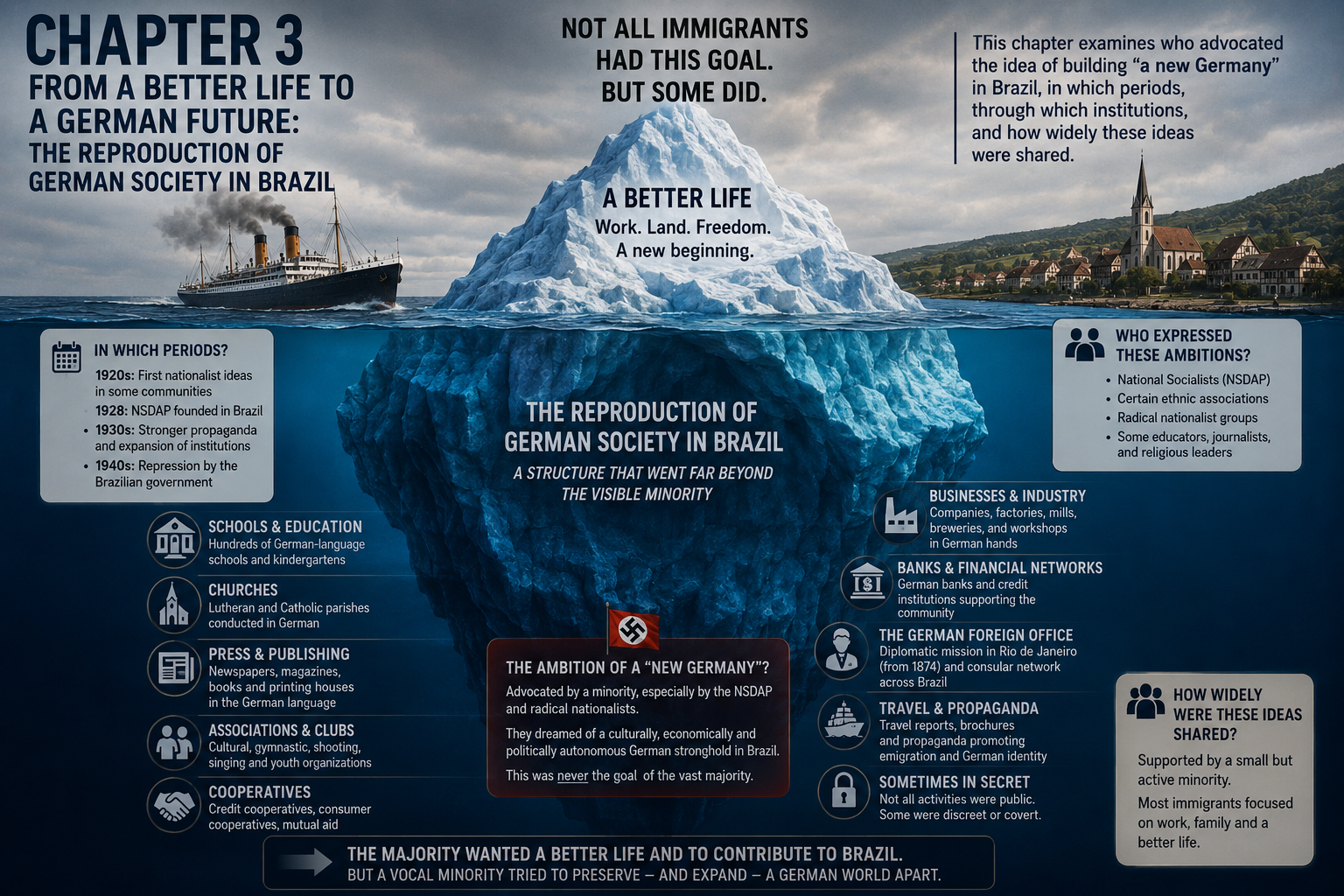
The collapse of 1945 meant more than military defeat, the destruction of German cities and the loss of state sovereignty. It marked the destruction of the most radical form assumed by the German Wir: the racial, expansionist and annihilating Volksgemeinschaft created by National Socialism.
The defeat affected not only a political regime. It discredited a national self-image that had increasingly connected German identity with unity, order, historical mission, cultural superiority, industrial achievement, military strength and entitlement to international power. After dictatorship, aggressive war, occupation, forced labour, genocide and unconditional surrender, German identity could not simply continue as though only an unsuccessful government had disappeared.
Yet the German Wir did not vanish. The people, language, families, regions, social institutions, economic structures, cultural memories and habits through which belonging had been experienced remained. National Socialism had been defeated from outside by military force; German collective identity had not dissolved itself from within.
This persistence created the fundamental tension of German history after 1945. …
…..
4.1 Disarmed Deutschtum, Enduring Wir: German Identity after 1945
After 1945, Germany lay in ruins as a political, military and moral power. The National Socialist state had collapsed. The Wehrmacht surrendered unconditionally. German sovereignty was replaced by Allied occupation, and the territories governed by Germany were divided into occupation zones.
The destruction was visible everywhere: cities, transport networks, housing, industrial facilities and public institutions had been damaged or destroyed. Millions of soldiers were dead, missing or held as prisoners of war. Millions of refugees and expellees arrived from territories east of the new borders and from other parts of Central and Eastern Europe. Families were separated, food was scarce and local administrations struggled to restore basic services.
The expression Stunde Null – zero hour – captured the feeling that the old order had ended and that German society faced an entirely new beginning. ….
…..
For decades, many company histories emphasized technical achievement, longevity and contribution to national prosperity while minimizing forced labour, Aryanization and cooperation with the regime. A fuller confrontation with these histories emerged substantially later.
The economic success of the Federal Republic therefore performed an identity function. It allowed Germans “to be somebody again” through peaceful achievement. The former military nation became an industrial and export nation.
……
Brazilian-German relations also had to overcome the consequences of wartime rupture, nationalization policies and suspicion toward German institutions. German-Brazilian communities rebuilt or adapted churches, associations, businesses and cultural activities within a society in which Brazilian citizenship and Portuguese language had become more firmly established.
…..
The German Wir was no longer able to represent itself positively without acknowledging the crimes committed in its name.
This acknowledgement did not automatically produce humility. It could later become the basis of a new moral self-image: Germany as the nation that had learned from history, confronted its crimes and become a model of democratic responsibility.
The possibility of transforming guilt into moral distinction would become one of the central tensions of later German identity.
….
Footnotes
- Norbert Frei, 1945 und wir: Das Dritte Reich im Bewußtsein der Deutschen (Munich: C.H. Beck, 2005), pp. 23–40 and 145; Helmut Dubiel, Niemand ist frei von der Geschichte: Die nationalsozialistische Herrschaft in den Debatten des Deutschen Bundestages (Munich: Hanser, 1999), …; Guy Tourlamain, Völkisch Writers and National Socialism: A Study of Right-Wing Political Culture in Germany, 1890–1960 (Bern: Peter Lang, 2014), ….
- Andreas Eichmüller, Die SS in der Bundesrepublik: Debatten und Diskurse über ehemalige SS-Angehörige 1949–1985 (Berlin and Boston: De Gruyter Oldenbourg, 2018), ….; Gerald Reitlinger, The SS: Alibi of a Nation, 1922–1945 (London: Heinemann, 1956), …
- Robert G. Moeller, “War Stories: The Search for a Usable Past in the Federal Republic of Germany,” American Historical Review 101, no. 4 (1996): ….
- Armin Grünbacher, West German Industrialists and the Making of the Economic Miracle: A History of Mentality and Recovery (London and New York: Bloomsbury Academic, 2017), pp. 1–38 and 147–150.
- Nikolaus Barbian, Auswärtige Kulturpolitik und „Auslandsdeutsche“ in Lateinamerika 1949–1973 (Wiesbaden: Springer VS, 2014), …..
- Frei, 1945 und wir, pp. 28–34 and 145; Tourlamain, Völkisch Writers and National Socialism, …..
- Norbert Frei, Vergangenheitspolitik: Die Anfänge der Bundesrepublik und die NS-Vergangenheit (Munich: C.H. Beck, 1996), pp. 30–46, 61 and 69–81; Fabian Link, Demokratisierung nach Auschwitz: Eine Geschichte der westdeutschen Sozialwissenschaften in der Nachkriegszeit (Göttingen: Wallstein, 2022), ….
- ….
- ….
- …..
- …..
- …..
4.2 Federal Republic and GDR: A Divided Nation, Different Models of Identity
The establishment of the Federal Republic of Germany and the German Democratic Republic in 1949 did more than consolidate the territorial division created by occupation. It institutionalized two competing answers to the question of what Germans were permitted to become after National Socialism.
Both states claimed to have learned from the catastrophe. Both presented their political order as the legitimate German alternative to dictatorship, war and destruction.
….
This transformation was not fictitious. Companies changed, production served new markets, labour relations were reorganized and democratic institutions placed limits upon private economic power. But the success narrative made it easier to separate post-war prosperity from the personnel, capital, professional networks and institutional continuities that crossed the boundary of 1945.
….
Constitutional patriotism did not necessarily reject the German nation. It placed conditions upon it. National unity could not be purchased at the expense of freedom, democracy or Western integration. The state and the nation remained connected, but the constitution was no longer to be sacrificed to national longing.
The idea expressed one of the deepest lessons drawn from the German past: unity without liberty had no moral priority.¹⁸⁸
….
Only in April 1990, after the collapse of SED rule, did the first freely elected Volkskammer acknowledge East Germans’ share of responsibility and issue an apology to Jewish people and Israel. This late declaration revealed what the official antifascist identity had long avoided: socialism had not removed the historical responsibility inherited by the people and institutions of the second German state.¹⁹⁰
The GDR attempted to create a new collective loyalty through the idea of the workers’ and peasants’ state. Work, socialist ownership, planned production, antifascist education, social equality and alliance with the Soviet Union were presented as the foundations of belonging.
Schools, youth organizations, workplaces, trade unions, political ceremonies and military rituals transmitted this identity. The Free German Youth, the Young Pioneers, workplace collectives and state celebrations integrated individuals into an officially organized social Wir.
The workplace acquired a particularly important role. It was not merely the location of employment but also a centre of social services, political education, collective recognition and everyday relationships. Housing, childcare, holidays, cultural activities and social advancement were often connected with state enterprises and institutions.
This produced real forms of social belonging. Many people experienced educational advancement, employment security, childcare provision, women’s participation in the workforce and forms of collective life that became meaningful parts of their biographies.
These experiences cannot be dismissed as mere propaganda. Nor can they erase dictatorship.
….
These differences were real and would not disappear when the border opened.
…
That question became central after 1990.
Footnotes
- Jeffrey Herf, Divided Memory: The Nazi Past in the Two Germanys (Cambridge, MA: Harvard University Press, 1997), pp. 1–14; Stefan Berger, The Search for Normality: National Identity and Historical Consciousness in Germany since 1800, 2nd ed. (New York and Oxford: Berghahn Books, 2003), pp. 45–48 and 69–98.
- Basic Law for the Federal Republic of Germany, 23 May 1949, preamble and art. 116; Berger, The Search for Normality, pp. 81–98.
- Armin Grünbacher, West German Industrialists and the Making of the Economic Miracle: A History of Mentality and Recovery (London and New York: Bloomsbury Academic, 2017), pp. 1–38, 97–121 and 147–150; Norbert Frei, Vergangenheitspolitik: Die Anfänge der Bundesrepublik und die NS-Vergangenheit (Munich: C.H. Beck, 1996), pp. 30–46, 61 and 69–81.
- ….
- …
- …
- …
- …
- …
4.3 Reunification and National Self-Perception
The collapse of the GDR did not begin as a national movement for German unity. The opposition groups that organized vigils, petitions and demonstrations in 1989 initially demanded freedom of expression, freedom of travel, political pluralism and democratic participation. Their central slogan, Wir sind das Volk – “We are the people” – challenged the SED’s claim to represent the population. It asserted popular sovereignty against party rule.
…
A democratic understanding of culture cannot defend plural belonging for Germans abroad while treating comparable forms of plural belonging inside Germany as inherently suspect.
The historical experience of German communities in Brazil and elsewhere demonstrates that migrants and their descendants can possess layered identities. They may be citizens of one country while retaining language, memory and emotional connections to another.
The danger does not lie in every multiple belonging. It arises where cultural identity becomes a project of segregation, superiority, political loyalty to an external power or refusal to recognize equal citizenship within the host society.
The same standard must apply to all communities. Cultural heritage deserves protection; political parallel sovereignty, contempt for the surrounding society and claims of ethnic superiority do not.
…
The transformation of the German Wir cannot be completed through a choice between an unchanged national culture and the dissolution of all common identity. Both alternatives are misleading.
Germany cannot return to an ethnically homogeneous past that never existed in the form imagined. Nor can a democratic society survive without shared institutions, historical awareness and a sense of reciprocal responsibility.
…
Footnotes
- Klaus J. Bade, Europa in Bewegung: Migration vom späten 18. Jahrhundert bis zur Gegenwart (Munich: C.H. Beck, 2000), ….; Klaus J. Bade, “From Emigration to Immigration: The German Experience in the Nineteenth and Twentieth Centuries,” Central European History 28, no. 4 (1995): ….; Ulrich Herbert, Geschichte der Ausländerpolitik in Deutschland: Saisonarbeiter, Zwangsarbeiter, Gastarbeiter, Flüchtlinge(Munich: C.H. Beck, 2001).
- Ulrich Herbert, Fremdarbeiter: Politik und Praxis des „Ausländer-Einsatzes“ in der Kriegswirtschaft des Dritten Reiches, 2nd ed. (Berlin: Dietz, 1999); Herbert, Geschichte der Ausländerpolitik in Deutschland; Robert Gellately, Backing Hitler: Consent and Coercion in Nazi Germany (Oxford: Oxford University Press, 2001), ….
- R. M. Douglas, Orderly and Humane: The Expulsion of the Germans after the Second World War (New Haven: Yale University Press, 2012); Klaus J. Bade, Europa in Bewegung, particularly the sections on forced migration, displaced persons and post-war population movements.
- Rogers Brubaker, Citizenship and Nationhood in France and Germany (Cambridge, MA: Harvard University Press, 1992), …; Dieter Gosewinkel, Einbürgern und Ausschließen: Die Nationalisierung der Staatsangehörigkeit vom Deutschen Bund bis zur Bundesrepublik Deutschland (Göttingen: Vandenhoeck & Ruprecht, 2001); Ingo von Münch, Die deutsche Staatsangehörigkeit: Vergangenheit – Gegenwart – Zukunft(Berlin: De Gruyter, 2007), ….
- Rita Chin, The Guest Worker Question in Postwar Germany (Cambridge: Cambridge University Press, 2007), …; Herbert, Geschichte der Ausländerpolitik in Deutschland; Deniz Göktürk, David Gramling and Anton Kaes, eds., Germany in Transit: Nation and Migration, 1955–2005 (Berkeley: University of California Press, 2007), …..
- Klaus J. Bade and Michael Bommes, “Migration und politische Kultur im ‘Nicht-Einwanderungsland’,” in Klaus J. Bade and Rainer Münz, eds., Migrationsreport 2000: Fakten – Analysen – Perspektiven (Frankfurt am Main and New York: Campus, 2000), ….; Chin, The Guest Worker Question in Postwar Germany.
- Andreas Müggenburg, Die ausländischen Vertragsarbeitnehmer in der ehemaligen DDR: Darstellung und Dokumentation (Berlin: Die Beauftragte der Bundesregierung für die Belange der Ausländer, 1996); Patrice G. Poutrus, “Foreign Workers in the GDR,” in Philipp Gassert and Alan E. Steinweis, eds., Coping with the Nazi Past: West German Debates on Nazism and Generational Conflict, 1955–1975 (New York: Berghahn Books, 2006), contextual material on post-war German concepts of foreignness.
- Brubaker, Citizenship and Nationhood in France and Germany, …; Bade, “Immigration, Naturalization, and Ethno-national Traditions in Germany: From the Citizenship Law of 1913 to the Law of 1999,” in Larry E. Jones, ed., Crossing Boundaries: The Exclusion and Inclusion of Minorities in Germany and the United States (New York and Oxford: Berghahn Books, 2001), …; Gosewinkel, Einbürgern und Ausschließen.
- Von Münch, Die deutsche Staatsangehörigkeit, …; Bade and Bommes, “Migration und politische Kultur,” ….
- Record of the conversation between Federal Chancellor Helmut Kohl and British Prime Minister Margaret Thatcher, 28 October 1982, British government records; Gesetz zur Förderung der Rückkehrbereitschaft von Ausländern, 28 November 1983, Bundesgesetzblatt I, ….; Herbert, Geschichte der Ausländerpolitik in Deutschland.
- Rita Chin, Heide Fehrenbach, Geoff Eley and Atina Grossmann, After the Nazi Racial State: Difference and Democracy in Germany and Europe (Ann Arbor: University of Michigan Press, 2009), ….; Joyce Marie Mushaben, The Changing Faces of Citizenship: Integration and Mobilization among Ethnic Minorities in Germany (New York and Oxford: Berghahn Books, 2008), particularly the chapters on asylum, citizenship and political mobilization.
- Gesetz zur Reform des Staatsangehörigkeitsrechts, 15 July 1999, Bundesgesetzblatt I, ….; von Münch, Die deutsche Staatsangehörigkeit, …; Bade, “Immigration, Naturalization, and Ethno-national Traditions,” …
- Christian Wulff, address marking the twentieth anniversary of German unity, Bremen, 3 October 2010; Naika Foroutan, Die postmigrantische Gesellschaft: Ein Versprechen der pluralen Demokratie (Bielefeld: transcript, 2019), pp. 42–65.
- Angela Merkel, Federal Press Conference, Berlin, 31 August 2015; Triadafilos Triadafilopoulos, Becoming Multicultural: Immigration and the Politics of Membership in Canada and Germany (Vancouver: University of British Columbia Press, 2012); Dorte Huneke, ed., Ziemlich deutsch: Betrachtungen aus dem Einwanderungsland Deutschland (Bonn: Bundeszentrale für politische Bildung, 2013).
4.5 Moral Self-Representation and Global Power: The German Wir to 2025
…..
Footnotes
- Jochen Thies, Hitler’s Plans for Global Domination: Nazi Architecture and Ultimate War Aims (New York and Oxford: Berghahn Books, 2012), especially ….
- Nina Barbian, Auswärtige Kulturpolitik und „Auslandsdeutsche“ in Lateinamerika 1949–1973 (Wiesbaden: Springer VS, 2014), ….; Eckard Michels, Von der Deutschen Akademie zum Goethe-Institut: Sprach- und auswärtige Kulturpolitik 1923–1960 (Munich: Oldenbourg, 2005), ….
- Barbian, Auswärtige Kulturpolitik, ….; Frank Trommler, Kulturmacht ohne Kompass: Deutsche auswärtige Kulturbeziehungen im 20. Jahrhundert (Cologne, Weimar and Vienna: Böhlau, 2014).
- Sebastian Conrad, Globalisation and the Nation in Imperial Germany (Cambridge: Cambridge University Press, 2010), …; René E. Gertz, O fascismo no sul do Brasil: germanismo, nazismo, integralismo (Porto Alegre: Mercado Aberto, 1987); Jeffrey Lesser, Negotiating National Identity: Immigrants, Minorities, and the Struggle for Ethnicity in Brazil (Durham, NC: Duke University Press, 1999).
- Barbian, Auswärtige Kulturpolitik, ….
- Luiz Alberto Moniz Bandeira, Das deutsche Wirtschaftswunder und die Entwicklung Brasiliens: Die Beziehungen Deutschlands zu Brasilien und Lateinamerika 1949–1994 (Frankfurt am Main: Vervuert, 1995), especially …..
- Marcelo Almeida de Carvalho Silva, Pedro Henrique Pedreira Campos and Alessandra Costa, “A Volkswagen e a ditadura: a colaboração da montadora alemã com a repressão aos trabalhadores durante o regime civil-militar brasileiro,” Revista Brasileira de História 42, no. 89 (2022): …, especially ….
- Silva, Campos and Costa, “A Volkswagen e a ditadura,” ….
- Leonardo Bandarra, “From Bonn with Love: West German Interests in the 1975 Nuclear Agreement with Brazil,” Cold War History 21, no. 2 (2021): 201–221; Moniz Bandeira, Das deutsche Wirtschaftswunder und die Entwicklung Brasiliens, …..
- Greg Miller, “The Intelligence Coup of the Century,” The Washington Post, 11 February 2020; Peter F. Müller et al., “BND und CIA sollen jahrzehntelang mehr als 100 Länder abgehört haben,” Der Spiegel, 11 February 2020; ZDF, Operation Rubikon, documentary, 2020.
- Stefan Berger, The Search for Normality: National Identity and Historical Consciousness in Germany since 1800(Providence, RI and Oxford: Berghahn Books, 1997), …..
- Berger, The Search for Normality, …; ZDF, Die Deutschen, documentary series, 2008–2010